.webp)
Master B2B lead nurturing in 2026. Learn to build campaigns that convert cold contacts into sales, increase your ROI, and boost SQL conversion rates.
Lead nurturing is the process of systematically maturing leads who aren't ready to buy right now, but will be if guided properly. In B2B, where sales cycles last for months, nurturing - rather than just the volume of leads - determines the actual ROI of lead generation. In this guide, we show you how to build effective lead nurturing step-by-step, how to measure its performance, and when it truly impacts your sales results.
Who is this article for?
This article is for you if:
- You run a B2B business (SaaS, software house, professional services).
- You generate leads, but most of them do not convert into sales.
- Your CRM is full of "cold" contacts.
- You want to increase conversion without increasing your lead gen budget.
Skip this article if:
- You rely on impulse buys (B2C, e-commerce).
- You expect "one email = one sale."
- You do not have a defined sales process or a CRM.
In this article, you will learn:
- What Lead Nurturing looks like in practice.
- How to align Lead Nurturing with Lead Generation.
- Why Lead Nurturing actually improves sales results - and the math behind it.
- When to implement lead nurturing campaigns.
- The "Waterfall" framework for a high-converting nurture campaign.
- Concrete email examples that avoid the "just checking in" trap.
- The top 5 mistakes that drain your pipeline, and how to fix each one.
- How to measure nurturing effectiveness beyond open rates.
What does Lead Nurturing look like in practice?
Lead nurturing is a long-term process of maintaining engagement with potential clients who have shown interest in your offer but, for various reasons, are not yet ready to purchase. In practice, this means that instead of aggressive selling from the first interaction, you provide leads with context, knowledge, and value at moments that actually make sense for them.
In B2B, purchasing decisions are rarely made instantly. They often require approval from multiple decision-makers, budget allocation, strategic alignment, and established trust in the provider. Lead nurturing addresses this exact challenge: it keeps your company top-of-mind until the lead is truly ready for a sales conversation.
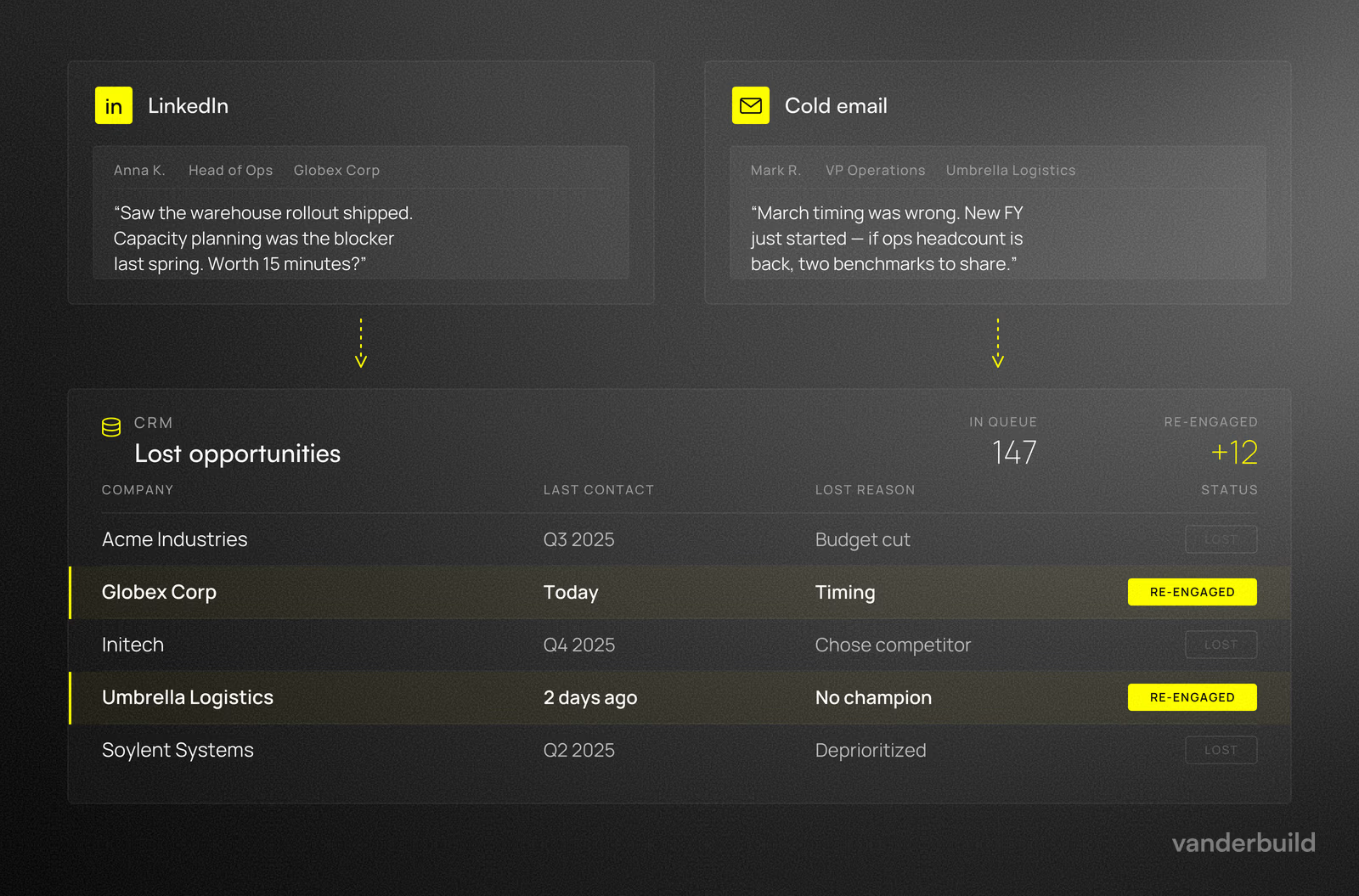
The key difference between lead nurturing and a classic follow-up lies in intent. A follow-up is typically a component of a cold email campaign designed to continue a sequence for new prospects. Lead nurturing is about re-engaging contacts already in your CRM - for example, a quarter after the last point of contact.
How to combine Lead Nurturing with Lead Generation?
Lead generation and lead nurturing are often lumped together, but they play distinctly different roles in the sales funnel. Lead generation is responsible for acquiring contacts. Lead nurturing handles everything that happens next.
In B2B, the average conversion rate from MQL (Marketing Qualified Lead) to SQL (Sales Qualified Lead) is approximately 13%. The vast majority of leads are not ready for a sales conversation at the moment of initial contact. Without a nurturing process, these leads get labeled "not interested" - even though they may have significant purchasing potential later.
Lead generation provides the raw material. Lead nurturing transforms it into real business value.
Why Lead Nurturing Actually Boosts Sales Results
One of the biggest myths in B2B is the belief that if a lead doesn't respond immediately, they're a lost cause. Most leads are not ready to purchase during initial contact. The average B2B sales cycle lasts about 11.5 months, and in some industries even longer.
Without a nurturing process, sales teams make a few contact attempts and move on. The lead acquisition cost gets burned, and marketing focuses on generating new contacts instead of maximizing value from the existing database.
The Math Behind Revenue Leakage
Here's a number most Founders don't calculate. If you spend $10,000 on lead generation and convert 5% into customers, your CAC is based on those 5 users. What about the other 95 people who showed interest but didn't buy?
If you ignore them, your nurture ROI is zero. If you implement a lead nurturing process, you can recover an additional 10-15% of that pipeline 6 months later - for nearly zero additional ad spend.
The benchmarks to aim for:
- 10:1 Target Ratio. For every $1 you spend on nurturing infrastructure, you should recover $10 in pipeline that would otherwise go dark.
- LTV:CAC Goal: 5:1. Recovered leads carry almost zero acquisition cost, which pushes this ratio significantly higher than new acquisitions.
Lead nurturing shifts the dynamic entirely. By maintaining regular, value-driven contact, you leverage already incurred acquisition costs, improve the quality of SQLs handed to sales, and shorten the actual time to a buying decision.
When to implement lead nurturing campaigns?
Lead nurturing shouldn’t be a "special campaign" triggered by a crisis. It is a continuous process that ensures no dollar spent on marketing goes to waste. If you treat your CRM as a graveyard for "not ready yet" leads, you are leaving massive revenue on the table.
Here is why lead nurturing is a mandatory, day-to-day operation:
1. Your pipeline is full of "sleeping" revenue
Statistics show that in complex B2B environments, only about 3% of your market is actively buying at any given moment. The remaining 10-15% of your pipeline often consists of leads that are high-quality but simply "stuck." They understand the value but aren't ready to pull the trigger today. Without a systematic nurturing process, these leads will eventually buy from a competitor who stayed top-of-mind.
2. Monetizing the "Closed-Lost" graveyard
Most sales teams write off a lost deal as a dead end. In reality, a "Closed-Lost" status is often just a "Not Right Now." * Budget issues? Budgets are reset every fiscal year.
- Missing feature? Your product roadmap will eventually solve it.
- Bad timing? Priorities shift every quarter. By categorizing these leads and entering them into long-term, value-driven sequences, you turn your CRM into a self-sustaining revenue engine. You’ve already paid for these leads-nurturing allows you to collect the ROI.
3. Bridging the gap in long sales cycles
In B2B, the path from "first touch" to "signed contract" can take 6, 9, or even 18 months. If your only contact with a lead is a sales pitch, you will lose them during the quiet periods. Regular nurturing through expert content and strategic case studies (like the Valueships approach to showing tangible business outcomes) keeps you positioned as a trusted advisor, not just another vendor.
4. Maximizing Inbound & Outbound ROI
Whether a lead comes from a webinar or a cold outreach campaign, their initial interest is fragile. If you don't have a process to guide them through education and trust-building immediately, the "decay" of that lead starts instantly. Nurturing ensures that the momentum gained during the first encounter isn't lost, transforming initial curiosity into purchase readiness.
The bottom line: Lead nurturing is the insurance policy for your marketing and sales spend. It ensures that when that "not ready" 97% of the market finally enters their buying window, your brand is the only logical choice.
How to conduct lead nurturing step-by-step?
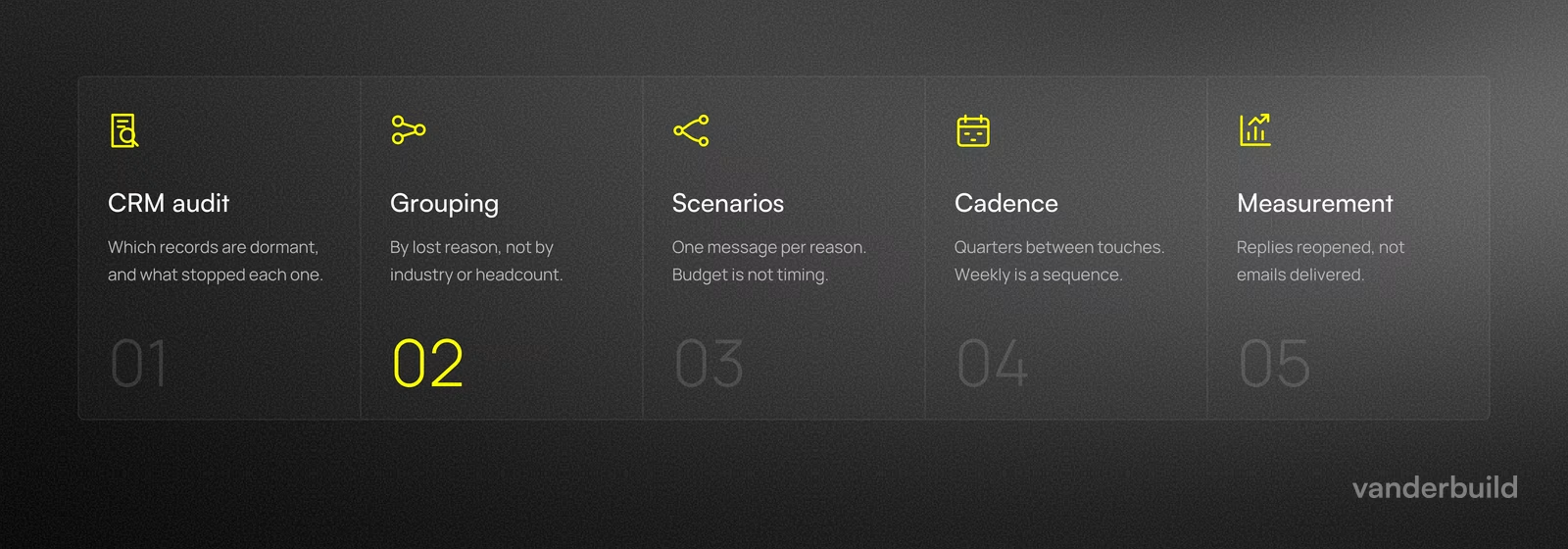
1. CRM Audit and Data Validation
You cannot run a nurture campaign on dirty data. Most B2B CRMs are digital graveyards. Before you send a single nurture email, clean house.
Three actions to take now:
- Identify Closed-Lost reasons. Categorize leads by why they didn't buy: No Budget, Bad Timing, or Missing Feature. Each category needs a different reactivation angle.
- Enrich your data. Use tools like Clay to check if a contact has changed jobs or been promoted. If someone was a Manager when you last spoke and is now a VP, your sequence needs to reflect that shift in seniority and purchasing authority.
- Validate your list. Run it through a verification tool before sending anything. Sending to 50% bounced addresses kills your domain reputation before the campaign even starts.
2. Meaningful Segmentation
Segment leads by criteria with real business significance: industry, decision-making role, company size, and funnel stage. The better the segmentation, the easier it is to deliver a relevant message.
Stop thinking in lists and start thinking in segments. A CTO cares about security, API documentation, and uptime. A VP of Finance cares about ROI, seat costs, and contract flexibility. If you send the Finance content to the Tech buyer, you signal that you don't understand their world.
3. Designing Communication Scenarios
Each segment needs its own nurturing scenario. You communicate differently with a SaaS founder than with a Head of Marketing at a software house. Each scenario should include a series of touchpoints spread over time, with a clearly defined goal for each stage.
4. Contact Frequency
In B2B, the optimal frequency is one contact every 1-2 weeks. Contacting too often gets perceived as spam. Too rarely, and the lead forgets you exist.
Speed also matters at the entry point. The "Golden Window" for B2B engagement is the first 48 hours after a lead enters your system. Data consistently shows that leads contacted within 5 minutes are significantly more likely to qualify than those reached on day 3. If your nurture sequence waits 3 days to send the first value-add piece, you've already lost the attention war.
5. Measurement and Iteration
Lead nurturing without data is storytelling without sales. Monitor opens, clicks, and replies - but above all, the impact on pipeline and sales. We cover the right metrics in detail further below.
The Nurturing Playbook: The "Waterfall" Framework
A great lead nurturing campaign is not a straight line. It's a waterfall - triggered based on behavior, not a calendar. Three specific flows cover 80% of your pipeline.
Flow 1: Inbound Lead Nurturing
Target: Prospects who downloaded a resource but didn't book a demo.
Goal: Move from Problem Awareness to Solution Awareness.
Tactic: 3-4 emails over 14 days focused on Jobs to Be Done. Lead with the specific problem the resource addressed, then connect it to a broader outcome your product drives.
Flow 2: Post-Demo "Ghost" Recovery
Target: Prospects who saw your demo and went silent.
Goal: Overcome friction and surface the real objection.
Tactic: Industry-specific case studies sent 3-5 days after silence begins. Don't ask "Did you have a chance to think it over?" - that's dead weight. Show them what a similar company achieved after making the same decision they're stalling on.
Flow 3: Long-Term Archive Nurture
Target: Closed-Lost deals from 6-12 months ago.
Goal: Reactivate the relationship when timing shifts.
Tactic: Low-frequency, high-value email every 45 days. Reference a specific change in their market, industry, or company - not your product update.
Multi-Channel "Surround Sound" Strategy
In 2026, an email-only nurturing campaign is not enough. 70% of your leads never see your message if inbox is your only channel. You need to meet buyers where they live.
The Surround Sound approach:
- Email (The Anchor): Primary source of long-form value. The campaign starts here.
- LinkedIn (The Social Layer): If a lead doesn't respond to email, trigger a CRM action to follow them on LinkedIn and engage with their posts. No pitch - just presence.
- Ad Retargeting (The Reinforcement): Sync your "Closed-Lost" list with LinkedIn Ads. They should see your case studies in their feed - not "Buy Now" ads.
A concrete day-by-day example:
- Day 1: Welcome email with a high-value asset (ungated).
- Day 2: Lead is added to a "Nurture" audience on LinkedIn. Case study ads start appearing in their feed.
- Day 7: Lead opens Email 3 but doesn't click. Trigger a soft retargeting ad on Google Display with a different angle.
- Day 14: If phone number is available and consent is given (GDPR/CCPA compliant), send a value-based SMS - for example, "Webinar starting in 10 mins."
Choosing Your Nurturing Tools
Automation is essential if you want to scale. The right tool depends on where you are.
- Enterprise: Salesforce for complex branching logic and deep CRM integration.
- Startups: HubSpot or specialized outbound tools like Instantly + Clay.
- The Vanderbuild approach: We combine CRM nurturing with AI-driven personalization. Custom scripts check for buying signals - a new hire in the target department, a funding announcement, a job change - before triggering the next step in the sequence.
The tool is not the strategy. A well-designed process in a lean stack beats a broken process in an enterprise platform every time.
Top 5 Mistakes in Lead Nurturing Campaigns
Most B2B nurturing campaigns fail because they treat lead nurturing as a static newsletter rather than a dynamic behavioral engine. If you're blasting the same generic drip sequence to every lead, you aren't nurturing - you're spamming.
The goal is not "engagement." It's Pipeline Velocity: how fast a lead moves from "Aware" to "Closed-Won."
Here are the 5 mistakes that drain your pipeline, and exactly how to fix each one.
Mistake 1: The "One-Size-Fits-All" Content Trap
You wouldn't pitch a CTO the same way you pitch a VP of Finance. So why are they getting the same email sequence?
The problem: Sending a generic "Intro to Our Platform" PDF to your entire database. The CTO cares about security and API documentation. The VP of Finance cares about ROI and contract flexibility. If you send Finance content to the Tech buyer, you signal that you don't understand their world. Result: unsubscribe.
The fix: Stop thinking in lists. Start thinking in segments.
- Define your Tier 1 ICPs - identify the 3 specific personas in the buying committee.
- Tag by entry point. Did they download a "Security Whitepaper" or an "ROI Calculator"? Tag them immediately in your CRM.
- Branch the logic:
- Tag = Technical → API docs + Developer Case Study
- Tag = Economic → ROI Calculator + Customer Success Story
Segmented campaigns consistently drive dramatically higher revenue than non-segmented ones. The math is not subtle - it's a function of relevance.
Mistake 2: Relying Exclusively on Email
Your prospects don't live in their inbox. They live on LinkedIn, Slack communities, and industry sites.
The problem: Even the best email sequence caps out at a 20-30% open rate. That means 70% of your leads never see your message. If email is your only channel, you're voluntarily ignoring most of your pipeline.
The fix: Orchestrate a "Surround Sound" strategy. When a lead hits a specific stage in your CRM, it should trigger ads, not just emails. (See the day-by-day Surround Sound example in The Playbook section above.)
Mistake 3: Friction-Heavy Content Delivery
You're making it too hard for them to buy from you.
The problem: Gating every piece of content and asking for a demo request in every single email. Requiring a form fill for every resource prioritizes data collection over education. Asking for a demo in every message creates decision fatigue.
The fix: The 3:1 Give-to-Get Ratio.
Give value three times before you ask for anything.
- Touch 1 (Give): Full blog post link - ungated.
- Touch 2 (Give): PDF checklist attached directly to the email - no click-through required.
- Touch 3 (Give): 2-minute Loom video explaining a common industry problem.
- Touch 4 (Get): "Ready to see how this works for [Company Name]? Book a tailored walkthrough."
You already have their email. Don't make them type it again.
Mistake 4: Misaligned Sales and Marketing Hand-Off
This is where the war between Sales and Marketing begins.
The problem: If Marketing passes every eBook downloader to Sales, SDRs burn out calling unqualified leads and stop trusting Marketing's pipeline. If Marketing hoards leads too long, a competitor engages them first.
The fix: Define a mathematical threshold for when a lead becomes an SQL.
Simple Lead Scoring Model:
The trigger: Alert the SDR only when Score > 60.
The alert looks like this: "Lead [Name] just visited the pricing page and has a score of 65. Call now."
No guesswork. No subjective judgment. The hand-off is automatic and based on real behavior.
Mistake 5: Setting and Forgetting Your Sequences
The market changes every quarter. Your sequence from 2024 is likely obsolete.
The problem: Using outdated stats, referencing old pain points, or running sequences that haven't been touched in 6 months kills credibility. Automated campaigns are a force multiplier - if the strategy is flawed, automation amplifies those errors at scale.
The fix: Treat your nurture sequence like a software product. It needs updates.
Quarterly Audit Checklist:
Pick one failing item from the list above. Assign it to your Marketing Ops lead to fix by next Friday.
What to automate in lead nurturing?
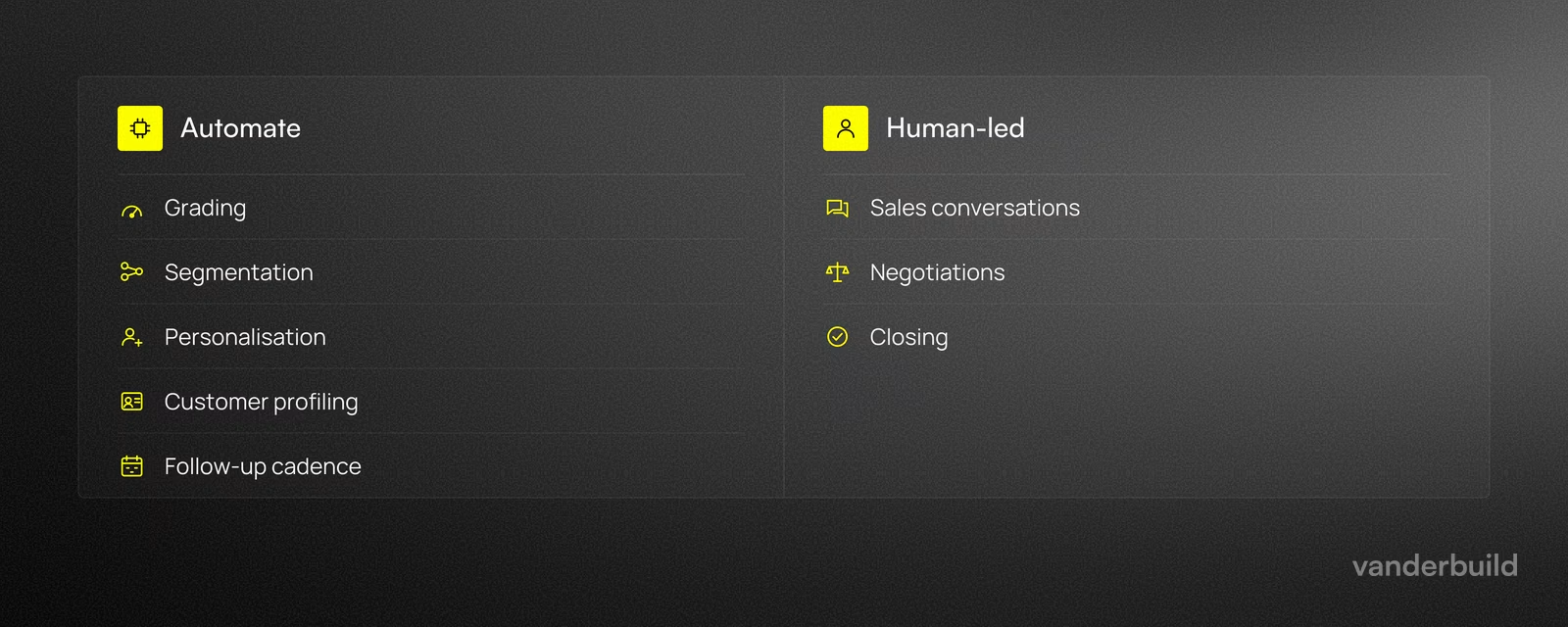
Automate the parts that repeat identically every time: scoring, segmentation, field-level personalisation, profiling, and the cadence that decides when the next touch goes out. A person makes these decisions the same way on the hundredth record as on the first, so software can take them over.
Keep the parts where the answer changes with the person. Sales conversations, negotiations and closing stay human, because each one depends on context a rep reads in five seconds and a system would need twenty rules to cover.
Before either list, check whether the process is ready. Run the play by hand first: ten records, every phrasing you can think of. That shows you which variation earns replies before you lock one in permanently. Automate first and you build one path out of ten, without knowing which nine you skipped. There is also a readiness check: if nobody on the team is asking to have this work taken off their plate, there is no pattern to encode yet.
Then build the exits. If a sequence keeps sending after a lead books a demo, replies, or signs with a competitor, the next message lands on someone who has already moved. Every workflow needs a condition that stops it.
How to measure lead nurturing effectiveness?
Measure lead nurturing through the lens of business impact, not marketing vanity metrics. Open rates are noise - especially with Apple's Mail Privacy Protection inflating numbers across the board.
The metrics that actually matter:
- Re-conversion Rate: How many "archived" leads come back to book a demo. If this number is climbing, your content and sequencing are working.
- MQL to SQL conversion rate: The most direct measure of nurture quality.
- Pipeline Influence: Which deals had at least one nurture touchpoint before closing.
- Sales Cycle Length: Effective nurturing shortens it. If it's not shortening, your sequences aren't educating buyers early enough.
Nurture Velocity is the composite metric that ties these together: how fast does a lead move from "Aware" to "Closed-Won." Every tweak to your campaign should be evaluated against whether it increases velocity.
For attribution, use multi-touch attribution - even a simple linear model. If a Closed-Won deal interacted with Nurture Email 4, that email gets credit. This is how you prove to the CFO that nurturing is not a cost center but a revenue generator.
Summary
Lead nurturing is a sales system. Companies that ignore it burn through their lead generation budgets. Companies that implement it maximize the value of data they already own and build a durable competitive advantage.
The highest-margin revenue in B2B doesn't come from new leads. It comes from leads you already paid to acquire - the ones sitting in your CRM right now, waiting for the right moment and the right message.
Build the process. Clean the data. Set the sequences. Then measure what actually moves pipeline.
If you want to see how lead nurturing aligns with market validation and data-driven sales, check out our case studies or talk to us about implementing the process in your organization.
FAQs
What is lead nurturing?
Lead nurturing is the process of building relationships with leads who aren't ready to buy yet - delivering relevant value over time until they are. In B2B, where deals take months and involve multiple decision-makers, it's what keeps you top-of-mind between "first touch" and "signed contract." It's not selling harder; it's staying useful until the timing is right.
What's the difference between lead nurturing and lead generation?
Lead generation acquires new contacts (top of funnel). Lead nurturing matures the contacts you already have toward a buying decision (middle to bottom of funnel). Generation is measured in volume; nurturing is measured in pipeline and conversion. You need both - generation fills the database, nurturing turns it into revenue.
What's the difference between lead nurturing and drip marketing?
Lead nurturing is behavior-based and personalized: "I saw you did X, so here's Y." Drip marketing is a static sequence sent to everyone regardless of actions. Nurturing consistently outperforms drip on conversion rate.
How do you distinguish lead nurturing from spam?
Lead nurturing provides value in every interaction and reacts to the recipient's behavior. Spam tries to sell regardless of context. If your messages are personalized, have a clear purpose for the recipient, and offer an easy way to unsubscribe - you're conducting nurturing, not spam.
Does lead nurturing only work for SaaS?
No. Lead nurturing works wherever the sales cycle is long and purchasing decisions are not impulsive. This includes software houses, technology companies, professional services, consulting, fintech, martech, and high-ticket B2B sales.
Does lead nurturing work for account-based marketing (ABM)?
Yes - and it's arguably where nurturing earns the most. ABM concentrates effort on a defined set of high-value accounts, and nurturing is what sustains relationships with the buying committee across a long cycle. Combine account-level signals (new hires, funding, job changes) with personalized, multi-channel touches, and nurturing becomes the engine that keeps named accounts warm until they're ready.
Can lead nurturing work for outbound prospects?
Yes - outbound nurturing is where the highest margins are. If a cold prospect says "not interested," they're a prime candidate for a long-term nurture sequence. Don't write them off. Write them into the right flow.
How does the lead nurturing process work?
A solid B2B process runs in five steps: (1) clean and enrich your CRM data, (2) segment leads by role, industry, and funnel stage, (3) design a communication scenario per segment, (4) set frequency - one touch every 1–2 weeks - with behavior-based triggers, and (5) measure pipeline impact and iterate. The sequence should react to what the lead does, not just fire on a calendar.
How often should I contact leads in nurturing campaigns?
In B2B, the optimal frequency is one contact every 1-2 weeks. More important than frequency is aligning communication with the customer journey stage. Active leads can be contacted more frequently; less engaged ones should be contacted less often.
How do you write a lead nurturing email?
Lead with the recipient's context, not your product. A good nurturing email references something specific to their situation, gives value (a checklist, a relevant case study, an insight), and asks for little or nothing. Follow a 3:1 give-to-get ratio - provide value three times before you pitch. Avoid the "just checking in" trap; it signals you have nothing new to say.
How does lead nurturing increase conversion rates?
Most B2B leads aren't ready at first contact — the average B2B sales cycle runs about 11.5 months. Nurturing keeps you present during that gap, so when the buying window opens, you're the default choice. It also improves SQL quality and shortens time-to-decision. Done well, you recover an extra 10–15% of pipeline that would otherwise go dark - at near-zero additional acquisition cost.
How long does it take for lead nurturing to start showing results?
Lead nurturing is a medium- to long-term process. The first signs of increased engagement (opens, replies, returning conversations) usually appear after 4-8 weeks. The real impact on pipeline and sales is typically visible after 3-6 months of consistent effort.
When should a lead move from nurturing to sales?
The transition to sales is triggered by intent signals: replies to messages, clicking on sales materials, attending webinars, demo requests, or direct pricing inquiries. Lead scoring (scoring threshold >60) automates this transition without relying on gut feel.
What tools are essential for lead nurturing?
The foundation is a CRM and a communication automation tool. As you scale, add tools for segmentation, lead scoring, and data enrichment Clay is the current standard for enrichment). The key is not the tool - it's a well-designed process.
How do you automate a lead nurturing workflow?
Start with a CRM and an automation tool, then layer behavior triggers on top. Automate the repetitive parts - educational sequences, segmentation, lead scoring, and the hand-off of hot leads to sales. The non-negotiable is exit triggers: when a lead books a demo or buys, they drop out of the nurture flow immediately. Automate the workflow, not the judgment.
Can I automate my entire lead nurturing process?
Automation is essential for scale - but "set it and forget it" is a mistake. If your sequences don't account for real-time actions (a lead booking a demo, a lead making a purchase), you risk sending irrelevant emails that make your brand look disconnected. Always build exit triggers into your workflows.
How do you measure lead nurturing success?
Skip open rates - Apple's Mail Privacy Protection has turned them into noise. Measure business impact instead: re-conversion rate (archived leads that come back), MQL-to-SQL conversion, pipeline influence (deals with at least one nurture touch), and sales cycle length. The composite metric is Nurture Velocity: how fast a lead moves from "Aware" to "Closed-Won."
What should I do if lead nurturing isn't working?
The most common causes are poor segmentation, a lack of a clear value proposition, or an overly sales-heavy tone. Go back to basics: verify your ICP, analyze data from your CRM and sales conversations, and test alternative communication scenarios. Run the Quarterly Audit Checklist from the Mistakes section above.