.webp)
Quick overview
A buying signals campaign is outbound that reacts to real intent. Instead of emailing 1,000 accounts and hoping for 20 replies, you monitor signals (pricing visits, competitor research, stack changes, hiring, engagement) and trigger the right play when timing is on your side looking for 100 accounts contacted and 20 replies. This guide shows you how to define signals, score them, route them into your CRM/SEP, and run “signal-to-sequence” outreach that drives higher replies and cleaner pipeline.
Let's brief it!
Outbound powered by intent signals that tells your team who to contact now and why.
They align outreach with the buying stage - your message lands while the prospect is already evaluating.
What is a buying signals campaign?
Buying signals campaigns shift outbound from “list-based outreach” to trigger-based. You’re responding to observable behaviors and changes that often show up right before a purchase decision.
At a high level, the loop looks like this:
- Detect intent signals (first-party + third-party)
- Score and prioritize accounts
- Route to the right owner (SDR/AE/CS)
- Trigger the right outreach play
- Measure > refine > repeat
Why does outbound performance drop without buying signals?
Most outbound fails for one simple reason: timing is wrong.
- You’re reaching out when the account isn’t actively looking
- Your message feels generic because you don’t have context
- Reps burn time on accounts that will not buy this quarter
- Meanwhile, competitors catch the same accounts mid-research and win the first conversation
Buying signals help you show up at the right moment with a message that actually fits what’s happening inside the account.
Who are buying signals campaigns for - and who should skip them?
This is for you if…
- You run B2B outbound and want better conversion,
- You have a defined ICP and a CRM you can trust (at least reasonably)
- You can route tasks into a Sales Engagement Platform (SEP) and act quickly
- You’re willing to iterate: signals are not “set and forget”
This is not for you if…
- Your strategy is purely “volume solves everything”
- Your data is a mess and no one owns fixing it
- You can’t integrate tools (or don’t have time/ops capacity)
- Your team refuses to personalize and insists on one template for everyone
What counts as a buying signal?
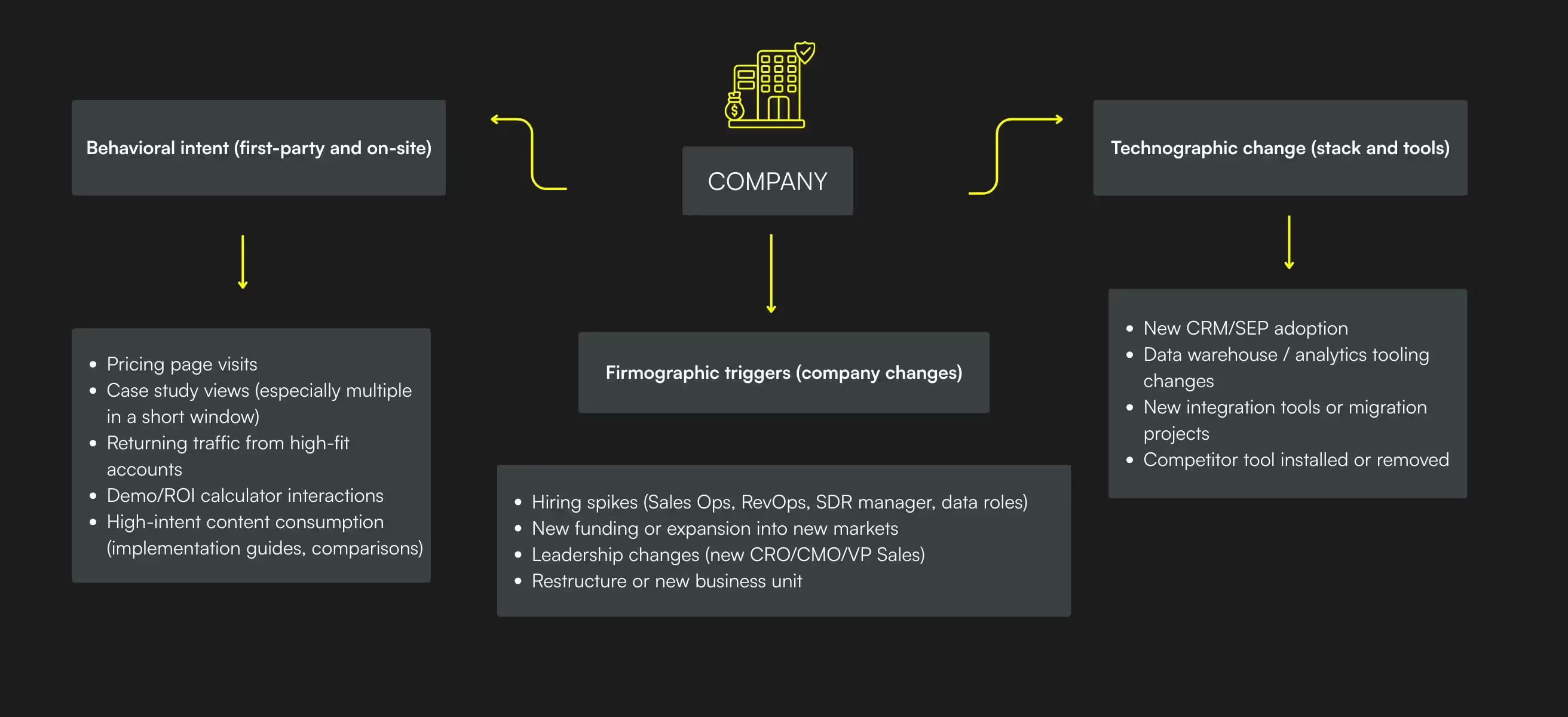
Buying signals usually fall into three buckets. The best systems combine all three so you don’t overreact to any single datapoint.
1) Behavioral intent (first-party and on-site)
Signals that show active evaluation, especially in clusters:
- Pricing page visits
- Case study views (especially multiple in a short window)
- Returning traffic from high-fit accounts
- Demo/ROI calculator interactions
- High-intent content consumption (implementation guides, comparisons)
2) Technographic change (stack and tools)
Signals that suggest a project, a pain, or a replacement motion:
- New CRM/SEP adoption
- Data warehouse / analytics tooling changes
- New integration tools or migration projects
- Competitor tool installed or removed
3) Firmographic triggers (company changes)
Signals that often correlate with budget shifts or new priorities:
- Hiring spikes (Sales Ops, RevOps, SDR manager, data roles)
- New funding or expansion into new markets
- Leadership changes (new CRO/CMO/VP Sales)
- Restructure or new business unit
How do you score buying signals without overengineering it?
Keep it brutally simple at the beginning. You’re trying to answer two questions:
(1) Qualification: Is this account a fit? (ICP match)
(2) Segmentation: Are they in motion? (intent strength)
A simple scoring model you can implement fast
- Fit score (0–5): industry, size, region, tech requirements, persona match
- Intent score (0–10): based on signal weights and recency
- Priority tier: Hot / Warm / Cold
Example weights (starter template):
- Pricing page visit (2+ in 7 days): +4
- Competitor comparison content: +4
- Implementation guide download: +3
- Tech stack change (new SEP/CRM): +3
- Hiring RevOps / SDR lead: +2
- General blog traffic: +1
Recency rule (simple):
- Happened within 48 hours > multiply intent points ×1.5
- Happened within 7 days > normal
- Older than 14 days > decay by half
You don’t need data science to win here.
You need consistency + follow-up discipline.
What does “signal-to-sequence” look like in practice?
Buying signals are useless if they don’t turn into action. The practical output of a buying signals campaign is:
- A prioritized account list with the reason why it’s prioritized
- A clear owner or system in place to activate data
A defined play (what to send, when, and how)
Signal converted to action framework (use this as your operational backbone)
| Signal | What it usually means | Best next action | Time to action |
|---|---|---|---|
| Pricing page repeat visits | Active evaluation | “Fit check” sequence + Li invite | < 2 hours |
| Competitor comparison engaged | Shortlist forming | Differentiation sequence referencing competitor angle | Same day |
| Implementation content consumed | Buying stage = “how”, not “what” | Send implementation POV + offer walkthrough | 24 hours |
| New CRM/SEP adoption | Project/migration motion | Integration + migration play | 48 hours |
| Hiring RevOps / SDR lead | Building GTM capacity | Ops/value framework + offer playbook | 24-48 hours |
You should be following rules of what potential customers think at the time and this table is a great representation of what should be the response for clients behaviour.
Prospect does X and needs Y - let’s provide the value.
What problems do buying signals campaigns solve?
Before: low-signal outreach
- Reps chase accounts that aren’t in market
- Reply rates stay flat
- Pipeline quality is inconsistent
- Sales cycles drag because the first conversation happens too early
After: targeted timing + context
- Higher relevance in messaging (“we noticed X”)
- Better prioritization (“contact these 30 today”)
- More qualified conversations, fewer wasted touches
- Cleaner measurement because the trigger is explicit
How should you visualize buying signals campaigns?
If you want adoption, don’t bury signals in dashboards no one checks. Put them where reps work.
Inputs
- CRM + historical conversion data
- Website analytics (first-party intent)
- Technographics + firmographics
- Third-party intent (optional, not required on day one)
Outputs (what the rep should see)
- Account ranked by priority tier
- The exact trigger(s) that fired
- Suggested or automated play + next step
- “Do this today” task created automatically
Best practices for intent-based outbound (that actually move numbers)
Use fewer signals, not more
Start with 5-7 signals max. Too many triggers = noise, distrust, and reps ignoring the system.
Write plays per trigger (not per persona)
Persona personalization matters but trigger personalization is usually the bigger lift. One trigger can map to a highly specific opener.
Match outreach channel to signal strength
Hot signals deserve multi-channel (email + LinkedIn + call). Warm signals can be email-first. Cold signals shouldn’t trigger anything and should be the info for you that something is happening.
Treat speed as a performance lever
Set SLAs. If “hot” doesn’t get touched quickly, you’re turning intent data into an expensive spreadsheet. Usually interested leads are getting colder after 20 mins after showing interest.
Run weekly reviews
Pick one question per week:
- Which signals produced meetings?
- Which signals created false positives?
- Are we over-weighting low-value actions?
- Then adjust weights - not everything at once.
What mistakes should you avoid?
1) Betting everything on one data source
Single-source intent creates false confidence. Blend first-party behavior with firmographic/technographic context. And remember that one signal does not mean that the prospect will be eager to buy from you. Signals are a play for companies and people that know how to play long term games and are patient.
2) Defining signals once and never updating
Buying behavior changes. So should your triggers. Review monthly; deep refresh quarterly. Wait for enough data to cross your pipeline but also create enough touchpoints with your clients to appear on their buying radar before the intent happens - that’s why marketing exists.
3) No agreement on ownership
If sales and marketing disagree on what “intent” means, you’ll create busywork, not pipeline. Your GROWTH team needs to be aligned on everything, otherwise it is a waste of time. Sales should provide insights from meetings with qualified prospects, marketing should ideate on conversion triggers and hot to trigger behaviours of potential customers.
4) Measuring only reply rate
Replies are nice. Pipeline is the point. Track meetings, qualified opps, cycle length, and win rate by trigger type. If there is no traction in terms of MQLs, SQLs then it means that something is off.
What tools support buying signals campaigns?
Here’s a clean way to think about the stack:
GTM Technology Stack
| Tool category | What it does | Examples | Why it matters |
|---|---|---|---|
| Intent data platforms | Third-party web intent signals. | 6sense, Demandbase, ZoomInfo, Bombora, Prospeo, Clay. | Finds in-market accounts beyond your site. |
| CRM + enrichment | Fit + routing foundation. | Salesforce, HubSpot. | Keeps ownership + history centralized. |
| Sales engagement | Turns triggers into sequences. | Outreach, Salesloft, Apollo, Lemlist. | Enables trigger-based execution. |
| Analytics | Attribute signals to pipeline. | HockeyStack, Dreamdata, Looker, Power BI. | Proves which triggers actually convert. |
| Integration | Moves data between systems. | Clay, Zapier, Make, Tray.io. | Automates “signal → task → sequence”. |
Is your team ready? (quick readiness framework)
Readiness Criteria
| Criterion | Best fit | Low readiness |
|---|---|---|
| Sales motion | Repeatable ICP + process | Still searching for PMF |
| Data quality | CRM is usable + owned | “Dirty data” and no owner |
| Ops support | RevOps/IT can help | No capacity for integrations |
| Culture | Willing to test + iterate | Wants a magic button |
| Speed | Can follow up fast | Leads sit untouched for days |
What does this look like in the real world? (mini scenario)
Situation: A B2B software company runs outbound sequences but sees inconsistent replies and too many “not interested” responses.
Decision: They set up a buying signals campaign focused on three triggers: pricing visits, competitor research, and implementation content engagement.
Execution: Hot accounts trigger a same-day multi-touch play; warm accounts trigger an email-first sequence.
Result: The team sees higher-quality replies and a cleaner path to qualified meetings because outreach matches timing and context.
How to launch your first buying signals campaign (without chaos)
Step 1: Pick one ICP slice
Choose a segment where you already close deals and clients are coming back for more.
Step 2: Select 5-7 signals
Balance behavioral + firmographic + technographic.
Step 3: Define tiers + SLAs
Hot = <2 hours
Warm = same day
Cold = no trigger
Step 4: Build two sequences
- Hot sequence: direct, fast meeting ask, high context
- Warm sequence: educational + problem framing, softer CTA
Step 5: Measure outcomes that matter
Meetings booked, opportunities creation, win rate by trigger, and cycle time.
Want help avoiding the common failure modes?
If you want this to work, you need three things: clean triggers, routing, and plays that match each trigger.
Option A: Buying signals audit
We map your ICP, pick the highest-leverage signals, and design the “signal to sequence” routing with SLAs
Option B: Pilot build (2–3 weeks)
We implement one campaign end-to-end: detection → scoring → CRM routing → SEP sequences → measurement.
FAQ
What is a buying signal?
A buying signal is an indicator that an account may be actively evaluating a solution—like pricing visits, competitor research, stack changes, or high-intent content engagement.
When should you integrate buying signals into your sales process?
When you have (1) a defined ICP, (2) a usable CRM foundation, and (3) the ability to act on signals quickly. Start with a pilot before scaling.
How fast should reps respond to a buying signal?
For high-intent signals, aim for hours, not days. The value of intent decays quickly.
What’s the difference between buying signals and lead scoring?
Buying signals are specific triggers. Lead scoring is the aggregate system that weighs multiple triggers to prioritize accounts.
Can small teams do this effectively?
Yes - small teams often win because they can move faster. Start with first-party signals and a simple routing rule, then expand.
How do you measure success?
Track meetings booked, qualified opportunities, sales cycle length, and win rate by trigger type.
We will run signal-based outbound for you
Most teams reach the right accounts at the wrong time. We monitor buying signals — funding, hires, leadership moves — and fire outreach within hours. You receive interested prospects with full signal context.