.webp)
Imagine that after months of work on your product, the first sales conversation ends with the client's question: "When can we start?". This is a real signal that your product has hit the core of market needs. Unfortunately, for most startups, such a situation is merely a dream.
Product Market Fit (PMF) is the moment when a product perfectly answers the actual needs of a specific customer segment. According to CB Insights, as many as 35% of startups end their operations due to a lack of product fit to market needs. Statistics can be brutal, 1 in 3 Founders fails due to a lack of a Go-To-Market strategy.
Lack of PMF leads startups straight into the "Valley of Death" - a period in which operating costs exceed revenues, and the company fights for survival. Knowledge of the PMF validation process can be the key difference between success and driving your company into the abyss.
In this article, you will learn:
- What is Product Market Fit in practice?
- Why does a lack of Product Market Fit lead to a startup's Valley of Death?
- When should a startup validate Product Market Fit?
- How to validate Product Market Fit step by step?
- Which metrics actually show Product Market Fit?
- How will Product Market Fit help you in fundraising?
What Is Product Market Fit in practice?
Product Market Fit is more than a theoretical concept from business textbooks. As Stripe explains, PMF represents the degree to which a product satisfies the needs of a specific market by solving at least one significant customer problem.
-ang.avif)
In reality, PMF is a combination of three key elements: the right product, the correct customer segment, and effective sales channels. It emphasizes that this is the moment when what you are building perfectly aligns with what the market actually needs.
Real PMF manifests in specific customer behaviors - it is a scenario where target customers buy the product, use it, and recommend it to others in significant quantities. It is not a one-time event, but a continuous process of adapting the offer to evolving market needs.
Is sales the moment of truth for PMF?
Sales is where PMF becomes tangible and measurable. In the sales process, the true value of the product and the customers' willingness to pay for a solution to a specific problem are revealed.
Analysis of sales conversations provides key signals regarding product-market fit. Repeatable patterns in the sales process, such as:
- similar customer questions,
- comparable decision cycles,
- similar reasons for purchase,
indicate solid PMF foundations. Repeatability in the sales process is built in stages, through the standardization of materials and tracking metrics.
Effective sales in the context of PMF is characterized by shorter sales cycles, less need to educate customers about the problem, and natural interest from potential buyers. This is a signal that the product addresses real, felt market needs.
Why does a lack of PMF lead to a startup's Valley of Death?
A lack of Product Market Fit leads startups into the "Valley of Death," a critical period in which the company burns cash faster than it generates revenue. Health VC describes this curve as a graphical representation of a startup's cash flows from the moment of inception until reaching profitability.
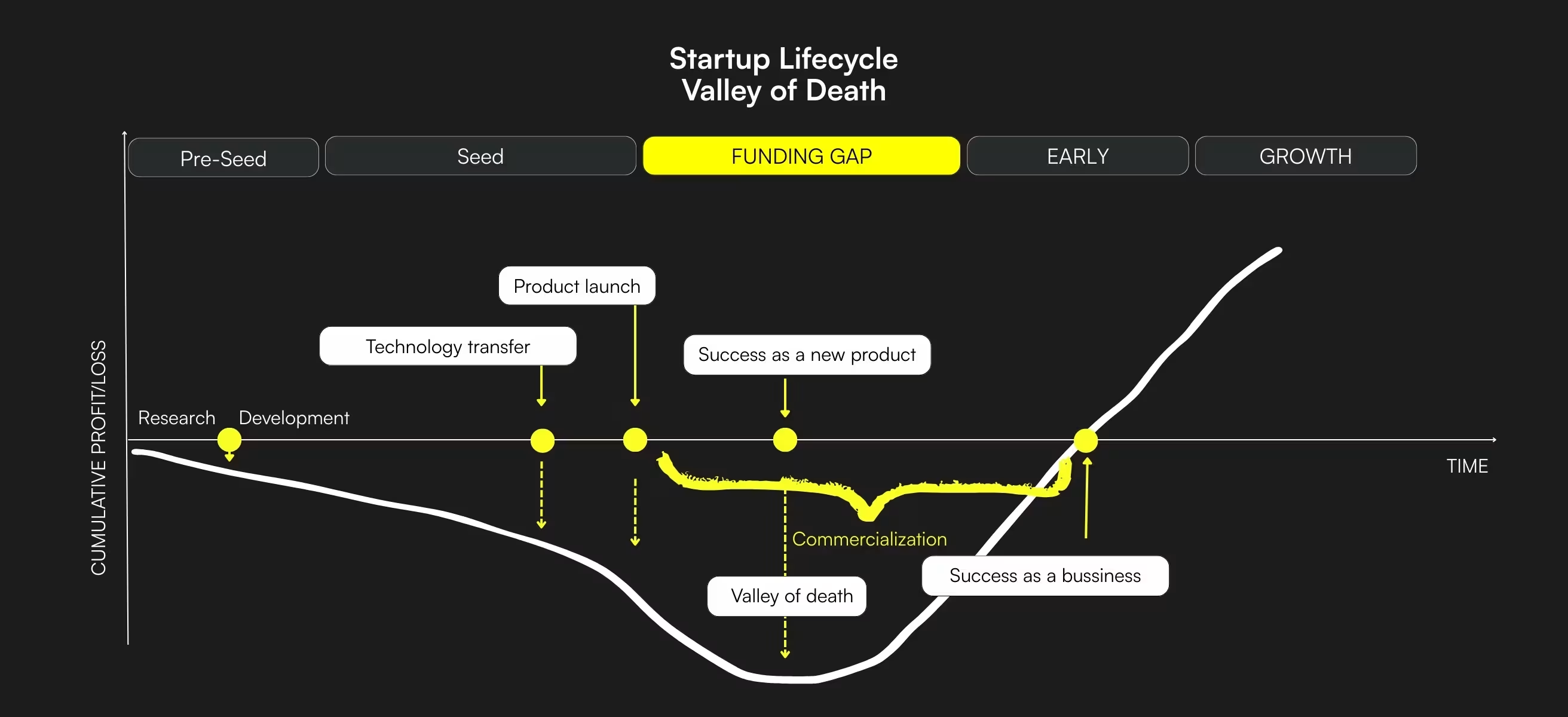
In the first year of operation, the main reasons for entering the Valley of Death are poor market fit and the inability to find new customers willing to pay for the product, as indicated. 90% of startups end their operations, and a key reason is precisely the incorrect reading of market demand.
Chaos in the Go-To-Market strategy further deepens these problems. Without a clear PMF, startups waste time and resources testing different sales channels, customer segments, and value propositions, while failing to achieve significant traction in any direction.
How to recognize a lack of Product Market Fit?
The symptoms of a lack of PMF are usually clear, though founders often ignore or misinterpret them. Key warning signals include: slow organic growth and long sales cycles.
The lack of a clearly defined customer segment is another “red flag.” When a startup cannot precisely define its ideal customer, it often means that the product does not solve a specific problem well enough. That is why understanding your detailed Ideal Customer Profile is so essential, as a foundation for effective marketing and sales activities.
Failed sales attempts also signal problems with PMF. If every sales conversation requires long explanations of the problem that the product allegedly solves, customers likely do not feel this need as a priority. Additionally, a lack of consistency in communication between marketing and sales teams often results from an unclear value proposition, another symptom of weak PMF.
When should a startup validate Product Market Fit?
PMF validation should begin even before full product development and continue throughout the startup's entire lifecycle. Initial validation should be a problem-solution fit of the future PMF.
Key moments for intensive PMF validation are periods before significant investments in scaling, before investment rounds, and before expansion into new markets. It is worth familiarizing yourself with the Minimum Viable Test framework as an alternative to the traditional MVP, allowing for faster and cheaper validation of business ideas.
PMF is not a static state, but a process that requires continuous iteration. Market changes, the emergence of competitors, or the evolution of customer needs can disrupt previously achieved fit. Therefore, regular monitoring of PMF metrics should be part of every startup's management routine.
How to validate Product Market Fit step by step?
Effective Product Market Fit validation requires a systematic approach. Validation helps ensure real market fit by testing assumptions early using prototypes, user interviews, and landing pages.
The first step is precise market segmentation and defining the ideal customer profile. ICP involves searching for patterns in customer data and discovering the common characteristics of your best customers.
The next stage is developing and testing hypotheses regarding your startup's value proposition. This is the stage where real interaction with the potential customer occurs, providing a chance to acquire the initial data that is crucial for subsequent iterations.
You can read more about validating PMF using outbound here.
Next, you should conduct interviews with potential customers, usability tests, and user behavior analysis. It is key to ask the right questions and listen not only to what customers say, but above all, to observe how they behave.
Which metrics actually show Product Market Fit?
When validating PMF, you can rely on intuition, but it is worth collecting data and then presenting it through specific metrics:
How will Product Market Fit help you in fundraising?
For investors, Product Market Fit is one of the most important signals of a startup's maturity and its actual readiness to scale. In practice, PMF has ceased to be a declaration based on vision or user count and has become a set of evidence from the market: consistent customer feedback, repeatable traction metrics, and clearly defined segments that are actually buying. Analyses from OpenVC show that investors increasingly expect not only a narrative of "why this will work," but also answers to who it is already working for and under what conditions.
Solid PMF validation has a direct impact on the fundraising process and its efficiency. Data from Equidam indicates that startups prepared for investor talks - those that possess verified market hypotheses, benchmarks, and a preliminary valuation - build greater trust and shorten negotiation times.
This is exactly why more and more startups are deciding to actively validate Product Market Fit before an investment round, rather than counting on its "confirmation along the way." Testing sales hypotheses, narrowing the ICP, and gathering data from real customer conversations allows them not only to better prepare the pitch deck but also to show investors a coherent, scalable go-to-market strategy.
We applied precisely this approach in our cooperation with a VoiceTech startup, helping them confirm PMF before Series A: from testing segments to securing the first enterprise leads, which we describe in detail in our case study.
Summary
Product Market Fit is a continuous process of adapting a product to changing market needs. Regular PMF validation serves as a key risk management tool that can protect a startup from entering the Valley of Death.
Success in achieving PMF requires a systematic approach: precise segmentation, testing hypotheses in real market conditions, and tracking the right metrics. The most important thing is to listen to customers and observe their behaviors, not just their words.
Does your startup already have a solid foundation for Product Market Fit validation? Remember: it is better to discover a lack of PMF early and pivot than to burn all your resources scaling a product that nobody needs.
FAQ: Product Market Fit
How long does it take to achieve Product Market Fit?
The time to achieve PMF varies significantly between startups. It can take anywhere from a few months to several years. The key is regular testing and iterating based on customer feedback, rather than setting rigid deadlines.
What are the most important PMF metrics for a B2B startup?
In the case of B2B, the most important are: CAC (Customer Acquisition Cost) payback period, Net Revenue Retention above 100%, high NPS, and repeatable sales processes with a short customer decision cycle.
Can you lose Product Market Fit after achieving it?
Yes, PMF can be lost due to market changes, the emergence of better competition, or the evolution of customer needs. Therefore, PMF validation should be a continuous process, not a one-time event.
How many customers are needed to confirm PMF?
There is no universal number, but most experts suggest at least 10-20 deep qualitative interviews and a minimum of 100 responses in a quantitative study (e.g., Sean Ellis Survey) for reliable conclusions.
How does PMF differ between B2B and B2C products?
In B2B, PMF often means longer sales cycles but higher LTV and lower churn. In B2C, fast adoption, virality, and high engagement rates are key, usually with a lower LTV per customer.
What to do when all metrics indicate a lack of PMF?
Consider a pivot - a change in customer segment, value proposition, or business model. It is important to conduct an in-depth analysis of the causes and make decisions based on data, not emotions or attachment to the original vision.