Guide
Lead Generation
B2B Lead Nurturing: The Complete Guide to Converting Leads into Sales (2026)
Master B2B lead nurturing in 2026. Learn to build campaigns that convert cold contacts into sales, increase your ROI, and boost SQL conversion rates.

Master B2B lead nurturing in 2026. Learn to build campaigns that convert cold contacts into sales, increase your ROI, and boost SQL conversion rates.
.avif)
Master B2B lead nurturing in 2026. Learn to build campaigns that convert cold contacts into sales, increase your ROI, and boost SQL conversion rates.
Lead nurturing is the process of systematically maturing leads who aren't ready to buy right now, but will be if guided properly. In B2B, where sales cycles last for months, nurturing - rather than just the volume of leads - determines the actual ROI of lead generation. In this guide, we show you how to build effective lead nurturing step-by-step, how to measure its performance, and when it truly impacts your sales results.
This article is for you if:
Skip this article if:
Lead nurturing is a long-term process of maintaining engagement with potential clients who have shown interest in your offer but, for various reasons, are not yet ready to purchase. In practice, this means that instead of aggressive selling from the first interaction, you provide leads with context, knowledge, and value at moments that actually make sense for them.
In B2B, purchasing decisions are rarely made instantly. They often require approval from multiple decision-makers, budget allocation, strategic alignment, and established trust in the provider. Lead nurturing addresses this exact challenge: it keeps your company top-of-mind until the lead is truly ready for a sales conversation.
The key difference between lead nurturing and a classic follow-up lies in intent. A follow-up is typically a component of a cold email campaign designed to continue a sequence for new prospects. Lead nurturing is about re-engaging contacts already in your CRM - for example, a quarter after the last point of contact.

Lead generation and lead nurturing are often lumped together, but they play distinctly different roles in the sales funnel. Lead generation is responsible for acquiring contacts. Lead nurturing handles everything that happens next.
In B2B, the average conversion rate from MQL (Marketing Qualified Lead) to SQL (Sales Qualified Lead) is approximately 13%. The vast majority of leads are not ready for a sales conversation at the moment of initial contact. Without a nurturing process, these leads get labeled "not interested" - even though they may have significant purchasing potential later.
Lead generation provides the raw material. Lead nurturing transforms it into real business value.
One of the biggest myths in B2B is the belief that if a lead doesn't respond immediately, they're a lost cause. Most leads are not ready to purchase during initial contact. The average B2B sales cycle lasts about 11.5 months, and in some industries even longer.
Without a nurturing process, sales teams make a few contact attempts and move on. The lead acquisition cost gets burned, and marketing focuses on generating new contacts instead of maximizing value from the existing database.
Here's a number most Founders don't calculate. If you spend $10,000 on lead generation and convert 5% into customers, your CAC is based on those 5 users. What about the other 95 people who showed interest but didn't buy?
If you ignore them, your nurture ROI is zero. If you implement a lead nurturing process, you can recover an additional 10-15% of that pipeline 6 months later - for nearly zero additional ad spend.
The benchmarks to aim for:
Lead nurturing shifts the dynamic entirely. By maintaining regular, value-driven contact, you leverage already incurred acquisition costs, improve the quality of SQLs handed to sales, and shorten the actual time to a buying decision.
Lead nurturing shouldn’t be a "special campaign" triggered by a crisis. It is a continuous process that ensures no dollar spent on marketing goes to waste. If you treat your CRM as a graveyard for "not ready yet" leads, you are leaving massive revenue on the table.
Here is why lead nurturing is a mandatory, day-to-day operation:
Statistics show that in complex B2B environments, only about 3% of your market is actively buying at any given moment. The remaining 10-15% of your pipeline often consists of leads that are high-quality but simply "stuck." They understand the value but aren't ready to pull the trigger today. Without a systematic nurturing process, these leads will eventually buy from a competitor who stayed top-of-mind.
Most sales teams write off a lost deal as a dead end. In reality, a "Closed-Lost" status is often just a "Not Right Now." * Budget issues? Budgets are reset every fiscal year.
In B2B, the path from "first touch" to "signed contract" can take 6, 9, or even 18 months. If your only contact with a lead is a sales pitch, you will lose them during the quiet periods. Regular nurturing through expert content and strategic case studies (like the Valueships approach to showing tangible business outcomes) keeps you positioned as a trusted advisor, not just another vendor.
Whether a lead comes from a webinar or a cold outreach campaign, their initial interest is fragile. If you don't have a process to guide them through education and trust-building immediately, the "decay" of that lead starts instantly. Nurturing ensures that the momentum gained during the first encounter isn't lost, transforming initial curiosity into purchase readiness.
The bottom line: Lead nurturing is the insurance policy for your marketing and sales spend. It ensures that when that "not ready" 97% of the market finally enters their buying window, your brand is the only logical choice.
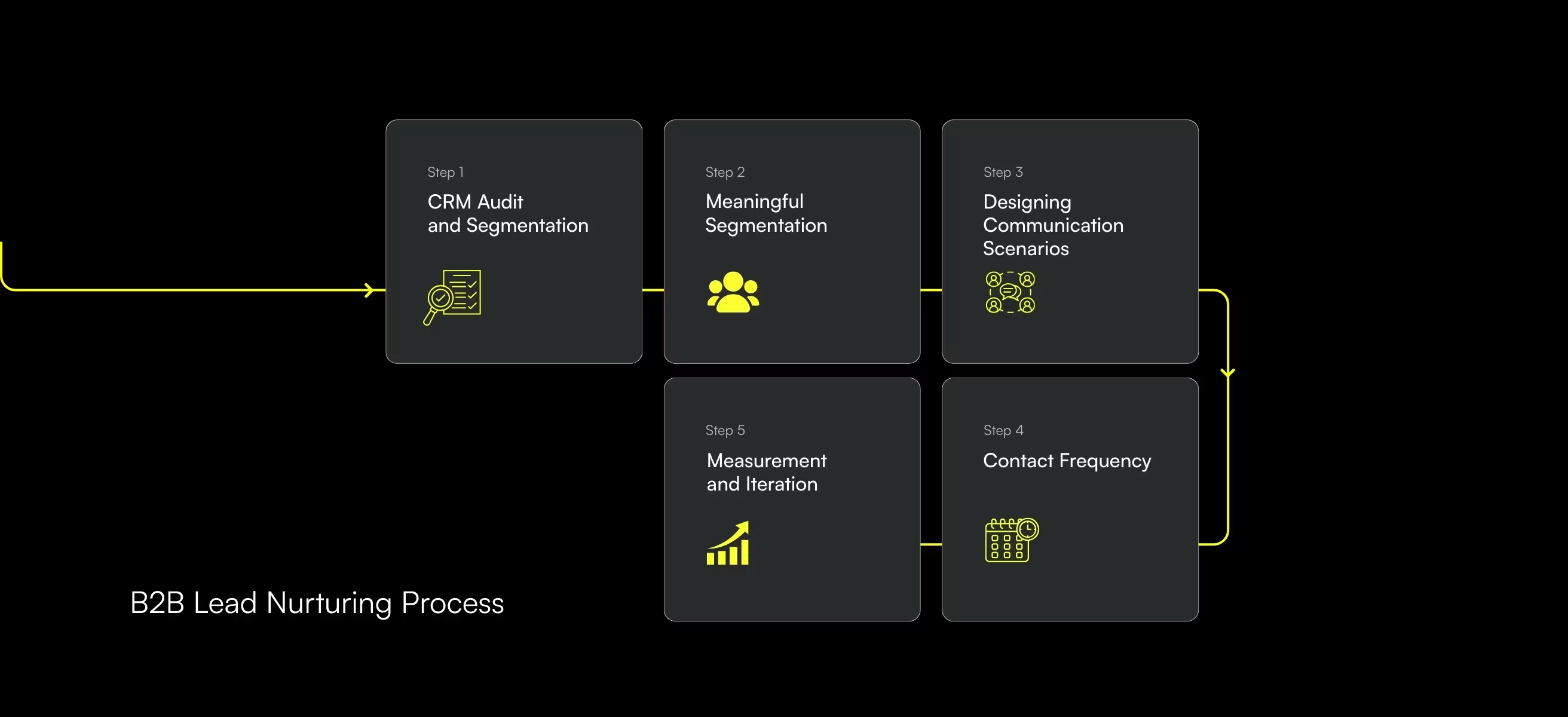
You cannot run a nurture campaign on dirty data. Most B2B CRMs are digital graveyards. Before you send a single nurture email, clean house.
Three actions to take now:
Segment leads by criteria with real business significance: industry, decision-making role, company size, and funnel stage. The better the segmentation, the easier it is to deliver a relevant message.
Stop thinking in lists and start thinking in segments. A CTO cares about security, API documentation, and uptime. A VP of Finance cares about ROI, seat costs, and contract flexibility. If you send the Finance content to the Tech buyer, you signal that you don't understand their world.
Each segment needs its own nurturing scenario. You communicate differently with a SaaS founder than with a Head of Marketing at a software house. Each scenario should include a series of touchpoints spread over time, with a clearly defined goal for each stage.
In B2B, the optimal frequency is one contact every 1-2 weeks. Contacting too often gets perceived as spam. Too rarely, and the lead forgets you exist.
Speed also matters at the entry point. The "Golden Window" for B2B engagement is the first 48 hours after a lead enters your system. Data consistently shows that leads contacted within 5 minutes are significantly more likely to qualify than those reached on day 3. If your nurture sequence waits 3 days to send the first value-add piece, you've already lost the attention war.
Lead nurturing without data is storytelling without sales. Monitor opens, clicks, and replies - but above all, the impact on pipeline and sales. We cover the right metrics in detail further below.
A great lead nurturing campaign is not a straight line. It's a waterfall - triggered based on behavior, not a calendar. Three specific flows cover 80% of your pipeline.
Target: Prospects who downloaded a resource but didn't book a demo.
Goal: Move from Problem Awareness to Solution Awareness.
Tactic: 3-4 emails over 14 days focused on Jobs to Be Done. Lead with the specific problem the resource addressed, then connect it to a broader outcome your product drives.
Target: Prospects who saw your demo and went silent.
Goal: Overcome friction and surface the real objection.
Tactic: Industry-specific case studies sent 3-5 days after silence begins. Don't ask "Did you have a chance to think it over?" - that's dead weight. Show them what a similar company achieved after making the same decision they're stalling on.
Target: Closed-Lost deals from 6-12 months ago.
Goal: Reactivate the relationship when timing shifts.
Tactic: Low-frequency, high-value email every 45 days. Reference a specific change in their market, industry, or company - not your product update.
In 2026, an email-only nurturing campaign is not enough. 70% of your leads never see your message if inbox is your only channel. You need to meet buyers where they live.
The Surround Sound approach:
A concrete day-by-day example:
Automation is essential if you want to scale. The right tool depends on where you are.
The tool is not the strategy. A well-designed process in a lean stack beats a broken process in an enterprise platform every time.
Most B2B nurturing campaigns fail because they treat lead nurturing as a static newsletter rather than a dynamic behavioral engine. If you're blasting the same generic drip sequence to every lead, you aren't nurturing - you're spamming.
The goal is not "engagement." It's Pipeline Velocity: how fast a lead moves from "Aware" to "Closed-Won."
Here are the 5 mistakes that drain your pipeline, and exactly how to fix each one.
You wouldn't pitch a CTO the same way you pitch a VP of Finance. So why are they getting the same email sequence?
The problem: Sending a generic "Intro to Our Platform" PDF to your entire database. The CTO cares about security and API documentation. The VP of Finance cares about ROI and contract flexibility. If you send Finance content to the Tech buyer, you signal that you don't understand their world. Result: unsubscribe.
The fix: Stop thinking in lists. Start thinking in segments.
Segmented campaigns consistently drive dramatically higher revenue than non-segmented ones. The math is not subtle - it's a function of relevance.
Your prospects don't live in their inbox. They live on LinkedIn, Slack communities, and industry sites.
The problem: Even the best email sequence caps out at a 20-30% open rate. That means 70% of your leads never see your message. If email is your only channel, you're voluntarily ignoring most of your pipeline.
The fix: Orchestrate a "Surround Sound" strategy. When a lead hits a specific stage in your CRM, it should trigger ads, not just emails. (See the day-by-day Surround Sound example in The Playbook section above.)
You're making it too hard for them to buy from you.
The problem: Gating every piece of content and asking for a demo request in every single email. Requiring a form fill for every resource prioritizes data collection over education. Asking for a demo in every message creates decision fatigue.
The fix: The 3:1 Give-to-Get Ratio.
Give value three times before you ask for anything.
You already have their email. Don't make them type it again.
This is where the war between Sales and Marketing begins.
The problem: If Marketing passes every eBook downloader to Sales, SDRs burn out calling unqualified leads and stop trusting Marketing's pipeline. If Marketing hoards leads too long, a competitor engages them first.
The fix: Define a mathematical threshold for when a lead becomes an SQL.
Simple Lead Scoring Model:
The trigger: Alert the SDR only when Score > 60.
The alert looks like this: "Lead [Name] just visited the pricing page and has a score of 65. Call now."
No guesswork. No subjective judgment. The hand-off is automatic and based on real behavior.
The market changes every quarter. Your sequence from 2024 is likely obsolete.
The problem: Using outdated stats, referencing old pain points, or running sequences that haven't been touched in 6 months kills credibility. Automated campaigns are a force multiplier - if the strategy is flawed, automation amplifies those errors at scale.
The fix: Treat your nurture sequence like a software product. It needs updates.
Quarterly Audit Checklist:
Pick one failing item from the list above. Assign it to your Marketing Ops lead to fix by next Friday.
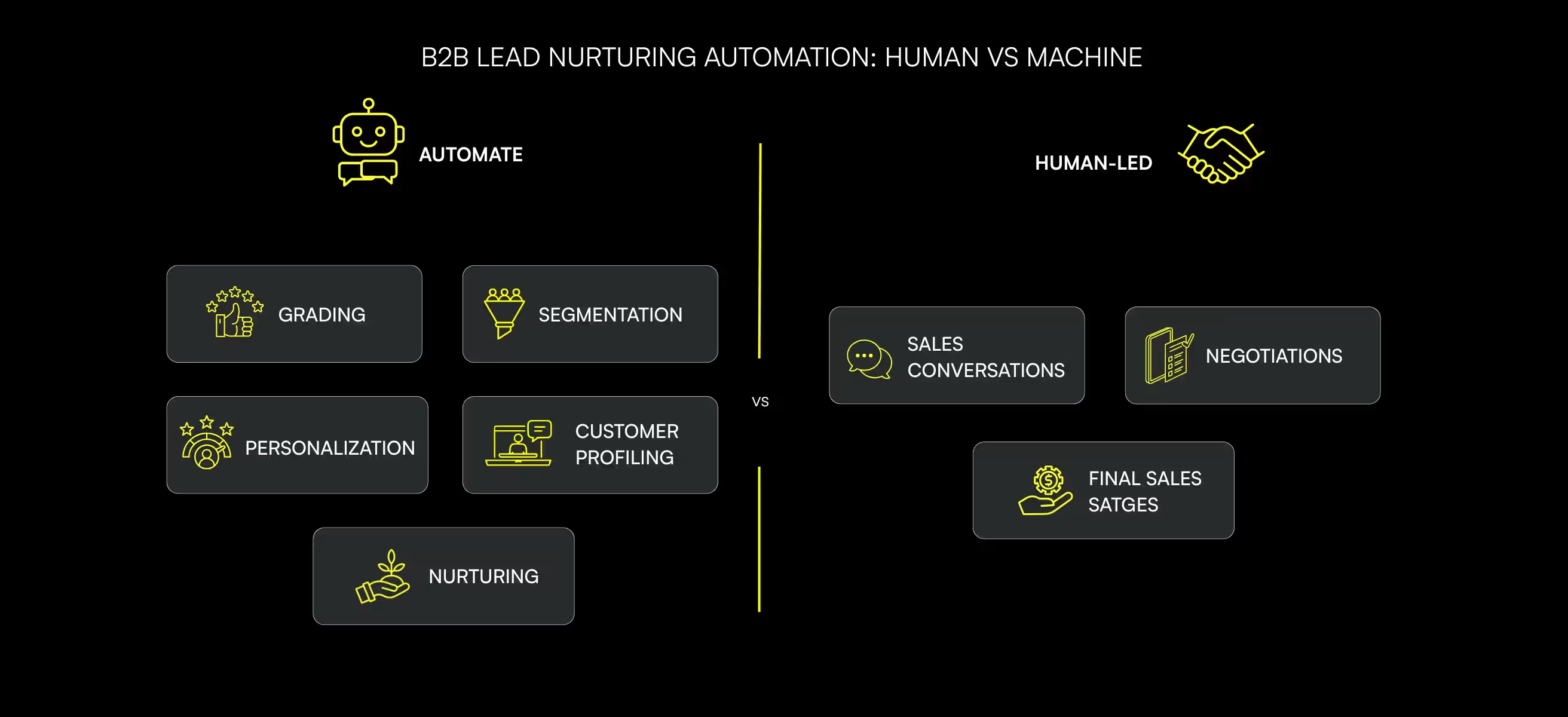
Automation is essential if you want to scale. Automate educational sequences, lead segmentation, scoring, and the hand-off of hot leads to sales.
Not everything should be automated. Sales conversations, negotiations, and the final stages of the sale should remain in human hands. Automation is meant to support the team - not replace it. If your sequences don't account for real-time actions (like a lead booking a demo), you risk sending irrelevant emails that make your brand look disconnected. Always build exit triggers into your workflows.
Measure lead nurturing through the lens of business impact, not marketing vanity metrics. Open rates are noise - especially with Apple's Mail Privacy Protection inflating numbers across the board.
The metrics that actually matter:
Nurture Velocity is the composite metric that ties these together: how fast does a lead move from "Aware" to "Closed-Won." Every tweak to your campaign should be evaluated against whether it increases velocity.
For attribution, use multi-touch attribution - even a simple linear model. If a Closed-Won deal interacted with Nurture Email 4, that email gets credit. This is how you prove to the CFO that nurturing is not a cost center but a revenue generator.
Valueships, a European pricing strategy consultancy, had a CRM problem most B2B teams will recognize. Hundreds of historical contacts, all of them once-warm conversations about pricing engagements, all of them now silent. The instinct was to write the database off and start fresh. The better question was simpler: does silence here mean "no fit," or does it mean "bad timing"?
That distinction matters. In B2B services, a non-reply is rarely a final answer. Priorities shift, budgets reset, decision-makers change roles. We treated the CRM not as a graveyard, but as a hypothesis to validate.
The challenge. Reactivate historical contacts without sounding like a generic re-engagement blast, without burning trust, and without leaning on the "long time no see" trope that signals you have nothing new to say.
What we did. We rebuilt the database in three layers before a single message went out.
First, a Pipedrive export cleaned of geo-irrelevant leads, close personal contacts, and "circle back later" notes. Then we pushed it into Clay for enrichment, qualification, and validity checks. One quick discovery in that step: most CRM records listed a single point of contact, but the original email threads showed 2-3 people involved in the buying conversation. Pulling those secondary stakeholders back in expanded the contactable pool by roughly 30%.
Next, status verification. For every contact, two checks ran in parallel: is the email address still valid, and did the person switch jobs on LinkedIn? Those signals built the segmentation. Same company and same role meant prior context was still warm. Internal promotion meant a congratulatory hook. New company meant a fresh angle entirely.
Then the message. Three variables drove the personalization: the month of the last conversation, the service topic that originally brought them to Valueships, and a low-friction reason to reply now - a 2026 pricing trends report and a 30-minute consultation with a pricing expert, no strings attached. Email went first. For non-responders, a LinkedIn workflow picked up the thread, referencing the same context to keep continuity.
The takeaway. Outbound here did not function as a sales channel. It functioned as a diagnostic tool. The reply data told Valueships which historical relationships still had purchasing potential, which were genuinely closed, and which simply needed a different timing. The CRM stopped being an archive of failed attempts and started behaving like a reactivable asset.
Lead nurturing is a sales system. Companies that ignore it burn through their lead generation budgets. Companies that implement it maximize the value of data they already own and build a durable competitive advantage.
The highest-margin revenue in B2B doesn't come from new leads. It comes from leads you already paid to acquire - the ones sitting in your CRM right now, waiting for the right moment and the right message.
Build the process. Clean the data. Set the sequences. Then measure what actually moves pipeline.
If you want to see how lead nurturing aligns with market validation and data-driven sales, check out our case studies or talk to us about implementing the process in your organization.
Lead nurturing is a medium- to long-term process. The first signs of increased engagement (opens, replies, returning conversations) usually appear after 4-8 weeks. The real impact on pipeline and sales is typically visible after 3-6 months of consistent effort.
In B2B, the optimal frequency is one contact every 1-2 weeks. More important than frequency is aligning communication with the customer journey stage. Active leads can be contacted more frequently; less engaged ones should be contacted less often.
Lead nurturing is behavior-based and personalized: "I saw you did X, so here's Y." Drip marketing is a static sequence sent to everyone regardless of actions. Nurturing consistently outperforms drip on conversion rate.
No. Lead nurturing works wherever the sales cycle is long and purchasing decisions are not impulsive. This includes software houses, technology companies, professional services, consulting, fintech, martech, and high-ticket B2B sales.
Lead nurturing provides value in every interaction and reacts to the recipient's behavior. Spam tries to sell regardless of context. If your messages are personalized, have a clear purpose for the recipient, and offer an easy way to unsubscribe - you're conducting nurturing, not spam.
The transition to sales is triggered by intent signals: replies to messages, clicking on sales materials, attending webinars, demo requests, or direct pricing inquiries. Lead scoring (scoring threshold >60) automates this transition without relying on gut feel.
Yes - outbound nurturing is where the highest margins are. If a cold prospect says "not interested," they're a prime candidate for a long-term nurture sequence. Don't write them off. Write them into the right flow.
The foundation is a CRM and a communication automation tool. As you scale, add tools for segmentation, lead scoring, and data enrichment (Clay is the current standard for enrichment). The key is not the tool - it's a well-designed process.
The most common causes are poor segmentation, a lack of a clear value proposition, or an overly sales-heavy tone. Go back to basics: verify your ICP, analyze data from your CRM and sales conversations, and test alternative communication scenarios. Run the Quarterly Audit Checklist from the Mistakes section above.
Automation is essential for scale - but "set it and forget it" is a mistake. If your sequences don't account for real-time actions (a lead booking a demo, a lead making a purchase), you risk sending irrelevant emails that make your brand look disconnected. Always build exit triggers into your workflows.