.webp)
Quick overview
Total Addressable Market (TAM) defines the maximum revenue ceiling for a product or service within a clearly defined market. In B2B, TAM is not a theoretical exercise for decks, but a practical tool for deciding whether growth goals are realistic, how much outbound capacity makes sense, and which segments deserve investment. In this guide, you will learn how to calculate TAM, how TAM connects to SAM and SOM, and how to translate market sizing into a repeatable outbound system.
In this article, you’ll learn:
- What Total Addressable Market (TAM) really means in a B2B context?
- How to calculate TAM using bottom-up, top-down, and value-based methods?
- The difference between TAM, SAM, and SOM and why does it matter for outbound?
- How to turn market sizing into a usable outbound account universe?
- How ICP, intent signals, and data quality activate TAM in practice?
- Which metrics actually validate TAM-based outbound strategies?
What is Total Addressable Market (TAM)?
Total Addressable Market (TAM) represents the full revenue opportunity available for a product or service if every potential customer in the defined market were acquired. In B2B, TAM is primarily a strategic input rather than an execution plan.
TAM helps leadership teams answer questions that shape long-term decisions:
- Can this market support the revenue targets we set for the next three to five years?
- Is it worth building a larger outbound team, or will the market cap growth regardless of execution quality?
- Are we operating in a niche by choice or by limitation?
The most important thing is that TAM describes the size of the opportunity, not the probability of capturing it. Confusing these two leads to over-hiring, unrealistic revenue projections, and outbound strategies that look good on paper, but collapse in practice.
What are TAM, SAM, and SOM?
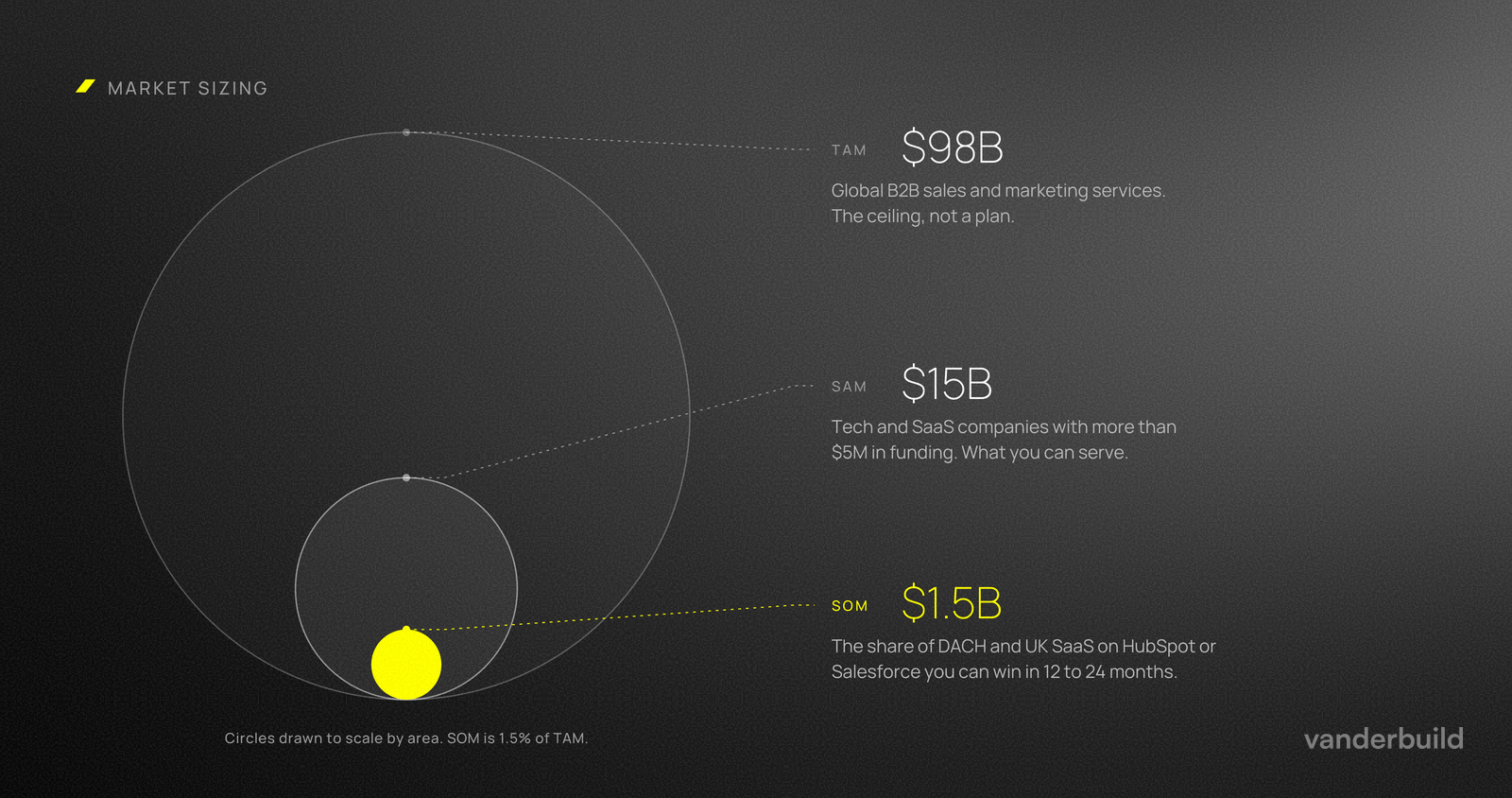
Market sizing becomes actionable only when TAM is broken down into operational layers. These layers create alignment between long-term ambition and short-term execution.
TAM (Total Addressable Market) describes the full theoretical demand for a category.
SAM (Serviceable Available Market) is the portion of TAM that you can serve based on product scope, geography, language, compliance, and delivery constraints.
SOM (Serviceable Obtainable Market) represents the realistic share of SAM that can be captured within a defined time horizon, usually one to three years.
Market sizing
TAM vs SAM vs SOM comparison
| Layer | Definition | Strategic role | Time horizon |
|---|---|---|---|
| TAM | Total demand for the category | Sets ambition and growth ceiling | 3-10 years |
| SAM | Market you can technically serve | Filters feasibility | 1-5 years |
| SOM | Market you can realistically win | Guides outbound execution | 6-24 months |
Outbound teams operate primarily within SOM. TAM exists to ensure that SOM is not artificially small due to poor assumptions or narrow thinking.
How do you calculate the Total Addressable Market?
There is no single correct way to calculate TAM. The right method depends on how you plan to use the number. In B2B outbound, some approaches are more useful than others.
How does bottom-up TAM calculation work?
The bottom-up method builds TAM using real account data and pricing assumptions. It is the most practical approach for outbound-driven teams.
Formula:
(Number of target accounts) × (Average annual revenue per account)
Example:
A B2B SaaS targets 1,200 mid-market companies in Europe with an average annual contract value of $15,000.
TAM = 1,200 × $15,000 = $18,000,000
This approach aligns naturally with outbound execution because it starts from a defined ICP and a real company universe. It also forces uncomfortable but necessary decisions around pricing, segmentation, and deal size assumptions.
How does top-down TAM calculation work?
Top-down TAM starts with industry-level market data and narrows it using segmentation assumptions. This method is often used for investor decks and category-level storytelling.
For example, a report might state that the global CRM market is worth $80B. You then apply assumptions around geography, company size, and use case to arrive at a smaller number.
The key risk is abstraction. Without validation against real account lists, top-down TAM often overstates opportunity and creates false confidence.
Use top-down TAM when:
- You need a high-level narrative for investors or stakeholders.
- You are exploring a new category with limited account-level data.
Avoid relying on top-down TAM when:
- You are planning outbound headcount or revenue targets.
- You already have access to firmographic and account data.
How does value-based TAM calculation work?
Value-based TAM estimates market size based on the economic value delivered per customer rather than price alone. This approach works well for products priced around cost savings, efficiency gains, or revenue impact.
Example:
If a solution saves an average of $50,000 per customer per year and you price at 20% of value delivered, the implied annual contract value is $10,000.
Value-based TAM is useful for reframing pricing strategy, but it should always be cross-checked with willingness-to-pay data. Without this validation, it risks becoming theoretical.
How do you build a usable TAM for outbound?
A usable TAM connects market size with execution reality. The goal is not precision, but decision-quality clarity.
Step-by-step checklist:
- Define firmographic and technographic ICP criteria.
- Build a real list of companies matching those criteria.
- Validate pricing assumptions against historical deals or market benchmarks.
- Calculate TAM using bottom-up logic.
- Narrow TAM into SAM based on delivery and market constraints.
- Define SOM based on realistic capture rates and time horizon.
Key fact: A TAM of 50,000 companies often translates into fewer than 5,000 accounts that are realistically usable for outbound in the next 12-24 months.
How do you turn TAM into an outbound focus?
Outbound performance improves when market sizing informs prioritization. TAM answers the question of how big the opportunity is, while SAM and SOM determine where sales teams should spend time today.
Instead of treating all accounts equally, high-performing teams prioritize segments that support deal size, sales velocity, and retention assumptions. This approach reduces wasted activity and improves pipeline efficiency.
The most important thing is that TAM should influence segmentation logic, not messaging volume. More accounts do not automatically justify more outbound.
Check our service TAM Outbound Campaign.
How do ICP and buyer personas activate the market?
Ideal Customer Profile (ICP) defines the companies most likely to convert, expand, and remain customers. Buyer personas describe the decision-makers within those companies.
ICP filters the market. Personas guide messaging.
For example, two companies may both fall within TAM, but only one matches ICP due to budget maturity, tech stack, or buying behavior. Outbound should never attempt to activate TAM without first narrowing to ICP.
How do intent and technographic data activate TAM?
Market size is relatively static, but buying readiness changes daily. Intent signals and technographic data reveal which accounts within SOM are more likely to convert in the near term.
Common activation signals include:
- Recent funding rounds
- Leadership or hiring changes
- Technology migrations
- Increased content consumption around a category
This signal-based approach allows outbound teams to prioritize accounts with higher short-term conversion probability without inflating TAM assumptions.
BUT
Remember that the outbound is a long term game. Reaching out to the account once a year won’t make any difference - you need to stay on their radar which means outbound has to be planned around TAM more carefully circling back to the same prospects every 90 days at least.
Why do campaign architecture and data quality matter for TAM?
Market sizing loses value when data quality and execution systems are weak. A large TAM does not compensate for poor deliverability, inaccurate enrichment, or inconsistent CRM usage.
Outbound stack
Core components of a TAM-driven outbound stack
| Layer | Purpose | Example Tools |
|---|---|---|
| CRM | Single source of truth for accounts and pipeline |
|
| Engagement platform | Sequencing and activity tracking |
|
| Enrichment & verification | Data accuracy and deliverability |
|
Want to compare more tools? Browse the full list in our Sales Tools Database.
Open the Sales Tools DatabaseHow do you personalize outbound at market scale?
AI enables personalization across thousands of accounts without manual overload. When combined with segmentation and intent signals, AI-driven outbound supports relevance at scale.
The key is constraint. Personalization works best when guided by ICP, SOM, and clear value hypotheses, not when applied blindly across the full TAM.
How do you measure the success of TAM-based outbound?
TAM-driven outbound strategies should be evaluated using pipeline and unit economics rather than activity volume.
Outbound metrics
Key outbound metrics to track
TAM campaigns are about market coverage and educating your market about your services. The people who reply are rarely hot leads. Treat them as a database for nurturing and as the backbone of your LinkedIn Ads audiences, not as bottom-of-funnel pipeline.
| Metric | Why it matters | Good | Ok | Needs work |
|---|---|---|---|---|
| Deliverability | The share of messages that reached an inbox, out of everything sent. Nothing else on this table is measurable until this holds. | Above 95% | 90 to 95% | Below 90% |
| Reply rate | Replies out of the contacted group. A coverage and engagement signal, not a buying signal. | Above 10% | 5 to 10% | Below 5% |
| Engaged market rate | How much of the market engaged, out of the contacted group. In a TAM campaign this is nurturing and retargeting fuel, not hot leads. | Above 5% | 2.5 to 5% | Below 2.5% |
| Sales opportunity rate | Contacts worth a direct offer, out of the engaged market. Most TAM value stays in nurturing and retargeting, so keep expectations here realistic. | Above 30% | 25 to 30% | Below 25% |
Indicative benchmarks vary by market. Measuring the same way every month matters more than hitting any single number.
Indicative benchmarks vary by market, but consistent measurement matters more than absolute numbers.
What should you do after defining your TAM?
Total Addressable Market connects strategy with execution when translated into SAM, SOM, and prioritized account lists. B2B outbound becomes more predictable when market sizing informs segmentation, data quality, and signal-based activation.
Teams that operationalize TAM avoid building growth systems on assumptions. Instead, they align ambition with reality and scale outbound on top of real opportunity.
Next step: If you want to validate whether your current outbound setup matches your real SOM, start by auditing your ICP, account universe, and pricing assumptions before adding volume.
FAQs: What questions do teams ask about TAM?
What is total addressable market (TAM)?
Total addressable market (TAM) is the maximum revenue opportunity available within a defined market - the number you'd hit if every company that could possibly buy your product actually did. It's a ceiling, not a forecast. In B2B, the cleanest way to think about TAM is total demand: every account that fits your category, multiplied by what each would pay you in a year. Most founders inflate it to impress investors. A useful TAM does the opposite - it's narrow enough to be believable and specific enough to act on.
How do you calculate total addressable market?
There are two ways to calculate total addressable market: top-down (start with an analyst's market-size report and shrink it) and bottom-up (start with real accounts and build up). Bottom-up wins almost every time. The formula is simple - number of accounts that match your ICP × average annual revenue per account. If 8,000 companies fit your profile and each is worth $12,000 a year, your TAM is $96M. The bottom-up method forces you to actually know who buys, which is the same work that makes your outbound land.
What is the difference between TAM, SAM, and SOM?
TAM, SAM, and SOM describe three shrinking circles of the same market. TAM is total demand - everyone who could buy. SAM (serviceable addressable market) is the slice you can realistically serve given your product, pricing, and geography. SOM (serviceable obtainable market) is what you can actually win in a set period, given your sales capacity and the competition in front of you. TAM is the dream, SAM is the reality, SOM is the plan. The most common market-sizing mistake is pitching your TAM as if it were your SOM.
Is TAM useful for startups?
Yes - but only when paired with realistic SOM assumptions. A big TAM tells an investor the market is worth entering. It tells you almost nothing about whether you can win the next 12 months. For an early-stage startup, SOM is the number that should drive your roadmap, your hiring, and your outbound targets. Lead with TAM in the deck; run the business on SOM.
Can TAM be too small?
Yes. A small total addressable market can cap your growth no matter how good your execution is. If only 400 companies on earth fit your ICP and each pays $20k a year, your hard ceiling is $8M - and you'll feel it long before you reach it. A small TAM isn't always fatal: you can raise prices, expand into adjacent segments, or add products. But you need to see the ceiling early, before you've built a sales team the market can't support.
Should TAM guide outbound headcount?
Only indirectly. TAM tells you the market is big enough to bother with - it does not tell you how many reps to hire. Headcount should track SOM and real sales capacity: how many accounts you can actually work, your conversion rates, your sales cycle. Hiring against TAM is how teams end up with eight SDRs and a pipeline built for two.
How often should you update your TAM?
Update your TAM whenever pricing, ICP, or market focus changes - not on a fixed annual schedule. Every time you raise prices, your TAM grows. Every time you narrow your ICP, it shrinks. A market-sizing number that's two product launches old is fiction. Treat TAM as a living input to your GTM strategy, not a slide you build once for the deck and never touch again.
Does TAM guarantee revenue?
No. TAM defines opportunity, not probability. A $2B total addressable market means $2B exists in theory - it says nothing about how much you'll convert, how fast, or against whom. Revenue comes from SOM, execution, and a repeatable motion to reach the accounts that actually fit. TAM gets you permission to play. It doesn't win the game.