Guide
Cold mailing
What is Cold Outreach? A Guide to Effective B2B Prospecting
Stop running a lottery. Master personalized B2B cold outreach with our 2026 guide to multichannel strategies, deliverability, and scaling your growth.

Stop running a lottery. Master personalized B2B cold outreach with our 2026 guide to multichannel strategies, deliverability, and scaling your growth.
.avif)
Stop running a lottery. Master personalized B2B cold outreach with this complete guide to targeting, infrastructure, multichannel sequences, and scaling your pipeline.
Cold outreach is a standard channel in B2B sales. But most people doing it are doing it wrong - and the results show: low reply rates, spam complaints, and wasted budget.
This guide covers what cold outreach actually is, how it works, and what separates effective campaigns from noise.
In this guide, you'll find answers to:
Cold outreach is the practice of contacting potential customers who have no prior relationship with you or your company. The goal is to start a relevant business conversation - not to sell immediately.
Cold outreach happens across multiple channels:
This guide focuses primarily on cold email and LinkedIn, which account for the majority of B2B outbound activity.
Every few years, someone declares cold outreach dead. It isn't.
What's true: generic, untargeted cold outreach performs poorly and is increasingly filtered. What's also true: well-targeted, relevant outreach still generates meetings at meaningful rates - reply rates of 5–15% are achievable for well-executed campaigns, depending on market and offer.
The difference is targeting, personalization, and infrastructure. Teams that treat cold outreach as a numbers game send 10,000 emails and get 3 replies. Teams that treat it as precision work send 1,000 emails and get 80.
Running a campaign without preparation is the fastest way to burn your domain reputation and your target group at the same time. Before you send a single message, complete this list:
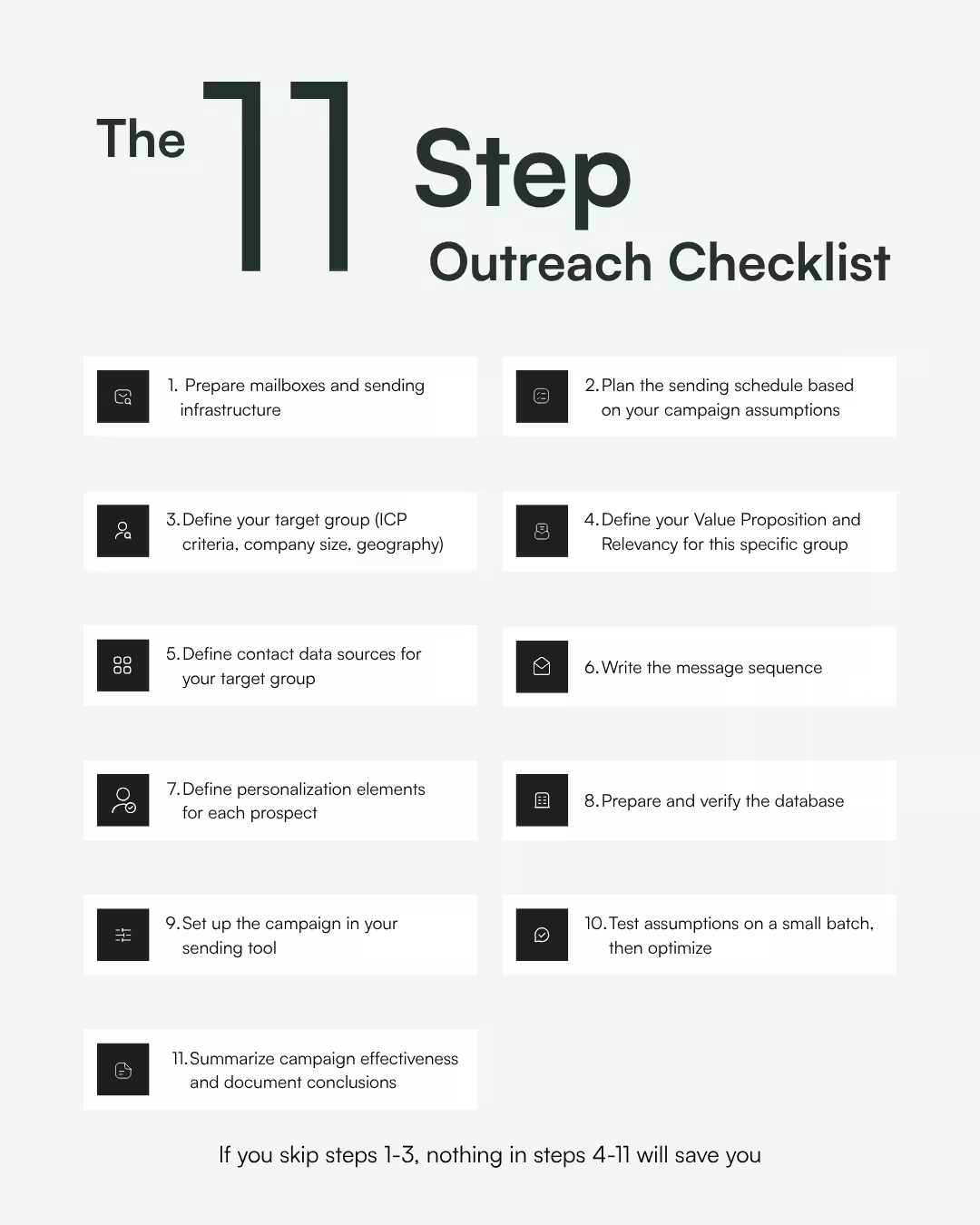
1. The Target List
Who you contact is the most important variable. A mediocre message sent to the right person outperforms a brilliant message sent to the wrong one.
A good cold outreach list is:
2. The Message
Cold outreach messages fail for predictable reasons:
What works:
Ready to transform your response rates?
Theory is one thing, but execution is where the revenue happens. Check "The Ultimate Cold Email Playbook" to get our proven frameworks, high-converting templates, and the exact outreach sequences we’re using in 2026 to break through the noise.
3. The Sequence
One message rarely converts. Most campaigns use a sequence of 3–5 touches over 2–3 weeks.
Structure that works:
Each follow-up should add something new. Sequences that repeat the same message perform significantly worse.
4. The Infrastructure
How you send matters as much as what you send. Cold email requires:
Skipping any of these steps results in deliverability problems. If your emails aren't reaching the inbox, nothing else matters.
Choosing a Sending Domain
Never send cold email from your main company domain. If something goes wrong - complaints, spam flags, domain blacklisting - it affects your brand email, customer communications, and everything else.
Register a lookalike domain (company.co, trysomething.com, etc.), configure it properly, warm it up, and use it exclusively for outbound.
DNS Records: SPF, DKIM, DMARC
When you purchase a new domain for cold mailing, you need to set three DNS records. Each does something specific:
All three are required. Missing any one of them will hurt deliverability.
The hard limit: 50 messages per mailbox per day. An alias is not a separate mailbox.
Work backwards from your campaign goals:
One mailbox handles roughly 300 contacts per month on a standard 3-message sequence.
For domains: keep a maximum of 4 mailboxes per domain. If you need 8 mailboxes, use 2 domains. This limits the blast radius if one domain gets flagged.
Before you set up the campaign, define these variables:
Example: you want to contact 1,000 people starting in 30 days, finish in 10 days, with a maximum of 3 messages per person sent over 5 days, with no pauses. You need 12 mailboxes minimum - 13 to be safe.
Define this before you build the list. The math determines your infrastructure requirements, not the other way around.
New domains and inboxes need time to build sending reputation. Warm-up tools simulate natural email exchanges to establish that reputation before you run real campaigns.
Use the built-in warm-up features in your sending platform or a dedicated warm-up tool. Plan for 3–4 weeks minimum before any cold sending.
Tool to use: Instantly or Lemlist - both include built-in warm-up.
You need a platform built for cold outreach, not a standard email marketing tool. Key capabilities to look for:
Recommended sending platforms: Instantly, Smartlead, Lemlist, Woodpecker
For data enrichment and personalization at scale: Clay
Keep it short. 60 - 100 words for the first email.
Structure:
Avoid:
Give Your ICP Industry Context
If you think your services are generalized - "we can do marketing in any industry" - you haven't done the work yet.
Ask yourself: how would you help a law firm vs. a manufacturing plant vs. a software house? The answer almost certainly differs. The more specific you get, the more relevant your message becomes. "Marketing agency for IT companies" beats "marketing agency" in every conversion metric.
Company Size Matters
Companies of different sizes share similar problems but face them at completely different scales. In smaller companies, the constraint is budget. In larger ones, it's complexity and decision-making speed. Don't put companies with 11–50 employees and 200–1,000 employees in the same campaign. The value proposition, message tone, and CTA will be wrong for at least one of them.
Location and Culture
Your market is not "Europe." It's specific countries, languages, and cultures - and they communicate differently.
Example: the title "Project Manager" translates as Projektijuht (Estonia), Responsabile del progetto (Italy), Projektmanager (Germany), Gerente de proyecto (Spain). Searching for prospects by job title in the local language can increase your match rate by 30–40% in some markets.
Beyond language: communication norms differ too. In Germany, address contacts by last name (Sehr geehrter Herr Sekta), not first name. In Poland or the UK, first name is standard. Ignoring this reduces reply rates and can generate negative sentiment. Also account for time zones - a factory director in Texas has a different schedule than an ops lead in Berlin.
Validate First, Then Scale
Start with the smallest group that still gives you statistically meaningful data: 500–1,000 target companies.
Here's the realistic math: from 1,000 companies, you'll find a decision-maker in roughly 60–80% of them. Of those, approximately 70% will have a verified corporate email address. That leaves ~420 contactable people.
Test your hypothesis on that group. If something works, replicate it. If it doesn't, iterate on targeting before scaling. Burning 10,000 contacts with an unvalidated thesis is expensive and wastes your market.
Level 1: Beginner: LinkedIn-Based Sources
LinkedIn Sales Navigator is the starting point. It gives you a large, structured database where people are already linked to companies. Export limitations exist, so you'll need a tool like Clay or Prospeo to process the data and find email addresses.
Also useful: Apollo for broad database prospecting without Sales Navigator.
Level 2: Intermediate: Scraped and Event-Based Lists
This includes any list you find or build from external sources: industry event attendee lists, "[industry] startups in [country]" searches, online directories, trade association registers.
The challenge here is data quality. Scraping requires cleaning, deduplication, and email finding. The advantage: these sources are less saturated than Sales Navigator, so your outreach faces less competition.
Level 3: Advanced: Company Registers and Government Databases
Most countries maintain digitized company registers that categorize businesses by economic classification codes (similar to NACE or SIC codes). These databases are highly structured, up-to-date, and rarely exploited by other outbound teams - precisely because access is harder.
Industry association registers (hotel industry bodies, medical associations, professional chambers) are another underused source. If you can build a workflow around these, you're prospecting from data your competitors don't have.
Personalization exists on a spectrum:
For most campaigns, signal-based personalization is the right balance. Tools like Clay make this scalable by pulling signals and generating personalized opening lines automatically.
Concrete personalization angles that work:
The more specific the trigger, the more relevant the message feels. Relevance is what gets replies.
A clean database structure saves you from CRM chaos later. The recommended column structure:
Verify emails before upload. Bounce rates above 3–5% damage your domain reputation and deliverability for everyone you send to.
Before you click send, check every one of these:Send the test. Read it in your inbox as if you're the recipient. If it doesn't feel relevant, don't send it to anyone else.
For most ICP-targeted outreach: send without a note, or with a very short one (under 20 words). Long notes on connection requests are commonly ignored.
Follow up quickly - within 24-48 hours of acceptance. Reference the context for reaching out, not a generic opener. Keep it to 2-3 sentences maximum.
LinkedIn automation tools let you run outreach at volume across multiple accounts. Recommended:
Stay within daily action limits and use tools that mimic human behavior patterns. LinkedIn enforcement is real.
Running email and LinkedIn in parallel consistently outperforms either channel alone. Here's the workflow:
This creates multiple touchpoints without doubling the friction. The LinkedIn connection provides social context; the email provides depth. Tools like HeyReach handle LinkedIn automation at scale and can be paired with email platforms for coordinated multichannel sequences.
For a practical example, see the Valueships case study, which illustrates the measurable impact of combining cold email with LinkedIn automation.
Treating it as a numbers game
Volume without quality produces noise. 1,000 well-targeted emails outperform 10,000 generic ones. Fix targeting before fixing volume.
Skipping infrastructure setup
Sending cold email from your main domain, without warm-up, without authentication records, is the fastest way to damage your sender reputation. Set up the basics before sending a single message.
Using the same follow-up text
A follow-up that copies the first email with "just checking in" added delivers zero value. Each follow-up needs a new angle, context, or proof point.
Ignoring deliverability metrics
If you're only tracking reply rates, you're missing the picture. Also monitor: bounce rate (keep under 3%), spam placement, open rates by inbox provider, and domain reputation via Google Postmaster.
Asking for too much too soon
"Book a 30-minute discovery call" is too much friction for a first cold touch. Ask for a yes/no answer or a small commitment first.
Not validating before scaling
Testing a new hypothesis on 10,000 contacts is an expensive experiment. Start with 400–600 verified contacts. If the results justify scaling, scale. If they don't, you've lost days - not months.
If deliverability is below 85%, fix infrastructure before anything else. If open rates are low, test subject lines. If reply rates are low, the problem is usually targeting, relevance, or copy - in that order.
A handpicked selection of tools for modern B2B prospecting in 2026.
In most B2B contexts, yes. In the EU, cold B2B email is permitted under GDPR's legitimate interest basis when the contact's role is relevant to your offer and you include opt-out mechanisms. B2C has stricter rules. Cold calling regulations vary significantly by country. For a detailed breakdown, see our guide on Cold Email and Data Privacy.
Targeting and relevance. Spam is sent indiscriminately to unqualified lists with no relevance to the recipient. Cold email sent properly goes to people who match a defined profile, with a relevant message, and includes opt-out mechanisms.
No more than 30–50. If you need more volume, add more inboxes. Pushing above this threshold damages deliverability - not just for this campaign, but for every future send from that domain.
3 -4 is standard. Beyond that, response rates drop significantly and complaint risk increases. Space them 3 -5 days apart and make each one distinct - new angle, new proof point, new context.
2 -5% for well-targeted campaigns. Above 5% is strong. Well-optimized campaigns in responsive markets can reach 5 -15%. Below 2% usually means a targeting or deliverability problem - not just a copy problem.
60 -100 words for the first email. Shorter is usually better. Longer emails are read less often and convert less reliably.
Use Google Postmaster Tools (free) for Gmail reputation monitoring. Platforms like Instantly or Smartlead include inbox placement monitoring. Track bounce rates, spam complaint rates, and open rates by provider.