.webp)
If your Senior Account Executives (AEs) are spending 30% of their week "vetting" leads that turn out to be $10/month startups with no budget, you aren't running a sales team, you're running an expensive research department. In the high-velocity world of B2B SaaS, manual qualification is the killer of growth. It creates a bottleneck that prevents your best closers from doing what they were hired to do: close.
The goal of an automated lead qualification system is simple: ensuring your most expensive human assets only talk to your most valuable prospects (Tier 1). Everything else should be handled by code, enrichment waterfalls, or automated nurture sequences.
In this 20,000-character manifesto, we will dissect the architecture, the math, and the technical implementation of a system that scales your revenue without scaling your headcount.
Let's brief it!
An Automated Lead Qualification System is a software-driven workflow that ingests raw leads, enriches them with third-party data (firmographics, technographics, and intent), and assigns a score to decide who gets a human touchpoint and who gets an automated nurture sequence.
It is the "Digital Bouncer" at the door of your CRM. It uses logic, not manual labor, to separate the "tire kickers" from the "revenue makers." By the time a lead reaches an AE’s calendar, they should already be 80% qualified based on data points the prospect never even provided.
Companies that prioritize Demand Generation over raw Lead Generation see a 25% shorter sales cycle and a 2x higher Win Rate because prospects enter the sales funnel already "pre-sold" on the solution's value.
In this article, you will learn:
- The Architecture: Building a "Qualification Engine" using Clay and your CRM.
- The Scorecard: B2B lead scoring criteria that actually predict revenue.
- The Tiered Delegation Model: How to route leads between AEs, SDRs, and Bots.
- The Business Math: Calculating the ROI of automated filtering.
- The Implementation Roadmap: A step-by-step guide to going live.
I. The Economic Impact: Why Manual Qualification is a Liability
Before we dive into the "how," we must address the "why." Most Founders treat lead qualification as a "necessary evil" for their SDRs. However, when you look at the unit economics, manual qualification is a massive drain on LTV:CAC.
When a demo lead lands in your CRM
Two paths. Same prospect. Different outcomes.
The Manual Path
- Lead signs up for a demo
- SDR checks LinkedIn 4 hours later
- SDR realizes they're a Tier 1 account
- SDR drafts and sends an outreach email
The Automated Path
- Lead signs up for a demo
- System enriches the lead in 2 seconds
- Tier 1 detected → instant Slack alert to AE
- Automated calendar invite delivered
2. AE Burnout and "Lead Fatigue"
When AEs are fed "garbage" leads, they stop trusting the marketing department. This leads to Lead Fatigue, where the AE starts cherry-picking leads based on gut feeling rather than data. An automated system restores trust by providing a "Clean Pipeline" guarantee.
II. The Architecture of a Modern Qualification Engine
A scalable system is built on three distinct layers. If any of these layers are manual, the whole system breaks at 1,000+ leads per month.
1. The Ingestion Layer (The Input)
Your system must be "channel agnostic." It shouldn't matter where the lead comes from; the qualification logic remains the same.
- Inbound: Website forms (Webflow, Typeform), "Contact Us" emails, and free-trial signups.
- Outbound: Cold outreach responses (Instantly, Smartlead) and LinkedIn connections.
- Partners/Events: CSV uploads from webinars or trade shows.
2. The Logic Engine (The Brain)
This is where the magic happens. Tools like Clay act as the orchestration layer. Instead of just sending a lead to HubSpot, the lead first goes into a "Logic Table."
- Enrichment: The system takes the domain (e.g., vanderbuild.co) and finds the company's headcount, funding, and tech stack.
- Filtering: It checks the data against your Ideal Customer Profile (ICP).
- Scoring: It assigns a numerical value based on the "Fit" and "Intent."
3. The Output Layer (The Delegation)
The Output Layer · Delegation
One score in. Three routes out — zero human hand-offs.
Fast-Track to AE
Automated Actions
- Create Deal in CRM
- Notify AE in Slack
- Trigger "Fast-Track" email
Discovery via SDR
Automated Actions
- Create Lead in CRM
- Assign to SDR for discovery
- Queue personalised outreach
Long-Term Nurture
Automated Actions
- Tag as "Nurture"
- Push to ActiveCampaign / Mailchimp
- Do not notify sales
III. B2B Lead Scoring Criteria: The "Fit vs. Intent" Matrix
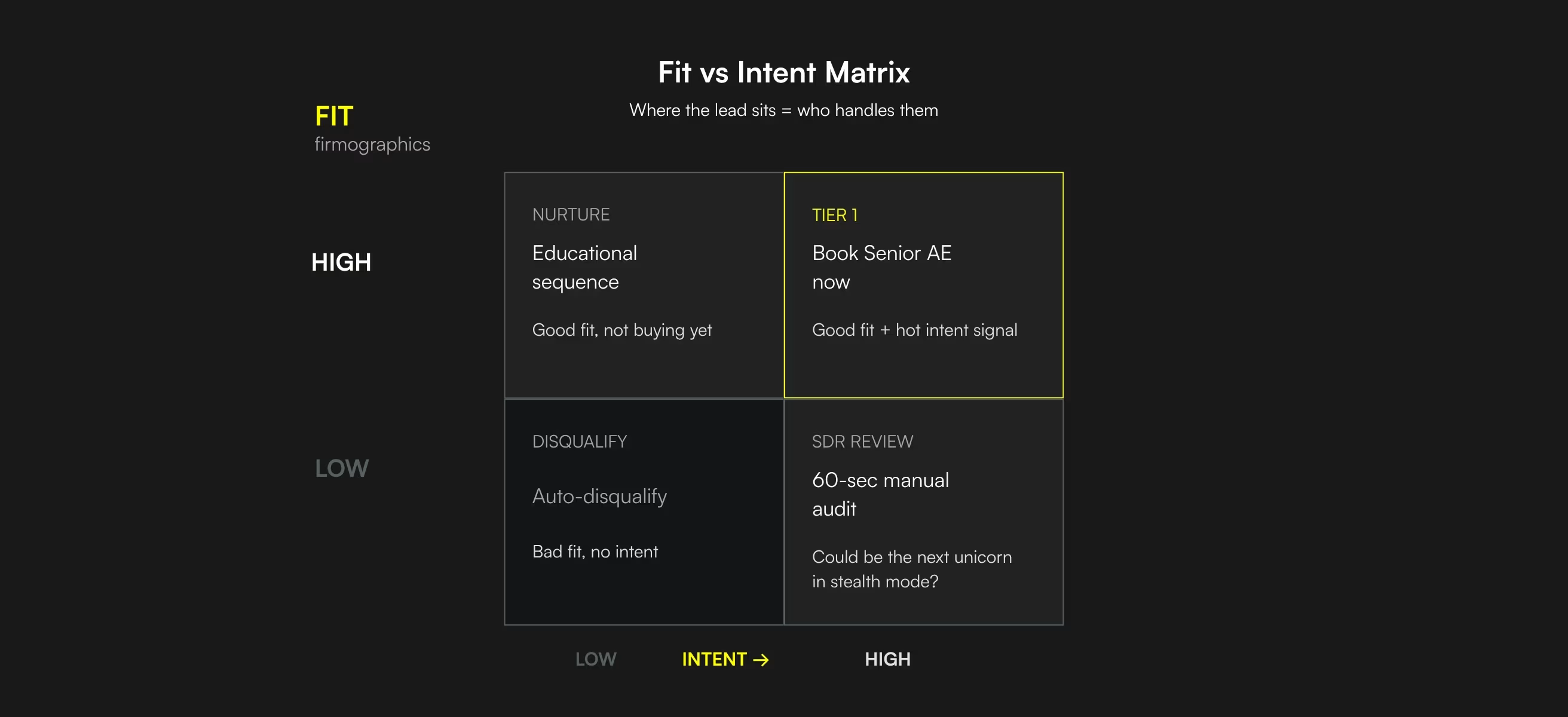
To build a reliable "Bouncer," you need a scorecard. A common mistake is scoring only on "Behavior" (e.g., "They opened an email"). In B2B SaaS, Firmographics (who they are) are often more important than behavior.
1. Firmographic Criteria (The "Fit")
These are static data points that determine if the company can actually afford and use your product.
- Employee Count: This is the best proxy for budget.
- Example: +20 points if >100 employees; -50 points if <10.
- Industry: Some industries have higher churn or lower ACV.
- Example: +30 points for "Fintech/SaaS"; -20 points for "Local Retail."
- Geography: Are they in a region you can legally or logistically serve?
- Example: +10 points for North America/EMEA; -100 points for restricted regions.
- Funding Status: Did they just raise a Series B? This indicates a "Window of Change."
- Example: +50 points for funding in the last 6 months.
2. Technographic & Signal Criteria (The "Context")
This tells you if they have a reason to buy right now.
- Tech Stack: Do they use Salesforce? If your product integrates with Salesforce, that's a massive score booster.
- Example: +40 points for specific tech stack matches.
- Hiring Trends: Are they hiring for roles that would use your software?
- Example: +20 points if hiring for "Account Executives."
- Web Activity: Use tools like Koala or 6sense to track "Intent."
- Example: +15 points for visiting the "Pricing" page more than twice.
3. Negative Scoring: The Silent Hero
Qualification is as much about disqualifying as it is about qualifying.
- Personal Email: -50 points if they use @gmail.com or @yahoo.com.
- Competitor: -200 points if the domain matches a competitor's list.
- Job Seeker: -100 points if they visit the "Careers" page immediately after signing up.
IV. The Business Math of Automated Qualification
Why spend weeks setting this up? Because the math of human labor doesn't scale.
The Lead Efficiency Ratio (LER)
We measure the health of a qualification system using the LER:
- Manual System: Often results in a 10-15% LER because humans are inconsistent and "MQL" definitions are often too loose.
- Automated System: Should aim for an LER > 40%.
The Cost of a "Wasted" Discovery Call
Calculate the true cost of an AE talking to a "bad" lead:

- If your AE earns $150,000/year,
- Their hourly rate (including benefits) is roughly $75/hr.
- If they spend 1 hour prepping and 30 minutes on a call with a startup that can't afford you,
- you just lost $112.50 in direct wages,
- plus potentially $5,000+ in lost pipeline because they weren't calling a Tier 1 account during that time.
V. Step-by-Step Implementation Guide
Setting up an automated qualification system doesn't require a 6-month engineering project. You can build a "V1" in a weekend using the Vanderbuild Stack.
Step 1: Centralize Ingestion
Use Zapier or Make.com to catch every new lead. Whether it's a LinkedIn Lead Gen Form or a Webflow "Get Started" button, send all data to a Clay table.
Step 2: The Enrichment Waterfall
In Clay, use a "Waterfall" of data providers to find the truth. Never trust what a prospect writes in a form.
- Input: Email address.
- Lookup 1: Use FullContact or PeopleDataLabs to find the person's LinkedIn URL and Title.
- Lookup 2: Use the domain to find the company page on LinkedIn.
- Lookup 3: Use Hunter.io or Apollo to verify the email and find the company's headcount.
- Lookup 4: Use BuiltWith to scrape their website for specific technologies.
Step 3: Apply the Logic
Create a "Formula" column in Clay that aggregates the points from Section III.
- If Total_Score > 80, set Status to Tier 1.
- If Total_Score < 30, set Status to Disqualified.
Step 4: CRM Synchronization
Push the data back to your CRM (HubSpot/Salesforce).
- Crucial Tip: Map a field called Qualification_Reason. If a lead is disqualified, the system should write: "Disqualified: Company size < 5 employees." This prevents Sales from wondering why a lead disappeared.
Step 5: The Notification Loop
For Tier 1 leads, don't wait for the AE to check the CRM. Push an automated alert to a Slack channel:
“Tier 1 Lead Detected! John Doe from Acme Corp (500 employees, using Salesforce, just raised $20M). [Link to CRM Record]"
VI. Tiered Delegation: Who Handles What?
The most common failure in "Qualification" is treating it as binary (Yes/No). A modern SaaS requires a Tiered Delegation Model.
Lead Tiering & Routing Matrix
Segmentacja leadów przychodzących na podstawie dopasowania (ICP) oraz intencji zakupowej.
| Tier | Profil (ICP + Intent) | Działanie (Action) | Odpowiedzialność |
|---|---|---|---|
| Tier 1 | Perfect ICP + High Intent | Natychmiastowy booking AE + Alert na Slacku | Senior AE |
| Tier 2 | Good ICP + Low Intent | Wielokanałowy Outbound (LinkedIn/Email) | SDR / BDR |
| Tier 3 | Poor ICP / Low Budget | Automatyczna sekwencja e-mail (Nurture) | Automation / Marketing |
| Tier 4 | Student / Competitor | Cicha dyskwalifikacja / Przeniesienie do folderu "Personal" | Brak |
VII. Advanced Strategies: Signal-Based Qualification
Once your basic firmographic filtering is working, you can move to Signal-Based Qualification. This is where you qualify based on events rather than traits.
1. The "Champion Move" Signal
If a person who was a "Power User" at a previous company starts a new job at a Tier 1 account, they should automatically be a Tier 1 Lead, regardless of their title. They are a "Warm Entry."
2. The "Technology Churn" Signal
If you can detect that a company has recently removed a competitor's script from their website (using tools like BuiltWith), that is a massive intent signal. They are likely looking for a replacement.
3. The "Hiring for Pain" Signal
If a company is hiring for "Head of Customer Churn," and you sell a retention tool, that is a high-intent signal. The system should bump their score by 50 points immediately.
VIII. Data Hygiene: Keeping the Machine Clean
As we discussed in our guide to CRM Data Hygiene, your qualification system is only as good as the data powering it.
- Waterfall Validation: Never rely on a single data provider. Use a "First-Match" logic across Apollo, ZoomInfo, and LinkedIn to ensure the employee count is accurate.
- Quarterly Audit: Every 90 days, look at your "Closed Won" deals. Did they all meet your Tier 1 criteria? If not, your criteria are too strict. If you have many "Closed Lost" deals in Tier 1, your criteria are too loose.
IX. Pros and Cons of Automated Qualification
Pros:
- Speed: Speed-to-lead is the #1 predictor of conversion. Automation reduces this from hours to milliseconds.
- Consistency: A computer never gets tired, bored, or biased. It applies the same logic at 2 AM as it does at 2 PM.
- Cost-Effectiveness: You can process 10,000 leads with a $500/mo software stack that would otherwise require three $60k/yr SDRs.
Cons:
- "False Negatives": Occasionally, a great lead will have a messy digital footprint and get disqualified.
- Fix: Always have a "Review" bucket for leads that have a high title but "Unknown" company data.
- Technical Debt: If your Clay/Zapier logic is too complex, it can be hard for a new RevOps hire to manage.
- Fix: Document every logic branch in a tool like Lucidchart or Miro.
X. The PQL Frontier: Product-Qualified Leads in the Automation Loop
For B2B SaaS companies with a "Freemium" or "Free Trial" model, traditional lead qualification isn't enough. You need to integrate Product-Qualified Leads (PQLs). A PQL is someone who has already derived value from your product, making them significantly more likely to convert than someone who just read a whitepaper.
Integrating Product Data into the Logic Engine:
- Activation Signals: Did the user complete the "Onboarding Checklist"? (+30 points).
- Usage Frequency: Has the user logged in 3+ times in the first 48 hours? (+25 points).
- Viral Loops: Did the user invite a teammate? (+50 points).
By connecting your product database (via Segment or Census) to your Clay qualification engine, you can trigger an AE reach-out the moment a user hits the "Aha! Moment." This is the pinnacle of "Contextual Selling."
XI. AI-Agent Pre-Qualification: The "Interrogator" Layer
In 2026, the "Static Form" is dying. The next evolution of automated qualification is the AI Sales Agent. Instead of a 10-field form (which kills conversion), you use a 1-field form (Email) followed by an interactive, AI-driven chat or voice experience.
The AI-Agent Framework:
- Initial Capture: User provides an email.
- Instant Enrichment: The system identifies them as a Tier 1 prospect.
- The Conversational Qualification: Instead of a generic "Thanks," an AI agent appears: "Hi [Name], I see you’re at [Company]. Most teams your size struggle with [Problem]. Is that why you’re looking at us today?"
- Sentiment Scoring: The AI analyzes the response. If the prospect mentions a specific "High-Intent" keyword (e.g., "Replacing Competitor X"), the system skips the SDR and books them directly with a Senior AE.
XII. The Feedback Loop: The "Sales-to-Ops" Delta Analysis
An automated system is never "finished." It requires a constant Feedback Loop between the people closing the deals (Sales) and the people building the system (RevOps).
The "Disqualification Audit" (Monthly):
Every month, the RevOps lead should sit with the Top 3 AEs and review the "Tier 1 Disqualified" list.
- The Goal: Find the "False Negatives." Did we disqualify a huge company because our data provider missed their funding round?
- The Adjustment: Update the "Waterfall" logic. If Provider A misses a data point, move to Provider B.
Conversely, review the "Tier 1 No-Shows." If an AE is getting meetings with people who "don't have the problem," your Technographic Scoring (the "Action" signals) needs to be tightened.
XIII. Automated Scheduling & The "Buffer" Strategy
Qualification is useless if the prospect drops off during the scheduling phase. A truly automated system removes the "Calendar Friction."
The "Fast-Pass" Workflow:
- Tier 1 Lead: The moment they hit "Submit," the page redirects to a Calendly/Chili Piper view of the AE's calendar.
- The "Round Robin" Logic: Use a weight-based distribution. Your "Alpha" AEs (highest close rate) should receive a higher percentage of Tier 1 leads automatically.
- The Buffer Rule: Never allow a Tier 1 lead to book more than 48 hours out. If your AEs are fully booked, the system should "overflow" the lead to a qualified SDR to ensure the lead doesn't go cold.
XIV. Handling Edge Cases: The "Stealth Mode" & "High-Value Maverick"
Data enrichment isn't perfect. Some of your most valuable leads will come from "Stealth Mode" startups or people using their personal emails (the "High-Value Maverick").
How to Automate the "Unknowns":
Create a "Human Intervention" Trigger for leads where:
- Title = CEO / Founder / VP.
- Company Name = "Stealth" or "Confidential."
- Score = Unknown.
Instead of disqualifying these, the system should route them to an SDR for a "60-Second Manual Audit." This ensures you don't miss the next unicorn just because they haven't updated their LinkedIn page yet.
XV. Global Scaling: Multi-Region & Timezone Logic
As your SaaS scales globally, your automated system must become "geographically aware."
Regional Routing Logic:
- Language-Based Routing: If the prospect is in the DACH region (Germany, Austria, Switzerland), route them to a German-speaking AE, even if they signed up on the English site.
- Compliance Automation: Ensure that leads from the EU are processed through a GDPR-compliant enrichment waterfall (e.g., using European data providers like Cognism instead of just US-centric ones).
- Currency Normalization: If you score based on "Revenue," ensure your logic handles the conversion between $USD, €EUR, and £GBP automatically.
XVI. Reporting & Dashboarding for RevOps
To prove the ROI of your "Bouncer," you need a specific set of dashboards. Don't just track "Total Leads." Track Pipeline Velocity.
The "Bouncer" Dashboard Metrics:
- Enrichment Match Rate: % of leads where we successfully found headcount/funding. (Aim for >90%).
- Tier Distribution: What % of our total lead flow is Tier 1? (If it's <5%, your marketing is too broad).
- Automation Bypass Rate: How often is a human overriding the system? (If high, your scoring logic is flawed).
- Lead-to-Meeting Rate per Tier: Tier 1 should be >60%; Tier 3 should be <5%.
XVII. The Technical "Security" Layer
Automated systems often move a lot of PII (Personally Identifiable Information) between tools (Typeform → Zapier → Clay → HubSpot).
- Data Minimization: Only enrich what you need for qualification. Don't scrape a prospect's home address if you only need their LinkedIn URL.
- Encryption at Rest: Ensure every tool in your "Stack" is SOC2 compliant.
- The "Right to be Forgotten" Automation: If a lead requests to be deleted, your system should trigger a "Wipe" command across your CRM and your enrichment tables in Clay simultaneously.
XVIII. Conclusion: The Perpetual Growth Engine
Automated lead qualification is not a "Set and Forget" project. It is a living, breathing Competitive Advantage. In an era where AI-driven outbound is flooding every inbox, the companies that win will be those that can respond to the right signals with the right person at the right time, every single time.
By removing the "Manual Drag" from your sales cycle, you empower your humans to be human and your machines to be efficient.
The result isn't just more leads; it’s a more profitable, predictable, and scalable business.
FAQ
Is automated qualification too impersonal?
No. Automation happens on the backend. To the prospect, the experience is actually better because they receive a highly relevant response from a human expert almost immediately, rather than a generic "Thanks for signing up" email 24 hours later.
What if my ICP is hard to define?
Start broad. Filter for the "Must-Haves" (e.g., Geography and Company Size). As you gather more data on which leads convert, you can tighten your filters.
Which tool should I use if I'm on a budget?
You can build a basic version using Apollo.io's built-in scoring and Zapier. However, if you want the "Scalability Blueprint," Clay is the undisputed gold standard for B2B SaaS.
How do I handle "Group" or "General" emails?
Your system should treat info@company.com differently. Use an enrichment tool to find the "Most Likely Contact" at that company and route the lead based on that person's profile, rather than the generic email.
Can I qualify based on "Dark Social"?
Yes. If you use a tool like Koala, you can see which accounts are browsing your site without identifying themselves. Your "Qualification Engine" can then reach out to the "Best Fit" person at that account via LinkedIn, this is the ultimate "Pre-emptive Qualification."