.webp)
Stop waiting for inbound. Master outbound lead gen to take control of your pipeline. Discover the math, strategies, tools, and B2B systems for 2026 growth.
If you are waiting for your "Inbound Machine" to fix your revenue gap, you are gambling with your company's survival. In B2B SaaS, relying solely on organic traffic is a "hope-based" strategy. Most founders realize too late that inbound lead generation has a ceiling. When you hit that ceiling, your growth stalls.
That does not mean inbound or outbound are better than one another. Depending on your growth stage, the focus on each channel shifts. The fact is: if you are not doing outbound, you are limiting your targeting and leaving it to algorithms.
Outbound lead generation is the only way to take full control of your sales pipeline. It is the proactive hunt for your Ideal Customer Profile (ICP). Instead of waiting for a lead to find you, you use data, psychology, and high-frequency activity to create a conversation where none existed.
In this article, you will learn:
- The fundamental difference between inbound and outbound sales
- Why traditional outbound is dying - and what replaced it
- Which strategy fits your company's current stage
- A step-by-step B2B lead generation process for outbound teams
- How to build a signal-based, omnichannel outreach sequence
- The full tool stack shaping outbound in 2026
- Email deliverability: the technical foundation most teams skip
- When to consider outsourced lead generation vs. building in-house
- The business math behind an outbound sales funnel
- What's coming next in outbound through 2026 and beyond
What is Outbound Lead Generation? Meaning and Context
To understand B2B lead generation, look at your calendar. If it's empty, you aren't doing enough outbound.
In its simplest form: outbound lead generation is a system where you define who you want to sell to and use outbound strategies to get a "Yes" to a meeting. Unlike inbound lead gen, where the prospect defines the timing, in outbound you define both the timing and the target.
.png)
This is a fundamental shift in power. It is why outbound is the backbone of Enterprise scaling.
Why Traditional Outbound No Longer Works?
Before you build anything, understand why most outbound fails today.
Response rates for generic bulk emails dropped from 2-3% in 2015 to 0.1-0.5% in 2023. Buyers have grown immune to templates. They immediately recognize AI-generated intros and delete them. Gmail's spam filters can now predict whether an email is relevant before the recipient reads it.
Four things are killing traditional outbound:
- Spam filters: Gmail's AI evaluates sender reputation, domain age, and message relevance before delivery. Generic sequences don't make it through.
- Buyer sophistication: Decision-makers receive hundreds of cold emails weekly. They recognize templates in the first two words.
- Data regulations: GDPR, CCPA, and similar laws limit how companies collect and use contact data. Purchased list blasting is a legal liability.
- Market saturation: Every niche has been blasted. Authentic, signal-driven outreach is the only thing that breaks through.
The teams winning at outbound in 2026 are not sending more emails. They are sending better ones, to a more precise list, at the exact right moment.
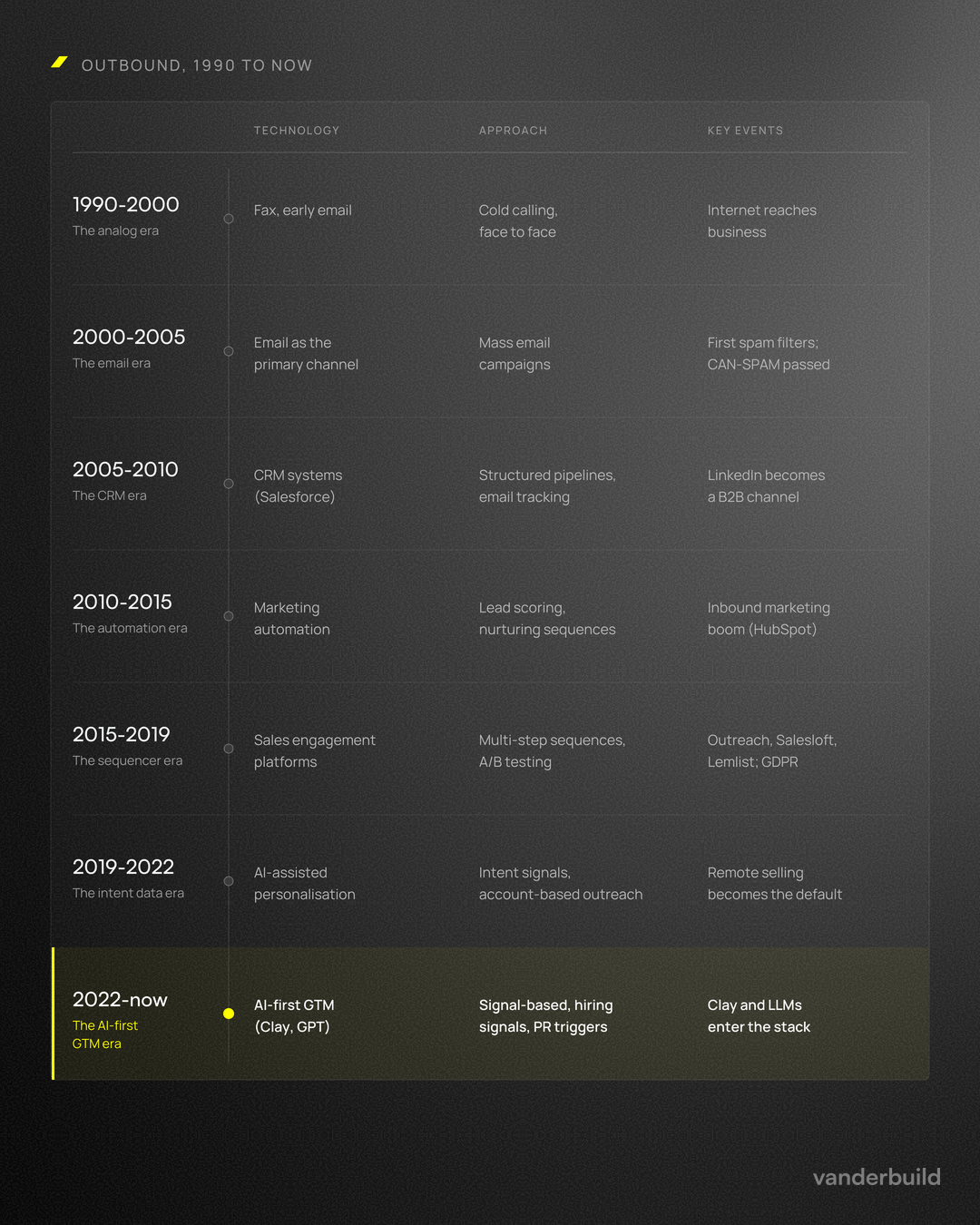
The shift is clear: from volume to precision. The teams that haven't made this transition yet are the ones asking why their open rates dropped.
Inbound vs. Outbound: The Revenue Battle
The difference between inbound and outbound is often framed as a choice. This is a mistake. High-growth startups need inbound and outbound to work in tandem. Understanding the difference is critical for resource allocation.
Lead generation
Inbound and outbound answer different questions
| Compare on | Inbound They find you | Outbound You find them |
|---|---|---|
| Who starts | They arrive having already framed the problem in their own words. | You arrive before they are looking, so the first message has to do the framing. |
| Time to a signal | Months. Content and rankings compound slowly, and early silence tells you nothing. | Two weeks. A hundred sends is enough to know whether the segment replies. |
| Who you reach | Whoever searches the term, including students, competitors and people you cannot sell to. | The accounts you picked. If the list is wrong, the campaign is wrong. |
| What it costs | Front-loaded. You pay before anything ranks, then cost per lead falls as the library grows. | Ongoing. Cost tracks headcount, data and inbox infrastructure, and stops when you do. |
| Sales cycle | Shorter. They came with a problem and a budget line already in mind. | Longer. You raise the problem first and the budget conversation comes later. |
| What breaks it | An algorithm change you did not choose and cannot appeal. | A list nobody refreshes and a domain nobody warms. |
| How it scales | Slowly, then quickly, and only if the content keeps its position. | In a straight line with budget and headcount. Twice the output needs close to twice the input. |
Outbound tells you within a month whether a segment replies. Inbound tells you within a year whether the market searches for you. Most teams need both eventually, and most start with the faster answer because it is the one that survives a quarterly review.
Inbound leads are "warm" but often smaller. Outbound leads are defined by "fit" over "intent." You are calling the CEO of a company because they should use your product, even if they aren't looking for it yet.
Which strategy fits your stage right now?
The answer depends on where the company is, not on which channel sounds more appealing.
Run outbound first.
You need revenue and an answer from the market, and organic traffic takes a year or more to compound. Cold email and LinkedIn test the ICP hypothesis in weeks. The first ten clients should come from outbound, because they also tell you who the next hundred are.
An IT freelancer messages potential clients on LinkedIn to land the first projects before spending anything on content.
Stay on outbound.
If the addressable market is 500 companies, SEO is competing for search volume that does not exist. You can reach all 500 by name inside a month, which is the whole argument. What you need is a precise list and a sequence built on one specific trigger.
A logistics software company contacts firms that invested in IT infrastructure in the last twelve months.
Layer inbound on top.
Content and search make the company name familiar before the message arrives. The same email reads differently when the recipient has seen the name that week, and the rep spends the first line on the point rather than on who you are.
A software house publishes case studies and guides that reach prospects before the outbound sequence does.
Outbound turns account-based.
Inbound carries the volume. Outbound carries the handful of accounts worth a named plan, the ones that will never arrive through a search box. Both run, and the content gives the account-based work something to point at.
A global technology company invests in educational content while reps run named-account sequences for strategic targets.
The B2B Lead Generation Process: A 5-Step System
To move beyond "random acts of prospecting," you need a repeatable system. Whether you run this in-house or through an outbound agency, the process is the same:
Step 1 - ICP and List Building
Use B2B data tools (Clay, Apollo, ZoomInfo) to build a verified, signal-enriched list. The list is the campaign. A bad list makes every other step irrelevant.
Step 2 - Outbound Lead Qualification
Before reaching out, confirm the lead is actually a fit. Don't waste your outbound strategy on accounts that can't afford you or are mid-contract with a competitor.
Step 3 - Multi-Channel Outreach
Combine cold email with LinkedIn and cold calling. Single-channel outreach is declining in effectiveness. The most successful campaigns use coordinated timing across all three.
Step 4 - Value-Based Pitch
Move away from "Do you have 15 minutes?" toward "I found a gap in your [X] and I have a fix." The Sales Development Representative (SDR) running this sequence is not a telemarketer - they are a strategic advisor opening a specific door for a specific reason.
Step 5 - Appointment Setting
The goal is a booked discovery call with a qualified prospect. Everything else is noise.
Omnichannel Sequence: The Day-by-Day Framework
Most teams know they should be multichannel. Few know how to orchestrate it. Here is a proven day-by-day sequence:
Multichannel cadence
Seven touches across fourteen days
| Day | Channel | What you do |
|---|---|---|
| Day 1 | Connection request with no note attached. | |
| Day 2 | Cold email built on one trigger you can name out loud. | |
| Day 4 | Phone | Call. Reference the email in the first sentence, then ask one question. |
| Day 6 | Reply to something they posted, or send one short message. | |
| Day 8 | Second email on a new angle. A reminder of the first one is not a second touch. | |
| Day 11 | Phone | Second call, at a different time of day than the first. |
| Day 14 | Last email. Say that it is the last one and what happens to the account now. |
The two calls are marked because they are the first steps to get cut when the week fills up. Drop them and this is an email sequence with two LinkedIn touches attached. Every step also exits on reply: if the cadence keeps running after someone answers, the next message tells them nobody read it.
The reason this works: you are not just "following up." You are appearing across different surfaces at different moments, each time with a slightly different context. By the 5th touch, you are familiar. By the 8th, you are memorable. Our data shows that 70% of meetings happen between the 5th and 8th touchpoint. Yet, most teams give up after only two.
Because outbound involves so many touches, "last-click" attribution will mislead you. You need multi-touch attribution to understand the full picture - the LinkedIn ad that warmed them up, the email that sparked curiosity, and the call that booked the meeting are all part of the same conversion. Track all of them.
Signal-Based Prospecting: Reach the Right Company at the Right Moment
The "Trigger Event" strategy is not just one idea among many. It is the core logic of modern outbound.
Instead of targeting companies randomly, you identify "buying signals" - events that indicate a company may be ready to purchase right now:
- New funding round: The company just raised money. They are buying.
- Hiring in sales or marketing: They are scaling a go-to-market function. They need tools.
- Leadership changes: A new VP of Sales is re-evaluating the entire stack in their first 90 days.
- Product launches: They are entering a new market. New challenges, new vendors.
- Expansion into new geographies: Growth creates operational complexity they may not have solved yet.
- Compliance events: A company that failed a recent audit needs a solution - urgently.
A company that just raised a Series B and is hiring 5 SDRs is obviously ready to invest in sales infrastructure. Reaching out to them in week 3 of their hiring push is fundamentally different from cold-calling a stable company with no active growth signal.
Signal-based prospecting is what separates a reply rate of 2.5% from 0.2%.
You can read more about how to build campaigns around buying signals here.
Outbound Sales Strategy: Scaling Your Pipeline
Three proven strategies for 2026:
The Trigger Event Strategy: Reach out when a company raises funding, hires a new VP, or switches their tech stack. Timing is the multiplier.
The Video-First Approach: Send a personalized 60-second video audit. An SDR who records a screen-share showing exactly where a prospect's website is losing conversions is impossible to ignore. This is one of the highest-performing cold outreach formats today.
Account-Based Outreach: Treat a single company as a market of one. Map out 5-10 stakeholders and reach out to all of them with a unified narrative. Different angles, same message. When the VP of Sales, the CFO, and the Head of Marketing all hear from you in the same week, you become hard to dismiss.
Stage is one variable. Fit is another, and it sits further upstream. Before you pick a motion, it is worth checking whether outbound suits your business at all: how much explaining your offer needs, how many companies are realistically in your market, and how much trust the purchase requires. Those three answers decide the shape of the campaign more than your stage does. We wrote up the criteria in how to know if outbound will actually work for your company.
The Tool Stack: What Powers Modern Outbound
Technology is not optional. These are the tools shaping outbound in 2026:
Outbound Tool Stack
Six categories that cover a full B2B outbound motion — from data to delivery.
| Category | Tools | What They Do |
|---|---|---|
| Data Enrichment | Enrich contacts with firmographic, technographic, and intent data | |
| Email Sending | Automated email sequences with deliverability management | |
| LinkedIn Outreach | Scalable LinkedIn connection and message campaigns | |
| Signal Detection | Identify buying intent signals before outreach | |
| CRM | Pipeline management and attribution tracking | |
| Video Outreach | Personalized video prospecting at scale |
 Clay
Clay
 Apollo
 ZoomInfo
 Clearbit
 Smartlead
 Woodpecker
 HeyReach
 Dripify
 Bombora
 G2
G2
 Demandbase
 HubSpot
 Salesforce
 Pipedrive
 Loom
Loom
 Sendspark
Clay sits at the center of the modern outbound stack. It pulls data from dozens of sources, runs AI-powered research on each prospect, and feeds enriched, personalized output directly into your sending tools. The teams that have mastered Clay are running campaigns that would have taken a 10-person research team two years ago.
Email Deliverability: The Foundation Most Teams Skip
None of the personalization, signal detection, or omnichannel orchestration matters if your emails land in spam. Deliverability is not a technical afterthought - it is the prerequisite.
The metrics that matter:
- Inbox placement rate: What percentage of emails land in inbox vs. spam or promotions?
- Domain reputation: How does Gmail and Outlook view your sending domain?
- Bounce rate: Invalid addresses that damage your sender score. Keep this below 3%.
- Spam complaint rate: Recipients marking emails as spam. Anything above 0.1% is a red flag.
The rules for 2026:
- Warm up new email domains for 4-6 weeks before any campaign volume
- Never send from your main company domain - use dedicated sending domains
- Cap at 30-50 emails per inbox per day, maximum
- Remove inactive contacts continuously - a clean list outperforms a large one
- A/B test subject lines and preview text every single campaign
- Monitor domain reputation weekly via Google Postmaster Tools
If you are seeing open rates below 40%, the problem is deliverability - not copy.
Outsourcing Lead Generation: agency vs. in-house
Many founders ask: should I outsource lead generation? The answer depends on your stage of traction.
Outsourced B2B lead generation works when you already know your ICP and your pitch is validated. An outbound agency provides the infrastructure - dialers, email servers, enriched data, deliverability systems - ready on day one. At Vanderbuild, our Plug & Play service is designed exactly for this: fast validation and fast pipeline, without the 6-month ramp of building an internal team.
Outbound agency or an in-house SDR team
Eleven dimensions that decide it in practice: speed, cost, product depth, risk, and the stage the company is at.
Before product-market fit, or with a narrow market, an agency is faster and carries less risk. You launch in 2 to 4 weeks rather than 3 to 6 months and get an answer on the ICP in about 60 days. In-house wins once the playbook is proven, the product needs a technical answer in the first call, and the volume justifies three or more full-time people.
| Dimension | Agency | In-house |
|---|---|---|
| Time to first email | 2 to 4 weeks, covering brief, list, infrastructure and first send. | 3 to 6 months, covering recruitment, onboarding and ramp. |
| Monthly cost, all in | $3,000 to $10,000 retainer, with tools, copy and sending infrastructure inside it. | $8,000 to $15,000 per person, once salary, benefits, tools and management time are counted. |
| Speed of ICP validation | About 60 days. Several sequences run against several segments at once. | Six months or more. One person runs one campaign at a time. |
| Product depth | A briefing loop. Technical questions come back to you before they get an answer. | Sits next to the engineers and answers the technical question inside the same call. |
| Sending infrastructure | Inside the retainer: domains, warmup, deliverability monitoring, the sending stack. | Bought separately. $800 to $2,000 a month in tools, plus weeks of setup. |
| Turnover risk | Carried by the agency, along with recruitment and ramp. | Yours. Average SDR tenure across the industry is about 15 months. |
| Pattern recognition | Dozens of campaigns across comparable segments, so a dead angle is recognised early. | One company's view. Patterns take years to accumulate. |
| Cost at volume | Past a certain volume you are renting capacity you could own outright. | Unit cost falls once the ramp is paid for and the playbook is settled. |
| Adding capacity | Days. The ceiling is sending infrastructure, not the number of people. | 60 to 90 days for each new person to reach full output. |
| Where knowledge sits | In playbooks and written procedures, so it survives a change of team. | In the person. It leaves the building when they do, unless someone writes it down. |
| Best fit | Before product-market fit, a narrow market, several segments to test, the first twenty clients. | After product-market fit, a settled playbook, a wide market of a thousand qualified accounts or more. |
Cost ranges are indicative for US and EU markets and are not drawn from a single survey. SDR tenure comes from industry reporting by The Bridge Group and RepVue.
The model that most SaaS companies use: outsource the top of funnel (meeting setting) and keep closing in-house with your Account Executives.
If you are still figuring out your message, hire an in-house SDR who can sit next to you and feed you market feedback in real time. Outsource once you have something to scale.
The Business Math of Outbound Lead Generation
In B2B lead generation, you must live by the numbers. If you don't track your outbound funnel, you are spending money, not investing it.
Benchmarks to hit:
- Meeting show-up rate: 80%+
- LTV:CAC ratio: Target 3:1 minimum
The math in practice: If you send 1,000 targeted emails per month with a 2% reply rate, you get 20 positive replies. If 60% of those convert to a booked meeting, that's 12 discovery calls. At a 30% close rate, 3-4 new clients per month. Now reverse-engineer from your revenue target.
The cost per meeting from an outbound service will often be higher than inbound. But the average contract value of an Enterprise deal booked through outbound consistently offsets this. You are not optimizing for cost per lead - you are optimizing for revenue per meeting.
How Vanderbuild Actually Runs These Plays?
Theory is cheap. The harder question is what happens when you push these principles through a live B2B campaign with real money on the line. Three campaigns from the last 12 months, each solving a different problem with the same outbound machine.
AI Hero: Segmentation Beats Volume
AI Hero sells AI implementation to large Polish enterprises (200+ employees). The problem wasn't market interest. AI is the trend everyone wants in on. The problem was reaching the right person inside a 1000-person company - the one who actually feels the pain.
Most competitors send one generic "We do AI training" message to every IT director on a list. We did the opposite. We split the database into four hermetic segments: HR, IT, Sales, and General Management. Each segment got a completely different angle.
- HR: "We take training off your calendar."
- IT: "We reduce the basic AI helpdesk tickets your team gets buried under."
- Sales: "More selling, less reporting."
The final email of every sequence wasn't a pitch. It was a "break-up" message asking for the reason behind the silence. People correct false assumptions more easily than they accept cold offers.
The results: 20.6% reply rate across all segments. 32% hot lead rate in the HR group alone. The clearest insight: HR, not IT, is the real gateway to enterprise AI implementation. Full case study →
CXLabs: Outbound as Product-Market Fit Validation
CXLabs had built three monday.com-based products for three different verticals: e-commerce, marketing agencies, and CRM use cases. They had zero data on which one would actually sell. Two options: spend six months building marketing assets for all three, or use outbound to test real demand in three weeks.
We ran six campaign variants across the three verticals. 12 mailboxes across 4 domains. Delivery rate held between 97.9% and 100%. Every reply was tagged: interested, objection, wrong person, not now. Weekly reports showed which hypotheses were generating signal and which ones to cut.
After three weeks, the data was unambiguous. The marketing/FMCG segment delivered three of four qualified opportunities. E-commerce needed messaging iteration. CRM showed the weakest signal of the three.
CXLabs walked away with 4 qualified opportunities, a clear winning vertical, and - just as valuable - data on where NOT to invest. Full case study →
Valueships: Outbound as a CRM Reheating Engine
Most CRMs are graveyards. Hundreds of leads who said "not now" 12 months ago and were never touched again. The standard playbook says: archive them, hunt new ones. We disagree.
Valueships - a European pricing consultancy - had exactly this problem. An active Pipedrive full of dormant relationships. The question: do these contacts still hold real business potential, or is the database actually dead?
We treated outbound as a diagnostic tool. We pulled deal histories into Clay, expanded each deal to include all participants (which added ~30% more contacts), and verified each person's current status. New company? Promotion? Same role? Each variable shaped a different message.
Then we layered cold email and LinkedIn follow-up, anchoring every message in the previous conversation context.
The numbers: 92% deliverability. 89.1% open rate. 43.5% email reply rate. 60% LinkedIn reply rate. Out of 50 reactivated contacts, 41.3% responded. The CRM wasn't dead. It was just under-used. Full case study →
The pattern across all three campaigns is the same. Outbound works as a flexible system, not a single tactic. You can point it at a fresh market, at different buyer roles inside one company, or at dormant pipeline. The variables change. The discipline doesn't: hypothesis-driven setup, real segmentation, and respect for the recipient's context.
Common Mistakes in Outbound Lead Generation
Mistake 1 - The "I-I-Me-Me" Pitch
Stop talking about your features. Talk about their problems. Every outbound email that opens with "We are a leading provider of..." is deleted before the second sentence.
Mistake 2 - Bad Data
If 20% of your emails bounce, your list is the problem - not your copy. List hygiene is the foundation. Verify every contact before it enters your sequence.
Mistake 3 - Stopping Too Early
70% of outbound meetings are generated between the 5th and 8th touchpoint. Most teams stop after the 2nd. The follow-up sequence is where the pipeline lives.
Mistake 4 - Single-Channel Dependency:
Email only, or LinkedIn only, shows declining results every year. Coordinated multichannel sequences outperform single-channel by a significant margin.
Mistake 5 - Ignoring Deliverability
Running a perfectly crafted campaign from a domain with a damaged reputation is like building a high-performance car and forgetting the engine. Fix the infrastructure before worrying about the copy.
What's Coming: Outbound Predictions for 2026 and Beyond
The gap between teams doing outbound well and teams doing it poorly is widening. Here is where the frontier is moving:
1. AI Agents for Full Campaign Automation
Early prototypes already exist. By end of 2026, AI agents will autonomously research prospects, draft personalized messages, and optimize sequences based on real-time reply data - with minimal human oversight. The human role shifts from execution to strategy.
2. Voice and Video Personalization at Scale
AI-generated personalized video messages and voice notes are emerging. Tools that create 1,000 "personal" video intros using AI will see mainstream adoption in high-value Enterprise prospecting.
3. Predictive Intent at Granular Level
Intent data is becoming more specific. Instead of "this company visited your website," you will know "this specific decision-maker researched your solution category on three separate occasions this week." The signal-to-noise ratio improves dramatically.
4. Cross-Channel Identity Resolution
Connecting LinkedIn behavior, email engagement, web visits, and offline event interactions into unified buyer profiles will enable truly coordinated multichannel sequences with no gaps or redundancies.
5. Compliance-First Outbound
As GDPR, CCPA, and equivalent regulations tighten globally, the tools and workflows that make compliance automatic and audit-ready will become competitive advantages. The teams that built compliant infrastructure early will scale without friction.
Conclusion
Outbound lead generation is not a "necessary evil" - it is a competitive advantage. While your competitors are waiting for the perfect inbound marketing flow to materialize, you can be actively booking meetings with their dream customers.
Whether you build an in-house SDR team or outsource to an outbound agency, the goal is identical: predictable, scalable revenue. The tools, the signals, and the frameworks all exist. What separates the teams hitting targets from the ones stalling is execution discipline and willingness to iterate.
Stop asking what an outbound lead is. Start asking how many you are going to generate this month.
FAQ
Is outbound lead generation still effective in 2026?
Yes - more than ever. AI-driven inbound has flooded the market with low-quality content. A personalized, signal-triggered outbound sequence stands out precisely because the baseline has gotten so noisy.
How long does it take to see results from outsourced lead generation?
Typically, 30 days for setup (infrastructure, scripts, list building) and another 30-60 days to see a consistent flow of Sales Qualified Leads. Plan for 90 days before drawing conclusions about performance.
Does outbound work for B2C?
Outbound lead generation in this guide refers specifically to B2B. In B2C, cold calling is heavily regulated and significantly less cost-effective than high-scale social advertising or SEO.
What is the difference between inbound and outbound leads in terms of cost?
Inbound leads often have a lower cost per lead. Outbound leads typically have a higher average contract value. You pay more per outbound lead, but the LTV usually justifies the difference - particularly for Enterprise accounts.
Should I use an outbound lead generation agency or hire an SDR?
If you have a validated message and a clear ICP, an agency scales it faster. If you are still finding product-market fit, hire an in-house SDR who can give you real-time market feedback from every call.
What tools do I actually need to start?
Minimum viable outbound stack: Clay or Apollo for data enrichment, Instantly or Smartlead for email sending, and HeyReach for LinkedIn. Add Bombora or G2 for intent data once you are ready to layer on signal-based prospecting.