.webp)
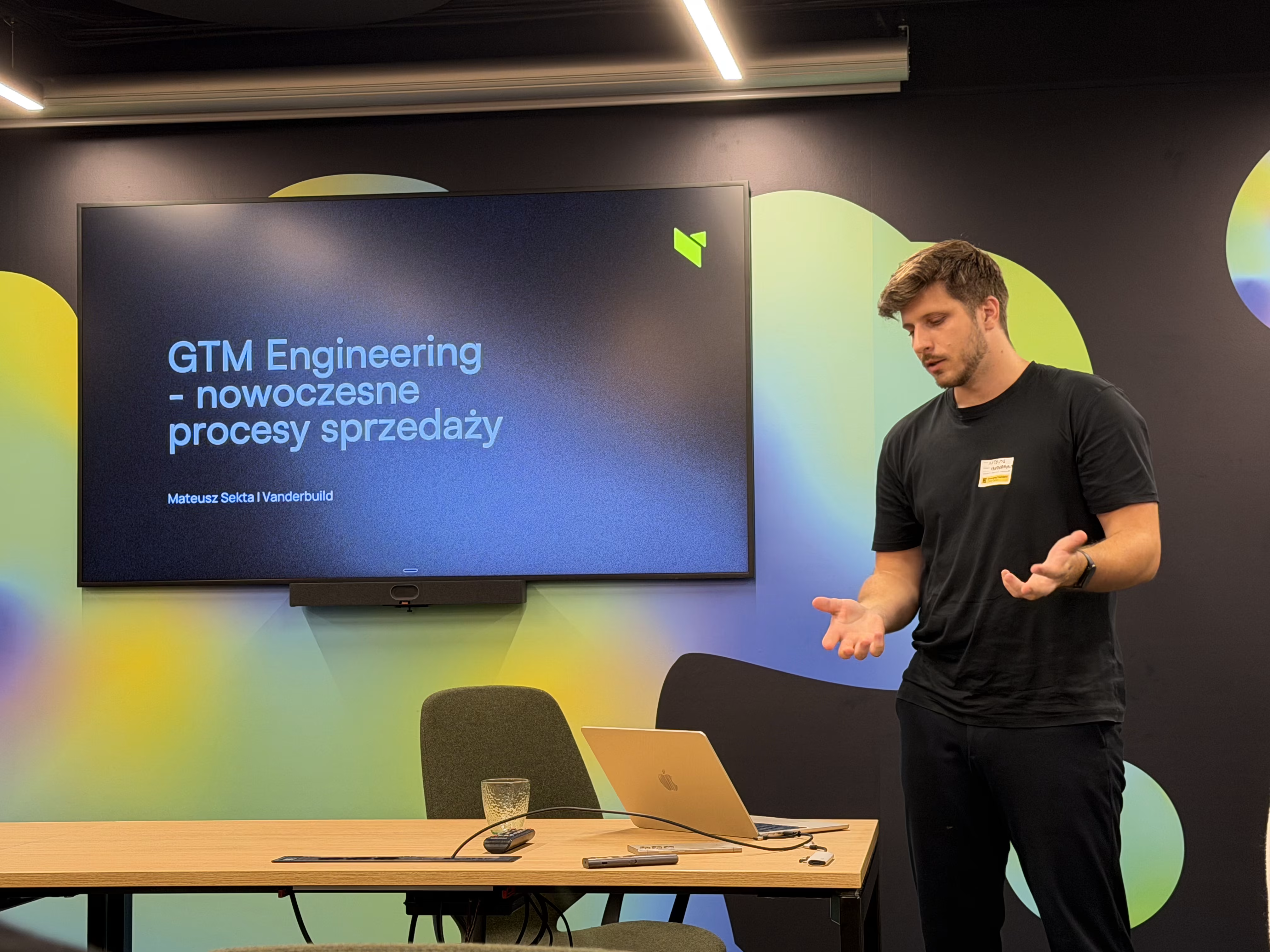
On 29 June I took the stage at Emerging Founders: GTM All Stars in Wrocław for a keynote on GTM engineering. The audience scored it 8.8 out of 10 and voted it the #3 talk of the day. Here's the full argument, for anyone who missed it.
The event ran Monday, 29 June 2026, from 9:00 to 16:00 at Ace of Space, Renoma. Emerging Founders, the CEE founder network behind it, built the day around a strict format: ten speakers, ten real case studies, each with twenty minutes to break one case down to first principles, from challenge to strategy to solution to tools. Deliberately an event about strategy, not tools. I shared the stage with Margaret Sikora (Woodpecker.co), Maciej Szott (GoToSmith), Yurii Veremchuk (YGTM), Krzysztof Szyszkiewicz (Valueships), Paweł Kobusiński (GetSales), Damian Goral (dealme), Piotr Zaniewicz (Meaningful Sales), Krzysztof Pawlak (WAYVE) and Wiktor Sobolak, with the whole thing pulled together by Jacek Ratajczak.

A market that changed faster in three years than in the previous twenty
I opened with a claim that set the tone for the room. The sales and marketing landscape has shifted more in the last three years than in the two decades before it. And I backed it with numbers rather than adjectives.
Between 2018 and 2026, the volume of available B2B contact data grew roughly eighteenfold, from around 50 million verified profiles to over 500 million. The number of tools in the martech and salestech stack multiplied 2.5 times, from a few thousand to more than 15,000. For the same $50 a month, a team that could reach around 225 verified contacts in 2018 can now reach nearly 5,000. The cost of acquiring a single verified B2B email dropped eight times, from ten cents to under two.
Then comes the twist. More data, cheaper than ever, has not made outbound easier. It has made it harder. We call it the data paradox: as the quantity of data rises and its cost falls, the difficulty of connecting that data into something useful goes up, not down. The market is saturated, and everyone has access to the same raw material.

The role that didn't exist five years ago
That saturation is exactly why a new function has appeared inside high-performing revenue teams: the GTM engineer.
The definition is plain. A GTM engineer is the person who can connect data, analyze it, and activate it automatically, at scale, while understanding the business context behind it. The role sits at the intersection of sales, marketing and IT, a place that used to be a gap on the org chart and is now a hire every serious B2B company is chasing.
The timing is not accidental. Three forces converged. AI and agentic tools can now move data between systems in ways that were impractical two years ago. There is a shortage of people who can bridge sales, marketing and technology. And founders are looking for ways to grow without simply adding headcount. The tooling budget tells the same story: monthly spend on tools per person climbed from $380 in 2019 to $1,670 in 2026, with stacks growing from roughly six tools to eleven.
From mass outbound to signal-based selling
The core of the talk was a shift I framed as a generational change in how outbound works.
Outbound 1.0 was mass selling built on target groups. Cheap, easy to access, low barrier to entry, and now brutally saturated. Everyone runs the same playbook, so it is hard to stand out, and conversion sits around 1 to 1.5 percent.
Outbound 2.0 is signal-based, built on buying readiness rather than a static list. The data is curated and harder to reach. It costs more, because it demands investment in tools and in the skill to use them. But the barrier to entry that makes it expensive is exactly what keeps it uncrowded: fewer people run it, precision is higher, and conversion lands in the 5 to 7 percent range.
Underpinning the whole approach is what I believe is the most important rule of the B2B market. At any given moment, only 5 to 10 percent of your market is ready to buy. The other 90 to 95 percent are not, which means the job of marketing and sales is to stay on the radar of target customers consistently and repeatably, educating the market until readiness appears.
.avif)
Watching the market, then acting on it
From there I walked the audience through what signal-based selling looks like in practice. It starts with observation across three levels: the industry, the company, and the individual. Macro events, competitor moves and regulatory change at the industry level. Growth, new offices, hiring surges, leadership changes and funding at the company level. Promotions, job changes, content downloads and website interactions at the persona level.
The guiding question is simple: what just happened that gives me a reason to reach out?
I was candid about the limits of signals, too. One signal can work, but a correlation of several is far stronger. Signals decay fast, losing their power within days. And a signal never means a company is ready to buy. It means the probability of readiness is higher. In an ideal setup, all of it is aggregated in the CRM and used to understand each account over time.

The CRM as the biggest untapped lead source
One of the sharpest points landed on something most companies already own. The CRM is the largest underused source of leads a business has.
A lead that hasn't been contacted for six months is not dead. In that window the company may have opened a new office, hired a new director, raised funding or started a new project. The contact may have changed jobs, been promoted, attended a webinar or downloaded material. Each of those is a fresh reason to reconnect. The key is that reheating a CRM is not about asking "do you want to buy now." It is about reminding the account that you exist, by sending a relevant industry report, a useful insight, or an event invitation.
The prerequisite is blunt. The foundation is clean data. If a CRM looks like it has been blown apart, the first job is to clean and organize it before any reactivation begins, because valuable information is often buried in email threads and meeting histories rather than the contact record itself.
.avif)
Where it's all heading
I closed by looking forward. The future I sketched has team competence at the center, augmented by a "super agent" that pulls from meeting transcripts, drive data, conversations and the CRM, then coordinates specialized agents for sales, marketing and administration. The result is not fewer people, but people doing sharper work with a boost to their capabilities.
That is the work we do at Vanderbuild: designing signal-based systems that hold up under pressure. Earlier the same approach took us to second in the world and first in Europe at the inaugural Clay Cup, the only live GTM engineering championship. Wrocław was a chance to put the thinking behind it in front of a room of founders.
Thanks to Emerging Founders and Jacek Ratajczak for the stage, and to everyone who scored the talk 8.8 out of 10. If any of the ideas above map onto a problem you're chasing, let's talk.