.webp)
Start with the database, not the blog post
There are more than 1,000 sales and GTM tools on the market right now. Most comparison content ranks them on features, pricing, and a demo the writer watched once.
We built the Sales Tools Database to rank them on something else: whether they connect. Every tool is checked for API access, MCP server support, and agentic readiness, because in 2026 those decide what you can actually build. It is free, and there is no signup.
Browse it first. Then come back and read why the filters are the ones we chose.
What is a sales tech stack?
A sales tech stack is the set of connected tools a team uses to find, qualify, contact, and close customers. It usually spans an orchestration layer, enrichment sources, a sequencer, and a CRM. The tools matter less than the connections between them.
That last sentence is the whole article, so it is worth slowing down on.
Most people picture a sales technology stack as a logo wall. A row of products someone pays for. That picture is why stacks go wrong. A row of logos is an inventory, and an inventory is not a system.
A stack is defined by its edges, not its nodes. Data leaves one tool and lands in the next one without a human copying a CSV, or it does not. If it does not, you own tools. You do not own a stack.
What LEGO gets right about your sales tech stack
Hand two people the same box of LEGO bricks. One builds a castle. One builds a spaceship. One builds a pile.
The bricks were identical, but the outcomes were not. Nothing inside the box decided what got built.
Same bricks, different builds
This is the sales tools market right now. Your competitor can buy the same Clay, the same Apollo, the same HubSpot, on the same pricing page, this afternoon. The bricks are a commodity, but build not.
So "which tool is best" lands about as usefully as "which LEGO brick is best." Best for what? Best next to what? Best on top of what? A 2x4 brick is perfect until you needed a hinge.
The differentiator was never the box. It is the decision about what goes where, and in what order.

The studs are the actual product
Here is the part people miss about LEGO. The value is not the plastic. It is the studs.
A brick molded in 1958 still clicks into a brick molded this morning. That compatibility standard is the whole company. Take the studs off and you are holding a small plastic rectangle. Nicely made. Connects to nothing.
Your tools work the same way. A tool's studs are its API and its MCP server. A tool with them can be orchestrated, automated, and called by an agent. A tool without them is a decoration you pay for monthly. It demos beautifully and it connects to nothing.
This is why our database flags connectivity before features. A brick that will not click is not a cheaper brick. It is a different category of object.
Nobody builds by shopping for the coolest brick
Watch anyone actually build something. They do not start by browsing for the most impressive single piece. They start with what they are making. Then they work out which pieces that needs. Then they check the bin for what they already own.
Software gets bought in exactly the reverse order. Demo first. Problem later. Business case last, if at all.
A bigger pile is not a better build
The bucket with 1,000 random bricks builds worse than the curated set with 60. You end up with forty identical 2x4s and none of the piece the design actually needed.
How tool sprawl actually happens
That bucket has a name in B2B. Tool sprawl is what you get when a stack grows by accretion instead of design. Not too few tools. Too many of the same tool, and gaps where it counts.
Every tool in your stack is a subscription. Every subscription renews whether you use it or not. Buy on hype, and you are not buying a capability. You are signing a monthly bill with no exit plan.
We hear the same four questions on nearly every intro call.
- "We're thinking about buying Clay - should we?" Asked before anyone mapped whether the system needs an orchestration layer yet.
- "We already have ZoomInfo, Sales Navigator, and Mixmax - do we need another tool to tie them together?" Three tools that half-overlap, and a fourth on the way to glue them.
- "What's cheaper, a new subscription or the credits we're already paying for?" A cost question that never got asked before the last three purchases.
- "How do we justify this spend internally?" The tell. When a purchase needs a business case after the fact, it was chosen backwards.
Sprawl does not come from one bad decision. It comes from ten reasonable ones made in isolation. Each tool solved a local problem. None were chosen against the stack as a whole.
The bill compounds. The overlap compounds. The thing you actually wanted, a system that produces pipeline, never gets built.
What choosing a sales tech stack actually means
After building outbound and CRM systems for enough B2B teams, one thing is clear. A stack is an architecture, not a shopping list.
Architecture means the tools are chosen to fit together and to fit you. It starts from the job you need done and the systems you already run, not from a category leaderboard.
A phone finder that wins every review is worthless if it will not connect to your orchestration layer. A "cheaper" enrichment tool is expensive if it forces a second tool to verify its output.
We treat tool selection as a first-class problem, not a footnote. If you want the wider frame, we wrote about what GTM engineering actually is. The short version: a GTM engineer builds systems, and the sales technology stack is the raw material.
Tool-first vs stack-first
Two teams, the same 1,000 tools, two completely different destinations.
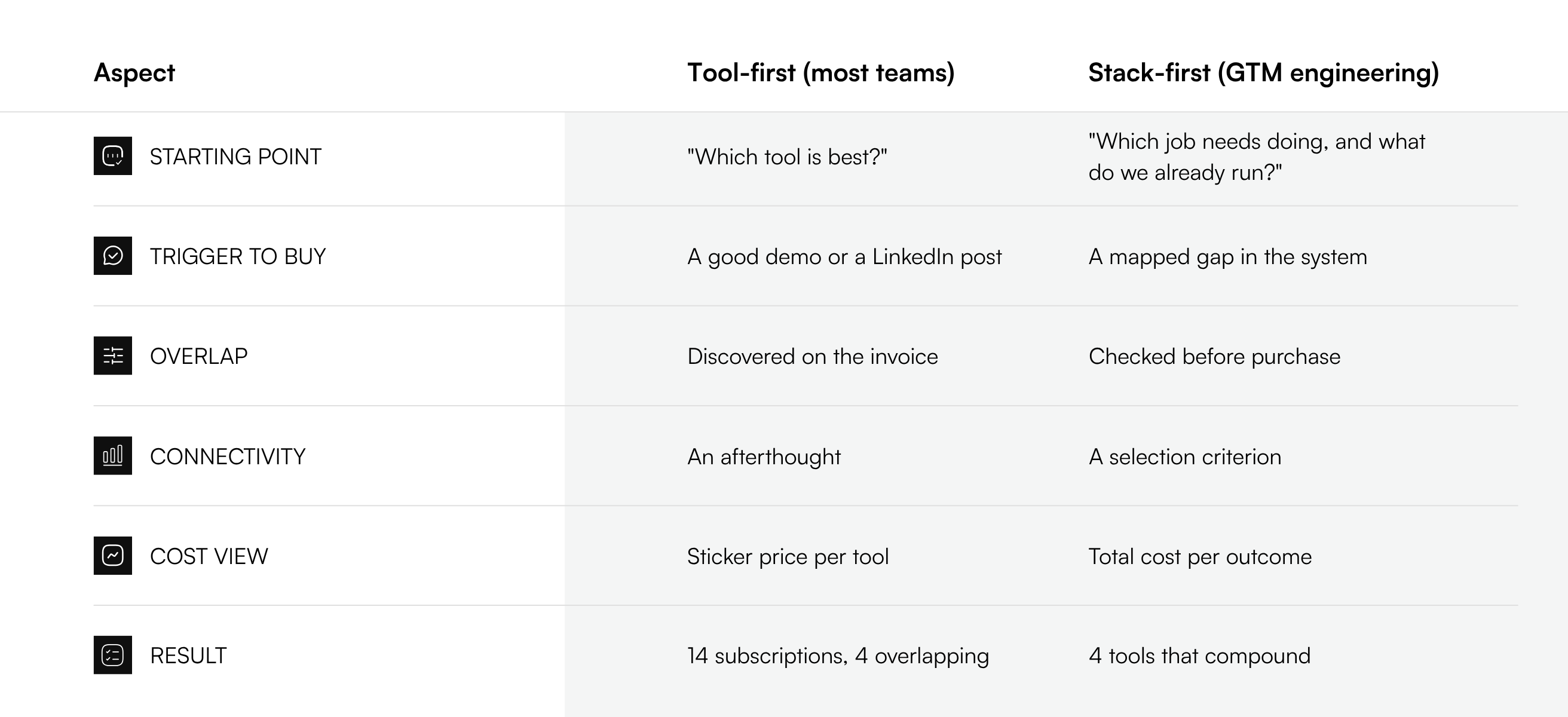
If your team lives in the first column, no amount of tool-hunting will fix it. The tools keep changing and the sprawl stays. The reframe is the unlock.
How to choose a sales tech stack: five criteria
Use these in order. The order is the point. Most teams start at criterion four and wonder why the stack never settles.
The criteria are the same whether you are picking outbound sales tools, RevOps tools, or a full B2B sales tech stack. Only the category changes.
1. Start from the job, not the tool
Name the specific job before you shop. Not "we need AI," but "our SDRs lose four hours a day verifying emails." Not "we need Clay," but "we have no way to score accounts against buying signals."
A tool is an answer. You cannot evaluate an answer until the question is written down.
- What stage of the pipeline is actually leaking time or money?
- What would "solved" look like, in one sentence?
- Is this a tool gap, or a process gap wearing a tool costume?
Skip this, and you buy solutions to problems you never defined.
2. Check it against the stack you already pay for
Before adding anything, audit what you own. Most teams already run tools covering 70% of the job they are about to buy for.
The ZoomInfo-plus-Sales-Navigator-plus-Mixmax pattern is not three capabilities. It is a lot of overlap and a few gaps.
- Does a tool we already pay for do this, even partially?
- Are we adding a capability, or duplicating one?
- Would consolidating two tools beat adding a third?
Skip this, and the new subscription quietly pays for work you were already funding.
3. Demand connectivity: API and MCP
This is the criterion old comparison posts miss entirely. In 2026 a tool does not live alone. It lives inside a system of other tools and, increasingly, inside agentic workflows.
Back to the studs. A tool with an open API and an MCP server can be orchestrated, automated, and called by an agent. A tool without them is a walled garden you will fight for the life of the contract.
- Does it expose a real API, or just a UI?
- Does it have an MCP server, so an agent can operate it?
- Will it plug into our orchestration layer and our CRM without glue code?
Connectivity is why we built our free Sales Tools Database to flag which tools ship API and MCP access, not just features. In an agentic world, a tool that will not connect is already legacy.
4. Price the outcome, not the sticker
Subscription cost is the number everyone looks at and the one that lies most. The real number is cost per outcome.
A single-source enrichment tool looks cheap until its coverage forces manual work. Our data enrichment waterfalls lift coverage from roughly 20% to 80% and cut cost 40-60% versus single-provider stacks, precisely because the tools are sequenced instead of stacked blindly.
- What is the cost per verified contact, per booked meeting, per cleaned record?
- Are we paying per seat, per credit, or per lookup, and how does that scale?
- Does this tool reduce cost elsewhere, or just add a line item?
Skip this, and you optimize the sticker price while the true cost hides in wasted hours.
5. Buy the category, then compare inside it
Only now do you compare specific products. Decide the category you need, whether that is a phone finder, an email finder, a sequencer, an orchestration layer, or a CRM. Then compare within it against your own constraints.
This is where a leaderboard finally helps, because you are comparing like for like against a job you already defined.
The first four criteria narrow 1,000 tools to a shortlist of three. The fifth picks one. Reverse the order and you are back to buying on hype.
Sales tech stack examples: the stack we actually run
We practice this. Vanderbuild runs a deliberately small core stack.
- Clay for data orchestration - the layer that connects data sources and feeds everything downstream.
- Instantly for cold email - sending and sequencing at volume.
- HeyReach for LinkedIn outreach - multi-account LinkedIn campaigns at scale.
- Claude - the AI and skills layer that qualifies calls, drafts briefs, and builds offer pages.
Four core tools, chosen to connect, not to impress. Four bricks that click.
Most sales tech stack examples you find online list fifteen logos across nine categories. Ours fits in four bullets because every tool earns its place by connecting to the next one. That is the only reason to keep a subscription.
The providers inside the brick
Read that list again and two names we use every day are missing: Prospeo and FullEnrich. That gap is deliberate, and it is the clearest example of what architecture means here.
Neither is a fifth tool. Both run inside Clay, as steps in a data enrichment waterfall. Clay is the brick. They are what sits under the studs.
Prospeo for verified emails is an extraction and verification engine, not a lead database. It exports from Sales Navigator and verifies aggressively, preferring false negatives over false positives. In our own tests it returned fewer emails than rival tools and the highest share of valid ones. Fewer contacts, cleaner sender reputation. A verified email costs 1 credit, a mobile number costs 10.
FullEnrich waterfall enrichment takes the opposite job. It cascades through 20+ vendors until a verified result comes back, and charges only when it finds something. Coverage runs 89% on email in the US and 84% across EMEA, because the algorithm routes to different vendors depending on where the prospect sits.
That last detail is the whole thesis in miniature. FullEnrich is not winning on a better database. It has no database. It wins on sequencing other people's data, which is architecture, not a product.
Read that as a pattern, not a shopping tip. Prospeo optimizes for precision. FullEnrich optimizes for coverage. Sequenced inside Clay, each one covers the other's weakness, which is why our waterfalls reach 80% coverage at 40-60% lower cost than a single provider.
Bought separately, as two more logos on a wall, they would be two more overlapping subscriptions. Same two products. The order is what makes them a stack.
We wrote up exactly how the Claude layer replaced six hours of manual work per deal in our Claude-for-sales workflows. The lesson there is the lesson here. The teams winning with AI in sales are not the ones with the most tools. They are the ones who picked the right few and connected them.
Sales tech stack health check
Run your current stack through this. These are rules of thumb, not laws, but three or more in the right-hand column is a signal.
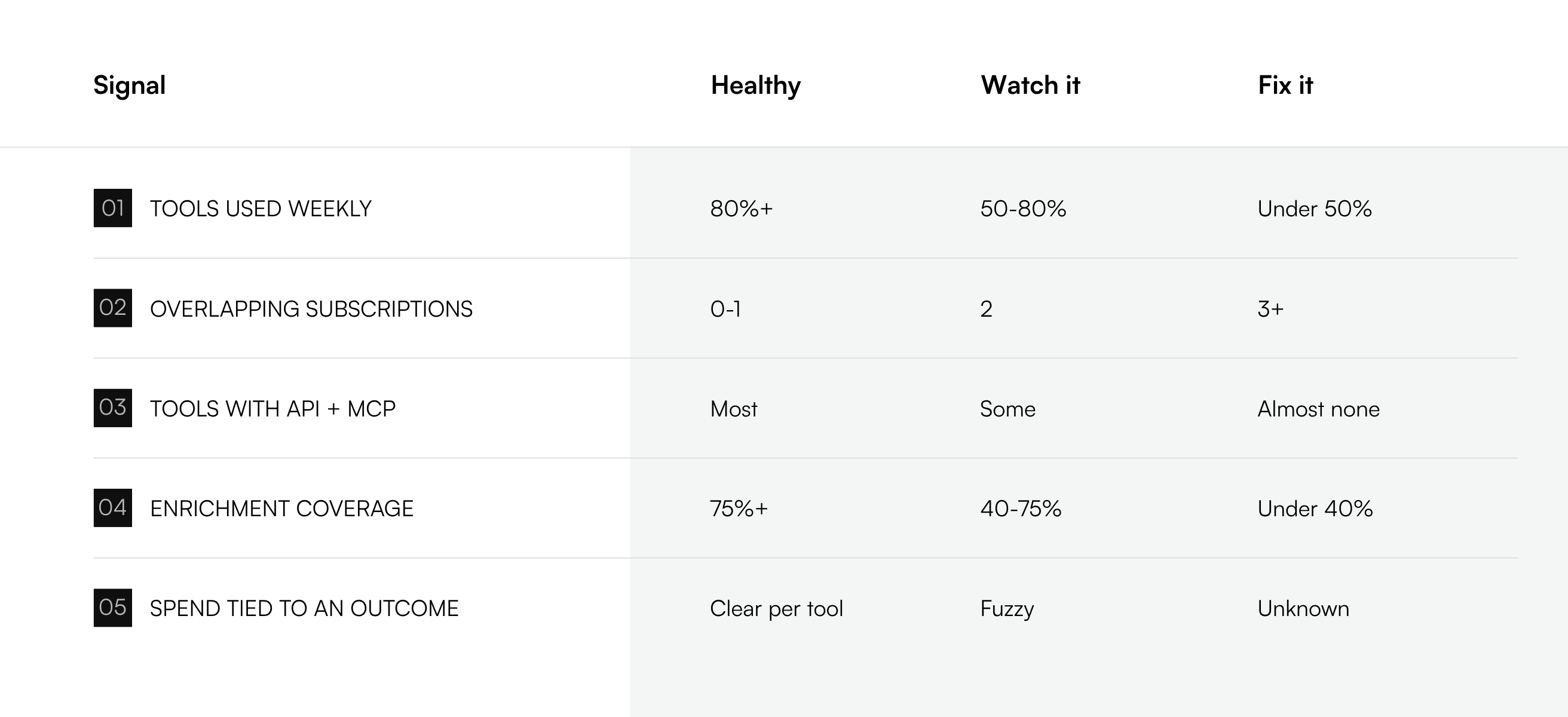
If most of your tools sit in the right two columns, the issue is structural. Swapping one product for another will not touch it.
When choosing well matters most
Three moments make this urgent. One makes it a waste of time.
- You're about to buy your fourth overlapping tool. The stack has grown by accretion, the invoices no longer map to outcomes, and someone is about to sign for a product whose main job is gluing together three things you already pay for. Consolidate before you add, not after. Every tool bolted on now becomes a dependency somebody has to unpick later, usually the person who inherits your seat.
- You're building outbound from zero. This sounds like the weak position and is in fact the strongest one available. Nothing is bought, nothing is entrenched, and nobody has to defend a decision they made last year in front of the person who signed off on it. Define the jobs and the connectivity rules before you open a single pricing page, and you skip two years of learning sprawl the expensive way.
- You're moving to agentic workflows. Here the criteria stop being preferences and turn into physics. AI agents for sales can only operate tools that expose an API or an MCP server, so a tool without them drops out of the running entirely, however well it demos. Connectivity stops being a nice-to-have and becomes the deciding criterion. We break down how these agents get built, and which tools they can actually drive, in our webinar on AI agents for GTM.
And the moment to ignore all of it: if you have not validated a repeatable motion yet, do not optimize the stack at all. A pre-PMF team with no working pipeline does not have a tooling problem. It has a strategy problem, and no subscription fixes that. Buying tools at that stage feels like progress because it produces artifacts, invoices, dashboards, a logo wall, while the thing that actually needs testing goes untested for another quarter. We do not touch a single tool for a client until the system is mapped, and neither should you.
FAQ: choosing a sales tech stack
What are sales tools?Sales tools are the software products a team uses to source, enrich, contact, track, and close prospects. Categories include orchestration, enrichment, sequencing, CRM, and signal detection. A sales tech stack is what you get when those tools are connected rather than merely owned.
How many tools should a B2B sales tech stack have?Fewer than you think. We run four in our core stack. The number matters less than the connections: if a tool cannot pass data to the next one automatically, it is not part of a stack, it is a silo you log into.
What is MCP, and why does it matter for sales tools?MCP (Model Context Protocol) lets an AI agent operate a tool directly rather than through a human clicking its UI. A tool with an MCP server can be driven by an agent. A tool without one caps how far you can automate, no matter how good its features are.
Should we buy Clay?Only if you have mapped a job that needs an orchestration layer. Clay is the core of our stack and of most GTM tech stack setups, but it amplifies decisions you already made. Vague targeting produces expensive, irrelevant data at credit cost.
How often should we audit the sales stack?Once a quarter, and always before adding a tool. The health check above takes twenty minutes and usually finds one subscription nobody can tie to an outcome.
What is the difference between a sales tech stack and a GTM tech stack?Mostly scope. A sales stack covers prospecting through close. A GTM stack adds marketing, data, and signal layers on top. The selection criteria are identical either way.
Three things to take away
- A stack is an architecture, not a shopping list. Tools are chosen to fit together and to fit you, or they are chosen wrong. Best-in-isolation means nothing.
- Selection criteria beat tool rankings. Job first, existing stack second, connectivity third, cost-per-outcome fourth, product comparison last. The order is the method.
- In an agentic world, connectivity is the new "best." A tool without an API or MCP server is a dead end, no matter how well it demos today.
You do not need the best tool, but the right sales tech stack, and the criteria to build it.
Everyone has the same bricks. Almost nobody has a blueprint.
If you want a second pair of eyes on the stack you already run, book a 30-minute call.