.webp)
What GTM Engineering Is? The Multiple Authoritative Definition
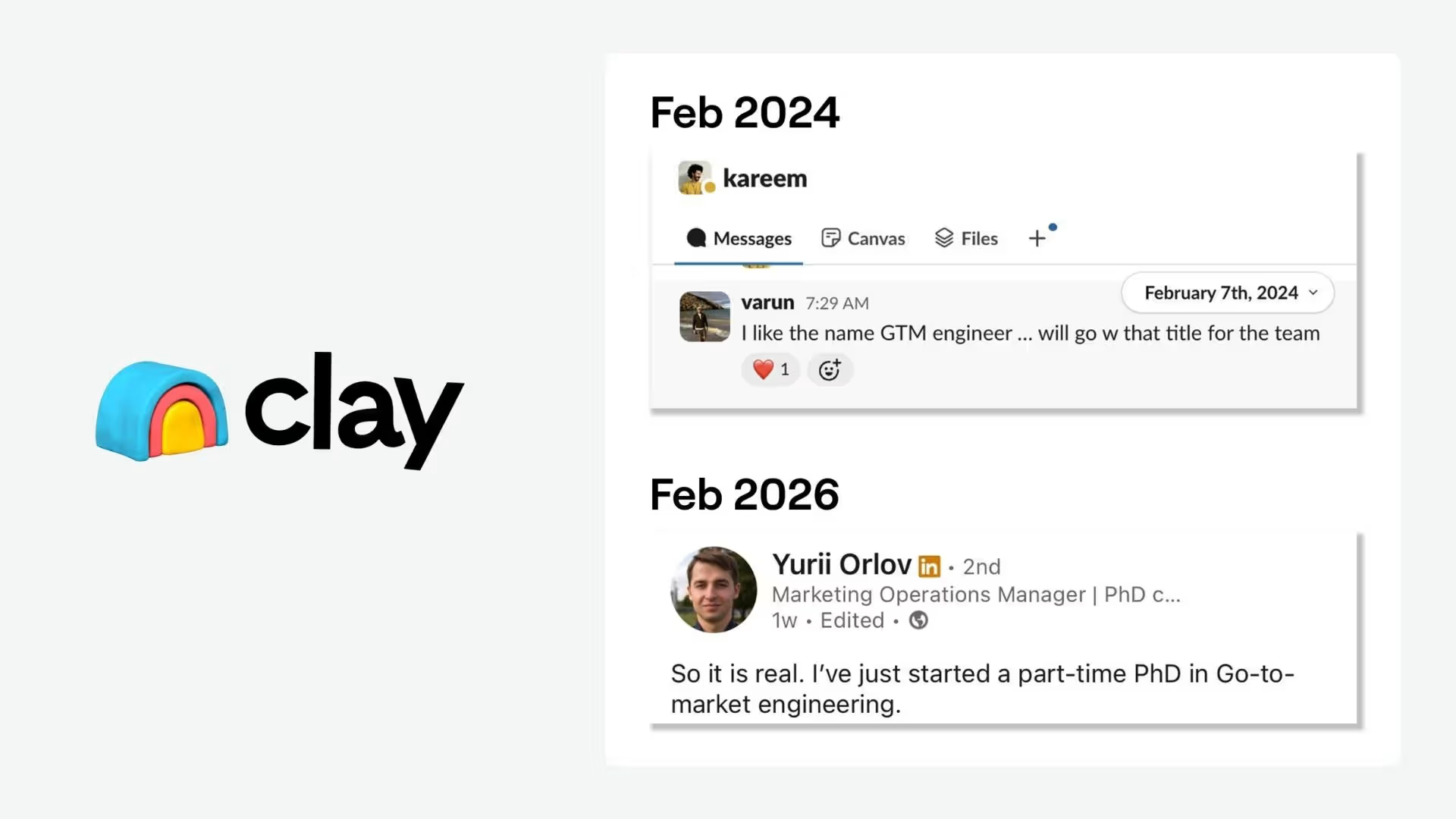
Clay (which coined the term in a 2024 internal Slack discussion) defines it most memorably: "GTM Engineers build revenue engines using AI and automation. Instead of coding software, they're coding revenue." Clay's June 2025 "Rise of the GTM Engineer" manifesto frames the function as one that "builds the revenue stack" rather than running it, with work progressing through three rungs: data foundation (clean, deduped CRM), data modeling (propensity scores, ICP attributes), and data activation (automated workflows).
ZoomInfo defines GTM engineering as "the discipline of building, automating, and scaling the systems that turn buying signals into revenue motion," with GTM engineers sitting "at the intersection of four roles: RevOps, marketing ops, data engineering, and prompt engineering." ZoomInfo's framing: "RevOps improves the output. GTM engineers build the machine."
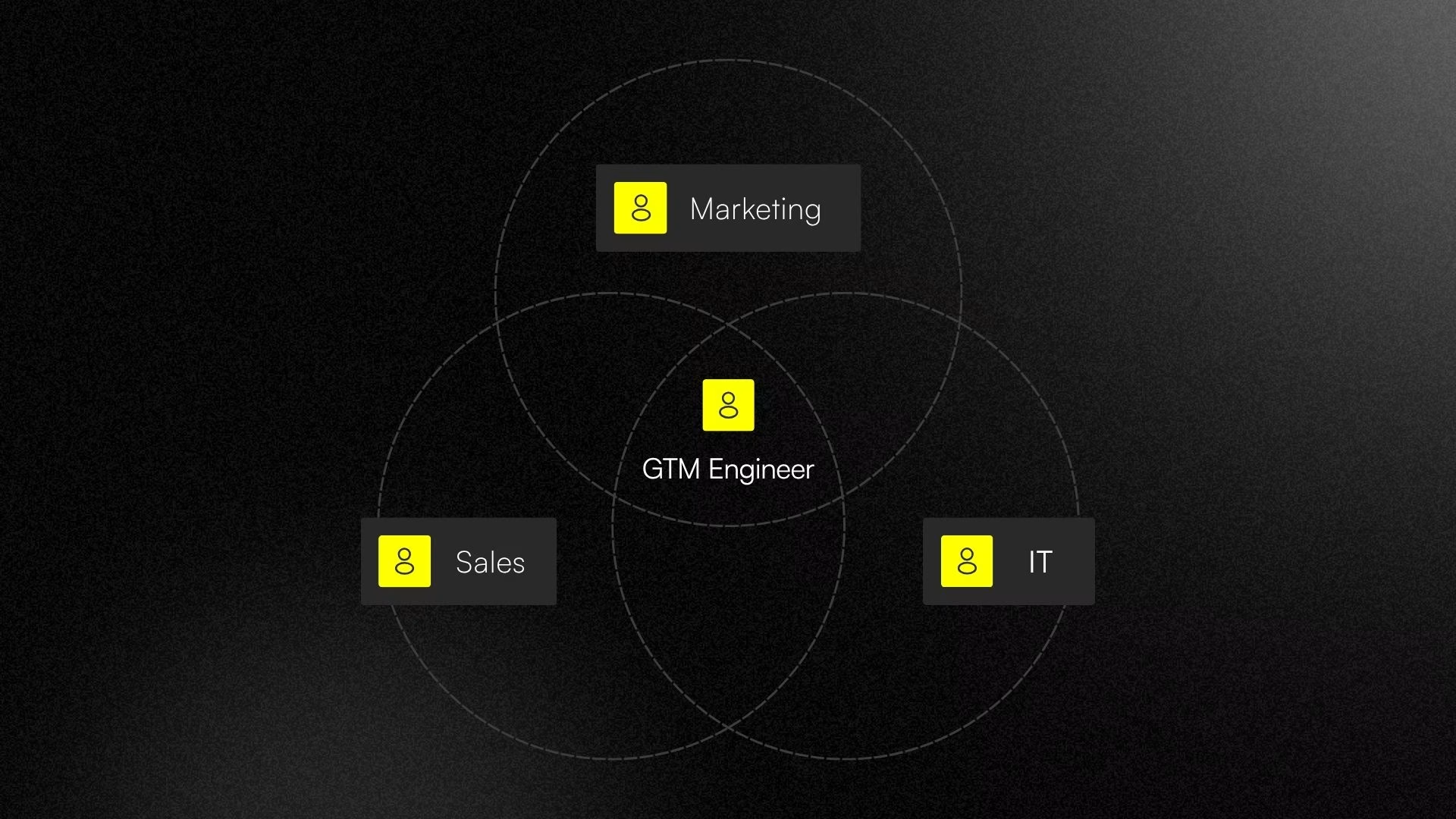
At Vanderbuild, we define a GTM Engineer as a person who can connect data, analyze it, and activate it automatically - at scale, while understanding the business context. We see the role sitting at the intersection of Marketing, Sales, and IT, and we treat its rise as a response to a structural shift: the B2B sales and marketing market has changed faster in the last three years than in the previous twenty.
Our core thesis is that go-to-market has moved from Outreach 1.0 - mass, target-group-based outreach that's cheap and easy but saturated, converting at 1-1.5% to Outreach 2.0, signal-based selling built on buying-readiness signals and converting at 5-7%. A GTM Engineer is the person who builds the systems that run Outreach 2.0. In our experience the CRM is the largest untapped source of leads, so the engineer's job is to observe the market for signals, reactivate dormant CRM data, and activate the existing network automatically - rather than endlessly buying new lists.
.avif)
When Clay raised its Series C, it described GTM Engineering to The New York Times as "one of the first AI-native jobs." In the August 2025 funding announcement, co-founder/CEO Kareem Amin said: "GTM engineering represents the first true AI-native profession, and we believe that it will be tech's next big job category."
Why GTM Engineering Matters
Data has never been cheaper. That's exactly the problem. Two curves are moving at once: the variety of available data is exploding, while the cost of acquiring it collapses. On paper that reads like a win. In practice it created a new bottleneck.
We call it the data paradox. A third line moves with the first two - the difficulty of correlating all of it. The cheaper and more abundant data gets, the harder it becomes to turn into a decision. Most teams now sit on more signals than ever: internal ones like CRM, product usage, and behavior, and external ones like intent, firmographics, tech stack, hiring, and news.
Two things then go wrong. The signals rarely merge into one source of truth, and only a fraction of them ever get used. Acting on that volume takes processes most orgs were never built to run. You have to activate, qualify, and segment data across dozens of angles at once - then decide what's worth acting on, and how. Ads? Outbound? Content? All three at the same time? That gap is where GTM engineering comes from.
A GTM Engineer is the person who can finally act on sales and marketing data - activate it, analyze it, qualify and segment it, and turn it into engagement, pipeline, and visibility. They sit in the blank space most companies have: between marketing context, sales context, process, and real data engineering. Cheap data is table stakes now. The next GTM advantage belongs to the teams who can actually do something with it.
GTM Engineering vs. RevOps (and SDRs, Sales Ops, Growth)
If you've spent any time hiring for go-to-market, you've probably asked the question out loud: isn't a GTM Engineer just RevOps with a trendier title? It's a fair challenge. On paper the two roles share most of their responsibilities, and plenty of companies use the names interchangeably. But there is a real line, and it matters when you're deciding who to hire and what to expect from them. The difference isn't the tool list or the seniority - it's the verb. RevOps optimizes the revenue system you already run. GTM Engineering builds the parts of that system that don't exist yet. Here's how they compare, side by side.
The 2026 GTM Engineering Tool Stack
Ask ten people what a "GTM stack" is and you'll get ten different tool lists. That's the problem - and the opportunity. The modern go-to-market stack isn't a pile of point solutions; it's a layered system where each tool does one job and hands off cleanly to the next. Data gets sourced, enriched, scored, routed, and activated - and an AI layer now runs through all of it. Get the layers right and a two-person team can outproduce a ten-person SDR floor. Get them wrong and you've just bought eleven subscriptions that don't talk to each other. Here's how the stack actually fits together in 2026.
The takeaway isn't which logos you buy, but how they connect. Most teams already own half this stack and still struggle, because the tools sit in silos with no orchestration layer tying signal to action. That orchestration is the actual work of GTM engineering, and it's why the same toolset produces a 1% reply rate for one company and 8% for another. Tools are commodities now; the system you build around them is the moat. If you want to see the full landscape - every tool, tagged by MCP support, API access, and agentic readiness - the Sales Tools Database above maps all 1,167 of them.
How to Become a GTM Engineer
We'll be honest about where our perspective comes from. In 2025, our founder Mateusz Sekta finished second in the world at the inaugural Clay Cup - Clay's first live GTM engineering championship - making him the highest-placed European in the field. We didn't get there through a certificate or a degree. We got there the way almost every GTM engineer does: by picking real revenue problems and building our way out of them, one broken pipeline at a time.
That's the first thing to understand about this role. There is no formal credential path, no university track, no exam. Nearly every practitioner is self-taught, and most "came from pain" - a clogged CRM, a cold-email channel that stopped converting, a founder asking for more pipeline without more headcount. The good news is that the path is learnable, and it's faster than most people expect. Here's how we'd walk someone into it today.
1. Start from a real revenue problem, not a tool.
The biggest mistake is learning Clay (or any tool) in the abstract. Pick something painful and concrete - "our leads go stale in the CRM" or "we can't tell which signups are worth a call" - and make solving it your curriculum. Ben Lang calls this "working downstream": choose the outcome first, then learn whatever it takes to get there.
2. Learn Clay as your core.
Clay shows up in more than 90% of GTM engineer profiles for a reason - it's the orchestration layer that connects data, enrichment, and action. Work through Clay University, then rebuild a real workflow of your own: source a list, enrich it with waterfall enrichment, score it, and push it to a sequencer.
Ps. if you want to know how to set up Clay - check this blogpost!
3. Add a CRM and an automation tool.
Get fluent in HubSpot or Salesforce (the two that dominate job postings) and one no-code automation tool like Zapier, Make, or n8n. This is the wiring that turns a clever Clay table into a system that runs without you babysitting it.
4. Layer in AI - including code.
The role is going agentic fast. Learn to use Claude and ChatGPT for research and copy, then push further into Claude Code and MCP to build custom tools and agents. This is also where the money is: engineers who can code out-earn no-code operators by $40,000 to $45,000, and SQL and Python each appear in nearly 4 in 10 postings.
5. Build in public and join the community.
Document what you build - on LinkedIn, in the r/gtmengineering subreddit, inside a local Clay Club (there are 60+ worldwide, from Warsaw to Manila). The GTM engineering scene is small and generous; proof-of-work travels faster here than any résumé.
6. Ship measurable outcomes.
What ultimately makes you a GTM engineer isn't tools, but results. Reply rates, meetings booked, pipeline reactivated, hours saved. 72% of practitioners report measurable revenue impact, and that's the portfolio that gets you hired or wins you the Clay Cup. Build the number, then show the number.
In-House vs. Agency - what is better for the GTM Engineering Area?
For most Series A to C companies, this is the real decision - not whether to invest in GTM engineering, but how. Here's how the two paths compare.
The cost and speed tradeoff:
In-house hire: $130K to $300K fully loaded, with a 3 to 6 month ramp before the systems are live and producing.
Agency / fractional: typically $4K to $12K per month, with capability to live in 2 to 3 weeks. (The State of GTM Engineering report found agency retainers ranging from $1K to $33K per month, with a median floor around $5K and a median ceiling around $8K.)
Build in-house when:
- You have a proven, repeatable motion you're confident will run for 12+ months.
- You're integrating 10+ tools that need a dedicated owner.
- Your outbound volume exceeds roughly 1,000 touches per month.
- You already have a RevOps or GTM team with the capacity to own the toolstack, write the copy, run the tests, and iterate week over week.
Use an agency or fractional engineer when:
- You need systems built fast - live in under 90 days.
- You're still finding product-market fit and your motion is likely to change.
- You don't yet have the internal headcount to produce results, or the team you have is already stretched.
The honest rule of thumb: if a dedicated GTM team with real capacity already exists, in-house is the right call. If it doesn't exist yet, or it's already stretched, an agency is faster and cheaper than hiring. That's why most companies end up running a hybrid: agency-first to build and prove the model, then an internal hire to own it once the motion is working.
TOP 10 GTM Engineers in North America & Europe
Summary: GTM Engineering in 2026
GTM Engineering is no longer a fringe experiment, but the fastest-growing function in B2B revenue, and the shift behind it is structural, not seasonal. The old model assumed the pipeline was a staffing problem: hire more SDRs, send more emails, book more meetings. That math broke. Generic cold email now averages a 3.43% reply rate, the average company juggles 100+ tools, and only about 5% of your market is ready to buy at any given moment. Throwing more people at that reality doesn't scale - engineering it does.
That's the whole idea in one line: pipeline stopped being an under-staffing problem and became an under-engineering problem. A GTM Engineer connects data, scores and routes it, watches for buying signals, and activates outreach automatically - turning a clean CRM and a few sharp signals into booked meetings, without a ten-person floor doing it by hand. The tooling has consolidated around Clay as the orchestration layer, an AI layer (Claude, Claude Code, MCP) running through everything, and a tight stack of enrichment, signal, and sequencing tools feeding it.
For a Series A to C company, the practical move is not to debate whether GTM engineering matters. They have to decide how to adopt it. Start by fixing your data foundation, prove a signal-based motion (a partner or fractional engineer gets you live in weeks), then bring it in-house once the motion works. The companies that win the next few years won't be the ones with the most reps. They'll be the ones who engineered their go-to-market while everyone else was still hiring to brute-force it.
If that's the system you want built, it's exactly what we do at Vanderbuild.
FAQs
What is a GTM Engineer?
A GTM (go-to-market) engineer is the person who builds the automated systems behind a company's revenue motion - data pipelines, enrichment, lead scoring, signal-based outbound, and CRM automation. At Vanderbuild we define it simply: a GTM Engineer connects data, analyzes it, and activates it automatically, at scale, while understanding the business context. They build the revenue machine rather than operating it by hand.
What does a GTM Engineer actually do?
Day to day, they design and run workflows that turn raw data into booked meetings. That means building waterfall enrichment to get accurate contact data, scoring and routing inbound leads, monitoring buying signals (funding, hiring, job changes, website visits), reactivating stale CRM records, and wiring AI tools into the stack to research accounts and draft outreach. The goal is a system that produces pipeline with minimal manual work.
GTM Engineering vs RevOps - what's the difference?
The cleanest test is the verb. RevOps optimizes the revenue system you already run - reporting, forecasting, pipeline hygiene, process. GTM Engineering builds the parts of that system that don't exist yet - the automations, data flows, and signal engines. The roles overlap heavily (one analysis of 1,000 job postings found ~90% shared responsibilities), but if it's a process, it's RevOps; if it's a system, it's GTM engineering.
How much does a GTM Engineer make?
In the US, salaries typically run from around $127,000 to $257,000, with a median near $135,000 and top earners at companies like Vercel and OpenAI exceeding $250,000. The biggest premium goes to engineers who can code: SQL and Python skills add roughly $40,000 to $45,000 over no-code operators. In Europe, rates generally run 30 to 50% below US levels.
What tools does a GTM Engineer use?
The core is Clay for data orchestration - used by the large majority of GTM engineers. Around it sits a stack of enrichment and data providers (ZoomInfo, Apollo, Prospeo), a CRM (HubSpot, Salesforce, Pipedrive), sequencers (Smartlead, Instantly, HeyReach), signal and visitor-ID tools (RB2B, Factors.ai), and an AI layer (Claude, Claude Code, ChatGPT) running through all of it. You can compare the full landscape in our free Sales Tools Database.
How do you become a GTM Engineer?
There's no formal credential - nearly everyone is self-taught. The fastest path: pick a real revenue problem, learn Clay as your core, add a CRM and a no-code automation tool, layer in AI and ideally some SQL/Python, then build in public and ship measurable results. Reply rates, meetings booked, and pipeline reactivated are the portfolio that gets you hired.
Should I hire a GTM Engineer in-house or use an agency?
If you already have a GTM or RevOps team with capacity to own the toolstack and iterate weekly, in-house makes sense. If that team doesn't exist yet or is stretched, an agency or fractional engineer is faster and cheaper - live in 2 to 3 weeks at roughly $4,000 to $12,000 a month, versus a 3 to 6 month ramp for a full-time hire costing $130,000 to $300,000 fully loaded. Most companies start with an agency to prove the motion, then hire in-house to own it.