.webp)
Buying outbound is unusually hard to do well, because almost everything that determines the outcome is invisible during the sales process.
You can see the deck. You cannot see whether the agency will run one sequence for a month and pour leads into the top of it. You can see the case studies. You cannot see whether the accounts in them looked anything like yours. By the time the difference shows up, you are three months and a retainer in.
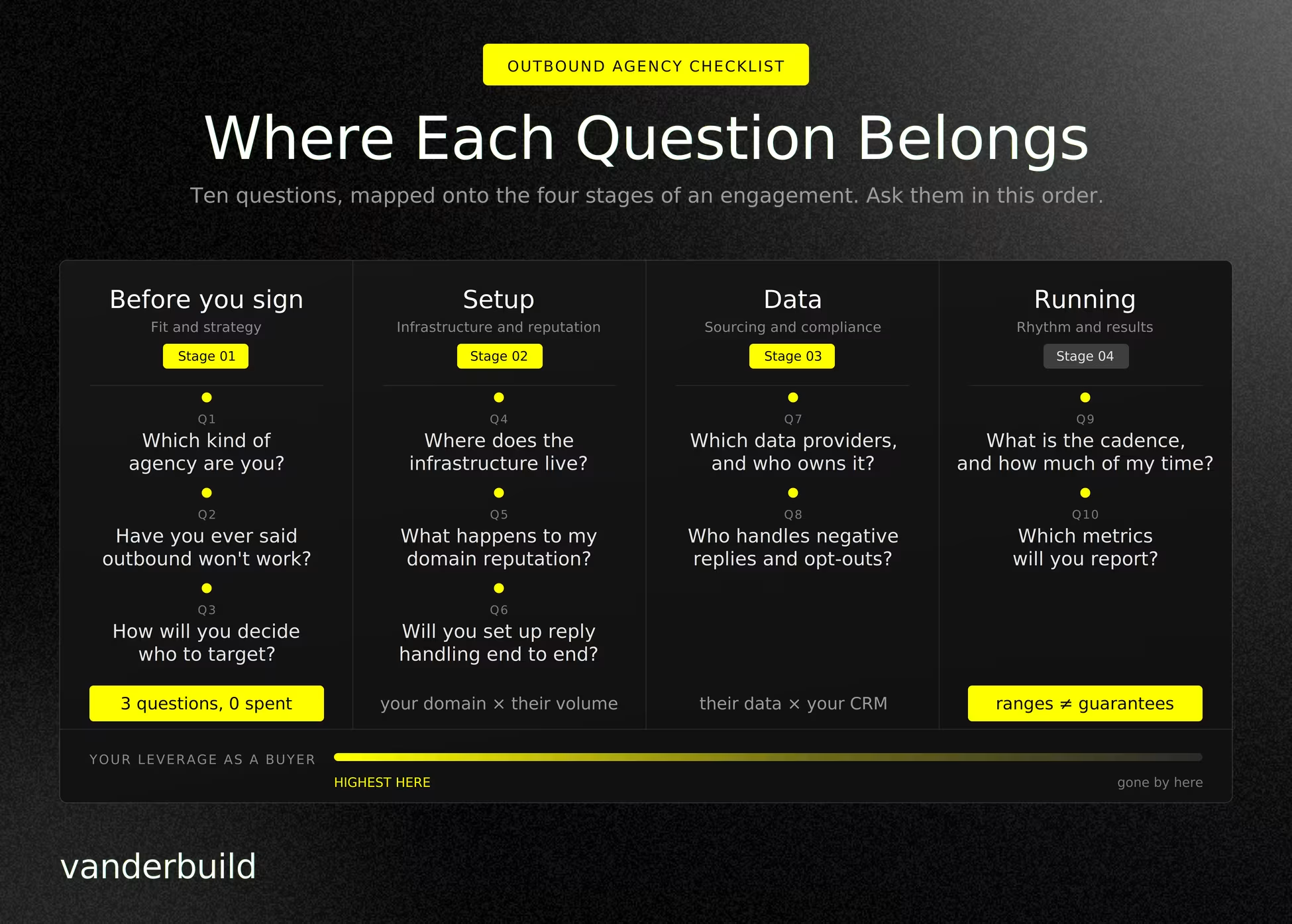
The questions below are the ones we get asked by the buyers who end up happiest, and the ones we wish more people asked. Each comes with what a real answer sounds like and what should worry you.
One thing to settle first, because it sits above all ten: whether outbound can work for your business at all. If your offer needs a market education program before it makes sense, the best agency in the world will underperform. We wrote the criteria up separately in how to know if an outbound sales strategy will work for your company. Read that first, then come back to this.
The four sections below follow the order of an actual engagement, because that is the order the questions matter in. Asking about expected lead volume before you have established whether the agency thinks outbound suits you at all produces a confident number and no useful information.
Before the engagement
1. Which kind of agency are you? (And is an outsourced SDR what I need?)
There are roughly three models of lead generation outsourcing, and they are not competing versions of the same thing.
The first sets up the system, closest to a straightforward outsourced SDR arrangement. They are strong technically, they will build your infrastructure and run your sending, and they will execute a strategy competently. What they will not do is invent that strategy. You are the brain of the operation. For a company with a clear ICP and someone in-house who owns messaging, this is often the cheapest correct answer.
The second covers strategy and execution together. They decide who to target, write the messages, and own the results. You are buying judgement, not just hands.
The third goes further and owns meeting-setting on top, taking the conversation from reply to booked call.
None of these is better. The failure mode is buying the first while expecting the second, which is where most disappointed outbound engagements start.
Good answer: they name their type without hedging, and tell you what they do not do.
Red flag: "we do everything." Very few agencies are genuinely strong technically and strategically, and the ones that are will say so specifically rather than generally.
2. Have you ever told a prospect that outbound would not work for them?
The most useful question on this list, and the one that produces the most revealing silence.
An agency that has never turned business away has either been extraordinarily lucky with inbound, or it takes anyone who pays. The second is far more likely. Outbound genuinely does not work for some businesses, and an agency that has thought about it will have a view on which ones.
Good answer: a specific example. The category, the reason, what they recommended instead. They should be able to name the criteria they use, and we published ours in full so you can compare.
Red flag: "outbound works for everyone if it's done right." It does not, and this answer tells you they have never checked.
3. How will you decide who to target?
Listen for whether the answer starts from your data or from your ambitions.
The most common targeting failure has nothing to do with tooling. A company sells successfully to mid-market operators, entirely through referrals, while the strategy deck says the target market is enterprise. Outbound goes to enterprise, produces nothing, and nobody can explain why. They targeted who they wanted their customers to be.
A good agency will ask to see closed-won data before it asks for budget. It will want to know which segments renew, which churn, and where deals close fastest. Then it will run those as testable sales hypotheses, which is the process behind message-market fit.
Good answer: they want your CRM export, and they propose testing several hypotheses rather than committing to one segment on day one.
Red flag: they accept your ICP as stated without asking how you know.
Infrastructure and reputation
4. Where does the cold email infrastructure live, with you or with me?
Cold email infrastructure is a genuine fork rather than a technicality, and it changes what you own at the end.
Infrastructure hosted by the agency is faster to start and cheaper to run. Infrastructure on your side costs more and takes longer, and it is yours when the engagement ends. Neither is wrong. What matters is that you decided rather than defaulted.
If it sits on your side, the follow-up question is what it sits on. Your own Google Workspace, or external sending tools? Custom infrastructure is expensive, and an agency that pretends otherwise is either inexperienced or selling you something. Our guide to email deliverability covers what the setup actually has to include.
Good answer: they explain the trade-off in terms of cost, speed, and ownership, then recommend one.
Red flag: they only ever recommend the vendors they have a partnership with. Ask directly whether they have one.
5. What happens to my domain reputation?
The reputational question is the one buyers ask last and worry about most.
Cold outreach done carelessly can damage the domain reputation of your primary domain, and that damage reaches your ordinary business email. Any competent agency sends from separate domains or subdomains for exactly this reason. If yours cannot explain its approach here in plain language, that is disqualifying.
The same question extends to any personal account being used. If the agency will be operating from a named person's LinkedIn profile, that person deserves to know what will be sent, when, and at what volume. Messages going out on a Sunday from an account somebody assumes is theirs is the kind of thing that damages trust internally long before it damages anything externally. The same care applies to how the channel itself is run, which we cover in our LinkedIn outreach playbook.
Good answer: separate domains, explained without jargon, plus a clear policy on personal accounts.
Red flag: any suggestion of sending from your main domain at volume.
6. Will you set up reply handling end to end?
Sending is the easy half. What happens when someone replies is where engagements quietly fall apart.
Forwarding has to be configured so that replies reach the people who can act on them, in a mailbox they actually watch, with enough context to respond intelligently. If this is left as an exercise for the client, expect replies to sit unread for days.
A related question worth asking: what happens to the replies that are interested but not ready. Those are the majority, and handling them is lead nurturing rather than lead loss.
Good answer: they treat forwarding and reply routing as part of setup, and they ask who on your side will own responses.
Red flag: reply handling is described as your responsibility without any setup support.
Data sourcing and compliance
7. Which B2B data providers do you use, and who owns the data?
Two questions that belong together, because the answers reveal different things.
On sourcing: most agencies buy from the same handful of B2B data providers, and if the honest answer is that everything comes from one scraped source, you have a problem, because your competitors have scraped it too. A market that has been contacted from the same list thirty times is not a market, it is a queue. Ask how they will assemble coverage of your actual addressable market rather than whatever a single tool returns. Proper coverage comes from layered B2B data enrichment, not from one export.
On ownership: the data belongs to you or it belongs to them, and you should find out before signing rather than at the end. The related practical question is how you will know whether a given account has already been contacted. If the agency's activity does not sync into your CRM, your own sales team will eventually email someone who received a sequence last week, and neither of them will know. That is the same hygiene problem we described in the CRM data hygiene manifesto, arriving from a new direction.
Good answer: multiple sources described specifically, data ownership stated as yours, and a concrete plan for CRM sync.
Red flag: vagueness about sourcing, or ownership that has never come up before.
8. Who handles negative replies and opt-outs?
Not every reply is a lead. Some are people asking to be removed, and a few are people who are annoyed.
Somebody has to process those, promptly and correctly. Under GDPR and equivalent regimes, opt-outs are not optional and delays are not defensible, as we set out in cold email and data privacy. The question is simply who does it, and the answer should not be "you."
Handled well, this is invisible. Handled badly, it becomes your problem in a way that has nothing to do with pipeline.
Good answer: the agency owns negative reply handling and suppression lists, and can describe the mechanics.
Red flag: the topic has clearly not come up before, or it gets waved away as a formality.
Working rhythm and expectations
9. What is the sales cadence, and how much of my time will this take?
Ask both halves. The sales cadence tells you whether you are buying a campaign or a broadcast.
Here is what a bad engagement looks like from the inside. One sequence is written. It runs for a month. New leads get poured into the top. Nobody tests a second angle, nobody segments, nobody looks at which variant performs. The message opens with a greeting, the sender's name, what the company does, and an ask. It runs until the list is exhausted, and then the agency reports that the market did not respond.
A real campaign has multiple sequences per segment, a fixed cadence for reviewing what is working, and per-variant reporting so that "it is not working" can become "variant three is not working." Our step-by-step guide to building a cold email campaign shows what that structure looks like.
The second half of the question matters just as much. A well-run engagement should require two things from you: an initial workshop, and time to handle positive replies. If the answer implies weekly strategy meetings and constant approvals, you are buying a job rather than a service.
Good answer: a named cadence, a described feedback loop, and an honest estimate of your time in hours.
Red flag: no iteration schedule, or a time commitment that is left vague.
10. Which outbound sales metrics will you report, and what do they turn into?
The commercial question, asked last because the answers only mean something once you understand everything above.
Ask which outbound sales metrics they report: sending volume, reply rates, positive reply rates, and what those convert into on a market like yours. Then ask when. An agency that has run comparable campaigns can give you ranges and explain what moves them. One that gives you a single confident number is guessing, or worse. For a reference point before the conversation, we published outbound costs, tools and benchmarks for SaaS.
Be alert to the expectation gap here, because it works in both directions. Buyers with genuinely complex offers frequently arrive wanting leads immediately, and are surprised to learn that positioning has to be built first. A good agency will tell you that before you sign rather than in month three.
Good answer: ranges rather than promises, tied to your TAM and the complexity of your offer, with a stated time horizon.
Red flag: a guaranteed number of meetings. Someone is either padding the definition of a meeting or planning to burn your market to hit it.
What the answers tell you
Read the ten together and a pattern shows up. The agencies worth working with are specific in places where it would be easier to be vague, and they volunteer constraints that a less confident vendor would hide.
That is the actual signal. Not the deck, not the logos, and not the number in the proposal.
The Checklist
Bookmark this and work through it during the call. Your progress is saved in your browser, so you can leave and come back mid-process.
Ask Us These Questions
If you want to run this list against us, book a 30-minute call. No pitch. We will answer all ten, including the ones where the honest answer is that we are not the right fit.