.webp)
Almost two years ago, at some of the first GTM events in Warsaw, the things that made people sit up were mass-scraping Google Maps, personalising cold emails without reading the prospect's website, and generating custom landing pages through Clay and Webflow.
Back then that was the stuff that got a "wait, you can do that?"
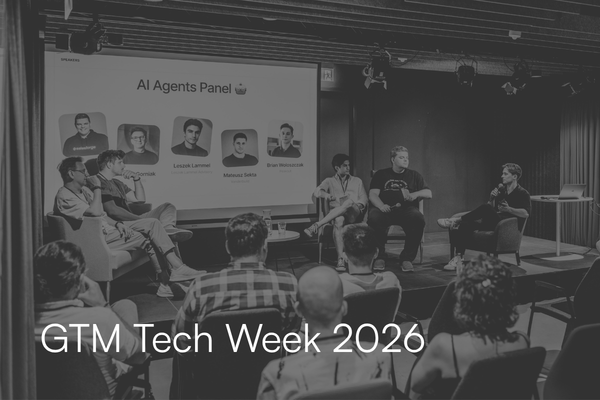
Last Friday, at Clay Club Poland with Salesforge, the room spent almost the entire night on how AI agents are going to orchestrate the whole go-to-market motion. Same room, same kind of people, same energy, completely different conversation.
This is what came out of that week, and what it means for anyone deciding where to start.
What you'll learn:
- What operators are building with agents, and what almost nobody is building yet
- The four conditions that make a task worth handing to an agent
- What separates an agent from a workflow
- How to build your first one without writing code
- Why the foundation underneath decides whether any of it works
What Is Being Built, and What Is Not
There is a gap between what gets talked about and what actually runs.
What shows up everywhere: frameworks, skills, semi-automated setups with a human in the loop. Someone reviews, someone approves, someone presses send. These work, and there are a lot of them.
What almost nobody has yet: an agent acting on its own, triggered by an event or a webhook, running in the background like a team member rather than a tool someone opens.
That second category is where the interest is now, and the interesting part is the size of what people are handing over. Not whole functions. Micro tasks.
The Four Conditions
A task is worth giving to an agent when all four are true.
- It repeats. Once a week, once a day, on a trigger. One-off jobs are not worth the setup.
- Somebody already does it manually. You know the steps, the exceptions and what good looks like, because you have done it.
- It has dependencies. It pulls from a source, checks something, and hands off. That is what makes it awkward to automate the conventional way.
- It is small enough to describe in a written instruction. If you cannot explain it in a paragraph, break it up.
That third and fourth condition together are the reason agents fit here. Building the same thing as a workflow means constructing branches and dependency chains by hand. Writing it as an instruction is faster, and it is where agents earn their place.
What Separates an Agent From a Workflow
The distinction is not the tooling and it is not whether AI is involved.
An agent makes decisions. A workflow executes a path someone drew in advance. When it hits a condition nobody anticipated, it fails or does the wrong thing. An agent reads the situation and picks.
That difference decides which tasks belong where. Anything with a fixed, knowable path is a workflow, and should stay one, because deterministic beats clever when you need the same result every time. Anything where the right move depends on what the agent finds is where an agent is worth the trade.
How to Build an AI Agent Without Technical Skills
The most useful question from the panel was the practical one: where do you start if you want to build one of these and cannot code?
The answer is a tool most people reading this already pay for. Claude, and specifically the Routines feature in Claude Code.
Four steps, and only the last one is optional.
1. Write the instructions
As detailed as you can manage. This is the whole job, and it is the part people rush. Describe the task the way you would explain it to someone joining your team on Monday: what to do, in what order, what to do when something is missing, and when to stop and ask.
2. Add the connectors
The tools the agent will use. Your CRM, your inbox, your data source, whatever the task touches. Give it what the job needs and nothing beyond that.
3. Set the environment
Which sites and systems the agent is allowed to reach. This is the boundary, and it is worth being deliberate about, because an agent with unnecessary access is a risk without an upside.
4. Set the trigger
Optional, and it is what turns a tool into a team member. A webhook when something happens, or a schedule that runs daily or weekly. Without it you have something you open. With it you have something that runs.
Start with one micro task that meets the four conditions. Not the most valuable process you have, the most repetitive one you understand best. The first agent is where you learn what instructions need to contain, and you want to learn that on something small.
What the Room Showed
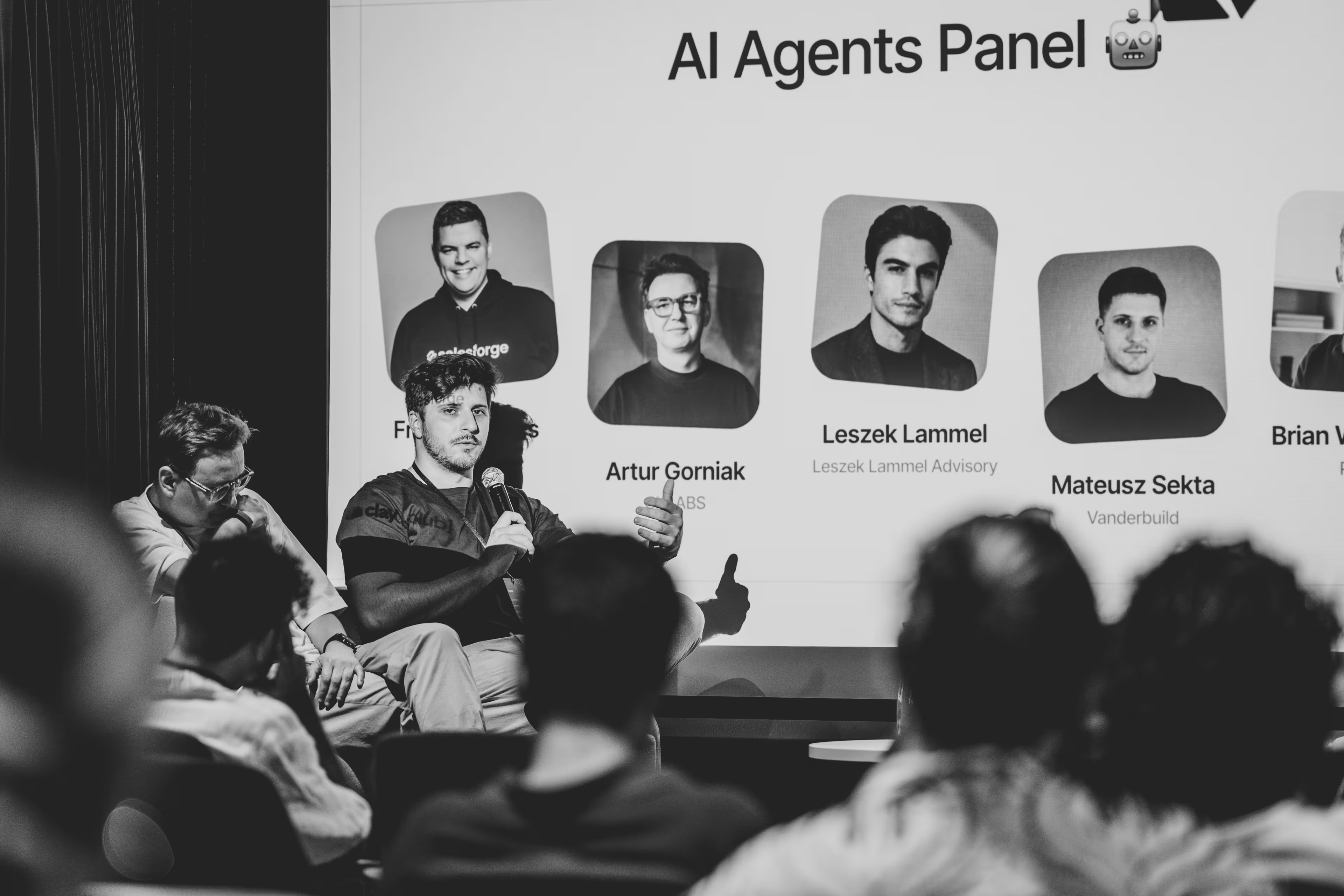
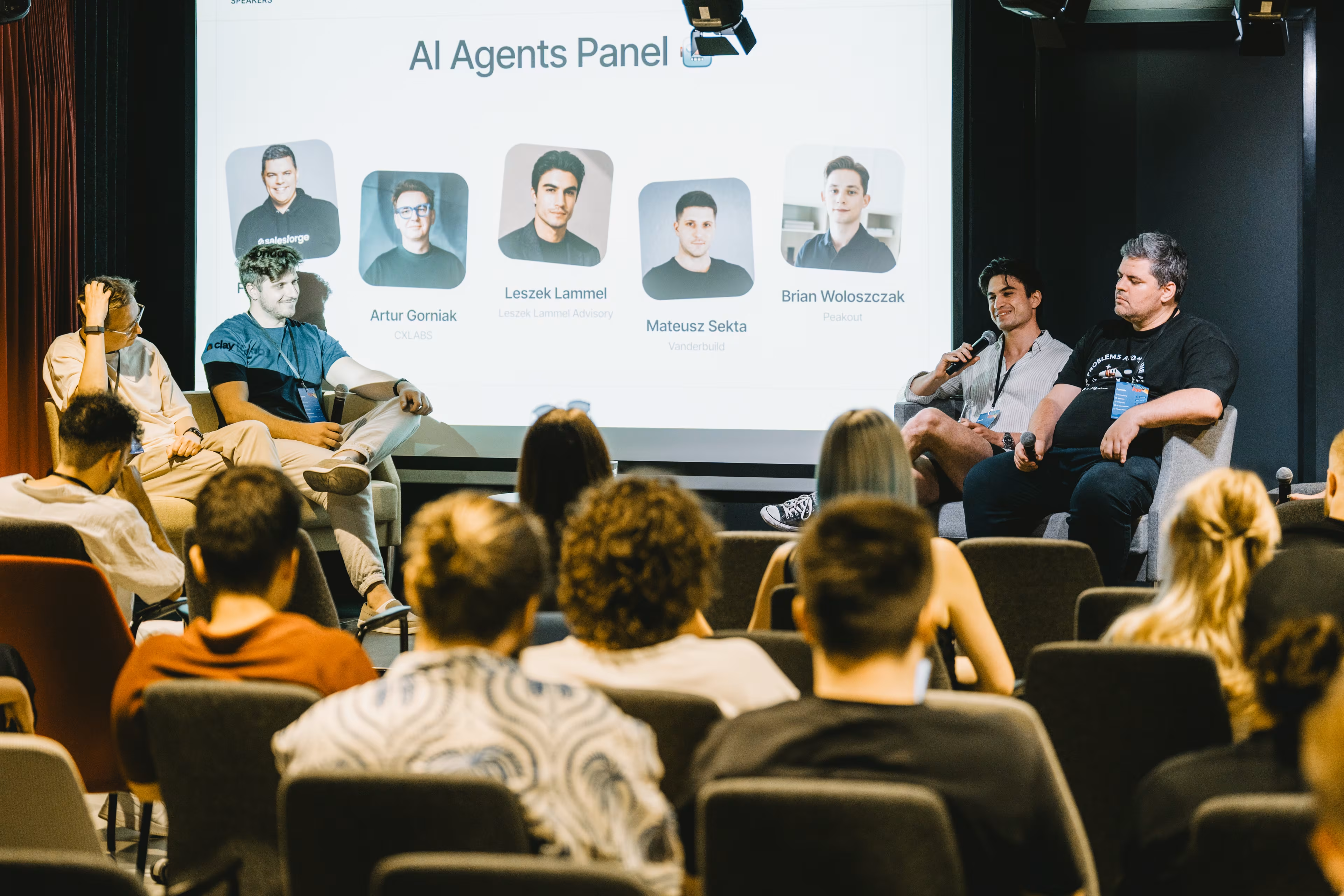
The panel, hosted by Brian Woloszczak, covered a wider range than any single talk would have.
Leszek Lammel demonstrated a fully autonomous agent handling LinkedIn posting, outbound and Clay table building on autopilot, which is the category almost nobody has running.
Jānis Plūme described 40 agents, a four-person team and 6 million messages sent. That ratio is the argument for agentic agencies in a single line, and it landed that way in the room.
Artur Górniak showed an agentic framework for validating a product-market-fit sales thesis across the whole cycle: lead generation, offer preparation and after-sales.
Frank Sondors covered running outbound off competitors' events, alongside the agentic frameworks side.
Paweł Nical went the other direction and talked foundations: what a signal actually is, how to use it properly, and how message design decides conversion. It is always good to see someone hold the room on fundamentals when everyone else is demoing, and it connects directly to how a signal layer gets built.
The Talk: GTM Engineering, Buzzword or Trend?
Two days earlier, at Growth Meetup in Warsaw, the question on stage was whether the whole category is a buzzword or a real shift in how companies generate leads.
The short answer given there: it is a shift, and the evidence is in what companies are hiring for rather than in what anyone is saying about it.
The argument ran in three parts.
The market changed faster in three years than in the twenty before it. Between 2018 and 2026 the volume of available B2B contact data grew roughly eighteenfold, from about 50 million verified profiles to over 500 million. The martech and salestech stack multiplied two and a half times, past 15,000 tools. For the same fifty dollars a month, a team that could reach around 225 verified contacts in 2018 now reaches close to 5,000.
Cheaper data made outbound harder, not easier. Everyone has the same raw material now, which is the whole problem. Mass outbound built on target groups converts at roughly 1 to 1.5 percent, because the playbook is public and the inbox has seen it. Signal-based outbound, built on buying readiness rather than a static list, lands between 5 and 7 percent. The barrier to entry that makes it expensive is exactly what keeps it uncrowded.
That gap is what GTM engineering exists to close. The role is the person who connects data, analyses it and activates it automatically, at scale, while understanding the commercial context underneath. Sitting between sales, marketing and IT used to be a gap on the org chart. It is now the hire serious B2B companies are chasing.
Underneath all three is the rule that drives the rest of this article: at any moment only 5 to 10 percent of a market is ready to buy. The job is to stay on the radar of the other ninety, and to recognise readiness when it appears.
The deck is below.
What This Actually Means
Two things came out of the week, and the second one is the work.
GTM has stopped being a buzzword in Poland. It is becoming a standard, a shared language teams build around. GTM engineering is landing here faster than most people expected, and it is changing how teams treat their sales and marketing data.
Agents are the layer on top of that, and they are only as good as what you feed them.
That is the part the demos do not show. An agent reading a database where the same company appears three times under three names makes three decisions instead of one. An agent with no structured context about your offer writes competent messages about the wrong thing.
So the real work for the next few months is underneath, and it is the same set of layers a revenue engine runs on:
- Stable data, structured well enough that a process can read it
- Structured context about your offer, so an agent knows what it is representing
- The company knowledge that makes any of it usable
- Stabilised funnels that bring the data into one place
Get the foundation wrong and you automate the mess faster.
That is also why the four conditions matter. "Somebody already does it manually" works as a check that you understand the task well enough to hand it over, which is the same reason validation belongs before the build in any automation project.
Thanks
To Brian Woloszczak for the invitation and for running the panel, and to Frank Sondors, Leszek Lammel, Artur Górniak, Paweł Nical and Jānis Plūme for what they shared on stage.
To the Growth Meetup crew for the stage, and to everyone who pulled the week together.
The Polish GTM scene is growing, and it is a good thing to be part of.