.webp)
Most companies do not have a revenue engine. They have outbound, and SEO, and a few events a year, and each of those is run by someone different against a different definition of success.
That is not a criticism of the individual activities. Each one can be well executed and still produce less than it should, because none of them knows what the others are doing.
A revenue engine is what you get when those activities share one source of truth and reinforce each other. This article covers the four layers that make that possible, the order they have to be built in, and how to tell after a quarter whether it is working.
What you'll learn:
- What changes when the channels are aligned rather than parallel
- The four layers, and why the order is not negotiable
- What to automate for an inbound lead, and what to leave alone
- How outbound and inbound leads differ in handling
- What to measure, and which numbers look good while nothing happens
What a Revenue Engine Covers
Three areas, in the order a customer moves through them.
Demand generation creates the conversations: outbound, inbound, signals, events, content. Sales conversion turns those conversations into deals: qualification, routing, pipeline, follow-up. Retention and expansion keeps and grows what you already won, plus everything that did not close the first time.
Those three areas are exactly the scope GTM engineering covers as a function. The name of the discipline is newer than the problem, but the problem is old: sales and marketing owning adjacent halves of one process and reporting on them separately.
What alignment actually changes
Three things, and they compound.
Quality goes up because the inputs are shared. One source of truth about who you sell to and why feeds every channel, so the case study your marketing team writes is the one your rep needs in a specific industry.
Volume goes up because the work is reusable. The same research produces a campaign, a post, a newsletter and a page.
The channels boost each other. An outbound campaign lands differently when the person receiving it has already seen you exist. If you are targeting a segment, having case studies from that segment ready is not a nice extra, it is what makes the first message credible.
Run those activities without alignment and each one carries its own weight and nothing else. Run them aligned and each adds a marginal effect to the others.
Where this is heading
The old split had marketing generating leads and sales closing them, with a handover in the middle. That has been breaking for a while, which is why growth and go-to-market functions exist.
The direction is clear enough to plan around. Large sales and marketing departments of fifteen people and up are being outperformed by small teams with a well-built automation layer, and the next step after that is agentic: systems that run the repetitive parts without a person triggering them.
One thing does not change in that transition. An AI layer built on top of a process nobody has run manually produces confident output about a motion that was never validated. You automate what already works and is repeatable. The manual round is not a stage you skip when the tooling improves.
The Four Layers, in Order
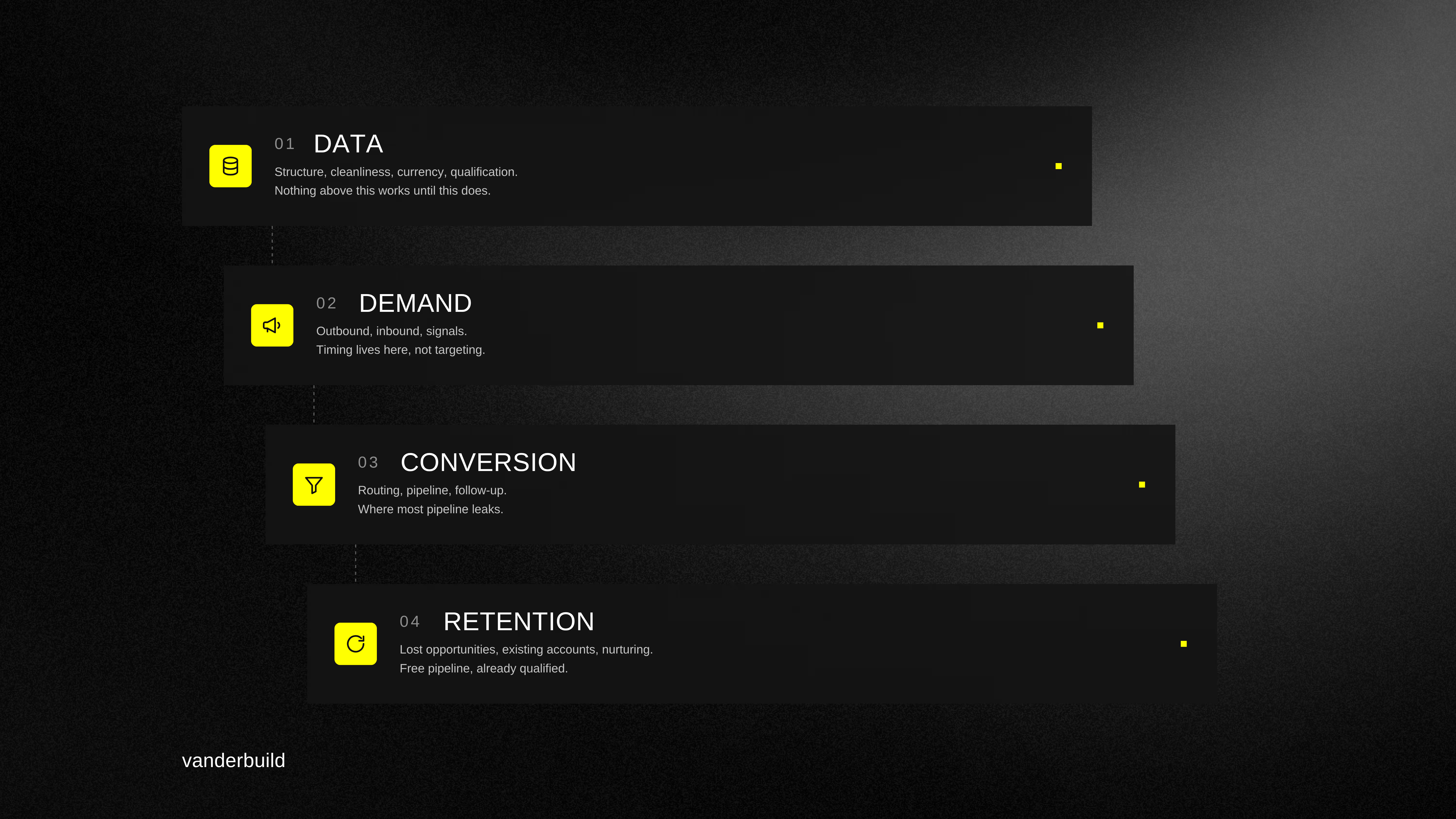
The three areas above describe what the engine does. These four layers describe what you build, and they depend on each other.
The consequence of starting at 02 shows up a quarter later. The campaign runs on records that are duplicated, stale or wrong, the reply rate is poor, and the conclusion is that outbound does not work in this market.
Layer 01: Data
Four phases, in sequence. Skipping one does not save time, it moves the cost later.
Normalise the structure. Three columns holding the same attribute, each partially filled, force every downstream process to guess which one to read. Decide which field is canonical and merge the rest.
Clean and fill. Enrichment on entry, gaps made visible, and an honest count of how many records are actually usable rather than how many exist.
Update what is stale. People change jobs, companies get acquired, domains change. Anything untouched for over a year needs checking before it is used.
Qualify. A binary rule for whether a record clears the bar at all, before any scoring model ranks the ones that do. Scoring an unqualified list produces a well-ordered list of people you should not contact.
What this layer costs you when it is wrong: every automation above it picks up the error and applies it at speed. That is the whole argument for building here first.
Layer 02: Demand
Outbound and inbound are two entry points with different starting conditions rather than competing strategies, and that difference decides how you handle everything downstream.
The difference that matters
An inbound lead arrives already aware. They know you exist and roughly what you sell, because that is why they filled in the form. Handled well, they usually close.
An outbound lead is one step back. They may know your value proposition after reading your message, but not how you deliver it. "We generate leads" can mean events, cold email, LinkedIn, SEO, ads or community building. The person on the other end does not yet know which of those you mean, so the first conversation starts at awareness rather than at intent.
This is why the same sequence sent to both underperforms on one of them.
Signals as the timing layer
Coverage tells you who could buy. Signals tell you when a specific account is worth contacting this week rather than any other week: a funding round, a hire into a relevant role, a regulatory change, a leadership change.
Two rules keep a signal layer from becoming noise. Strength should accumulate before anything fires, because a single website visit could be an accident while three visits in two weeks is not. And a minimum interval between contacts, or the accounts generating the most signals receive the most messages. The mechanics of building that layer are a project of their own.
Layer 03: Conversion
This is where most pipeline leaks, and where automation pays back fastest.
What to automate for an inbound lead
Seven things, in the order they happen.
A notification system that tells everyone, not just sales. The rep needs to pick the lead up. Marketing needs to see which companies are arriving and why, because that is the fastest feedback loop they have.
Qualification and segmentation. Two jobs at once: keep reps off leads that cannot be qualified, and make sure the strongest closers get the strategically important deals while pre-sales handles the ones that arrive with little information.
An automatic reply to the thinnest leads. Someone who writes "interested in your service" and nothing else gets a short response asking what specifically caught their attention. If they are real, they answer and book. If they are not, nobody spent time on it.
Meeting preparation. Case studies, delivery model and offer assembled from the context of where the person came from and what their company does, ready before the call starts.
A call before the call. Ten minutes on the phone beforehand often produces more usable context than thirty minutes of a cold meeting.
After the meeting: summary, next meeting, offer. The offer built from the call, as a page rather than a PDF, generated in minutes. With a human in the loop: the closer reads it, approves it and sends it, along with a prepared covering message.
Then contract and order. By this point the automation is administrative and uncontroversial.
Building this on unqualified data is the most common sequencing error, which is why automated qualification belongs before any of it.
What not to automate
Anything where the right action depends on context a person reads in five seconds and a system would need twenty rules to cover. Those twenty rules will be wrong in a way nobody notices.
Layer 04: Retention and Expansion
At any moment roughly 5 to 10% of your market is ready to buy. Everyone else received your message, formed an impression, and went quiet. This layer decides whether that group is a dead file or a pipeline.
Four segments, handled differently
Lost opportunities. Qualified, an offer went out, and it failed on budget or timing rather than on fit. These are the highest-value contacts in your database because the qualification work is already done.
Current customers. The upsell path. Reactivation is not only for people who said no.
Former customers. The deal was won, the engagement ended. Worth keeping warm, and worth doing by hand: something physical at the end of the year works better here than any sequence.
Warm contacts who never converted. Downloaded something, subscribed, engaged, never became a deal. Source these against real qualification criteria rather than treating the whole list as one segment.
How often, and with what
For lost opportunities: a simple bump using the context of the last conversation, first after a month, then after three. Every message after that needs a new reason, because the same bump repeated stops being a reminder and starts being noise.
A report or piece of research works well as that second reason. An invitation works better still: an event you are running, or one you know they are attending. That is the difference between reaching out and having a reason to reach out.
Three things can trigger the contact: time since last touch, a resource worth sending, or something that happened at their company. The full nurturing picture covers the sequencing.
How to Build It
The order above is the plan. What follows is how to start without stalling in week two.
Before you build anything
Three questions. If you cannot answer one, that is where the project starts.
- Where does a contact live, and is there one answer to that question?
- Which motion has been run by hand often enough that someone can describe what varies?
- Who owns this in six months? A process nobody maintains degrades within a quarter.
Map what already runs
Before designing, talk to the people running the motion today. The documented process and the real one are usually different, and the difference is the part worth automating.
Ask what they actually do step by step, why they think it works, when it converts, and what they have stopped doing. That last answer saves you testing things that have already failed.
Build in dependency order
Data, then demand, then conversion, then retention. Within each layer, automate what happens most often and varies least before anything that requires judgement.
Where teams go wrong on sequencing: they build the workflow before validating the assumption underneath it. Ten accounts contacted by hand will tell you in an afternoon what a six-week build only assumes. The order of operations in automation is worth reading before you start layer 02.
Who keeps it running
Building and maintaining are different jobs. Once the systems exist, RevOps is the function that keeps them working and improves them. Hiring for that before anything is built produces someone maintaining nothing.
What to Measure
Per layer, and with the vanity metric named next to each one.
How to tell after a quarter
It is working when the time between a lead arriving and a person contacting it is measured in hours, when you can say which segment responds and which does not, and when someone can name what they stopped doing because the data said so.
It is not working when activity metrics rise and pipeline does not.
FAQ
What is a revenue engine?
The connected system of demand generation, sales conversion and retention, running on shared data. The distinction from having sales and marketing is that the activities share one source of truth and reinforce each other rather than running in parallel.
Where do I start if I have nothing?
The data layer, every time. Every automation above it works with whatever state the data is in.
How long does it take to build?
The first layer is a project of weeks rather than days. A working engine across all four layers is a quarter at minimum, and it is never finished, because the fourth layer is a permanent motion rather than a build.
Do I need a GTM engineer to do this?
Not for the first layer. Data structure and cleanup is a defined project. The engineer becomes worth hiring when there is a repeatable process to turn into a system.
What about AI agents?
They belong on top of workflows that already work. An agent running an unvalidated process makes the not-knowing autonomous and faster.
How is this different from RevOps?
RevOps maintains and improves what runs. Building the engine is what happens before there is anything to maintain.
Where Is Yours Breaking?
Most companies have one layer built well and two running on somebody's memory.
Book a 30-minute call. We will work through the four layers with you and tell you which one is the bottleneck.

.avif)
.avif)