.webp)
There is a pattern we see in almost every audit, and it looks like diligence.
A team decides intent signals are the answer. Six weeks go into designing a system to capture them, enrich the accounts, score them and route them into sequences. The build is clean, the documentation is good, and every component does exactly what it was meant to. Then it runs for a quarter and the pipeline barely moves, because the signal it was built around turned out not to predict very much.
The system worked exactly as designed, and the assumption underneath it was never tested.
This article covers the order of operations in sales process automation: what has to be true before you build, the test that takes an afternoon rather than a quarter, and the mistakes that show up repeatedly in RevOps and GTM engineering work.
What you'll learn:
- What sales process automation covers, and what it leaves untouched
- Why a repeatable process has to exist before anything gets built
- The one rule that predicts whether a project succeeds
- How to map the process before anyone opens a tool
- How to validate a signal in an afternoon
- What a working signal system produces, with real numbers
- Eight mistakes that cost teams a quarter each
What Sales Process Automation Actually Covers
Sales process automation means handing repeatable steps in the revenue process to software so the team can spend its time on the parts that need a person. Sales automation as a broader category covers the same ground, with the process framing making the sequencing explicit.
In a B2B motion that usually covers sourcing and enriching accounts, deciding which ones qualify, routing them to an owner, triggering outreach when something happens, and reactivating contacts who went quiet. It sits inside RevOps as a function and gets built by whoever owns the technical layer.
The limits are worth knowing before the budget conversation.
Automation scales a process rather than fixing one. A play that fails by hand fails faster once it is automated.
It executes a decision somebody already made, faster and more consistently than a person would, so the quality of that decision limits everything built on top of it.
It works with the data you have, in whatever state that is. Point it at a messy database and it produces confident errors at speed, which is why data hygiene comes first.
Why a Repeatable Sales Process Has to Come First
If you take one thing from this article, take this.
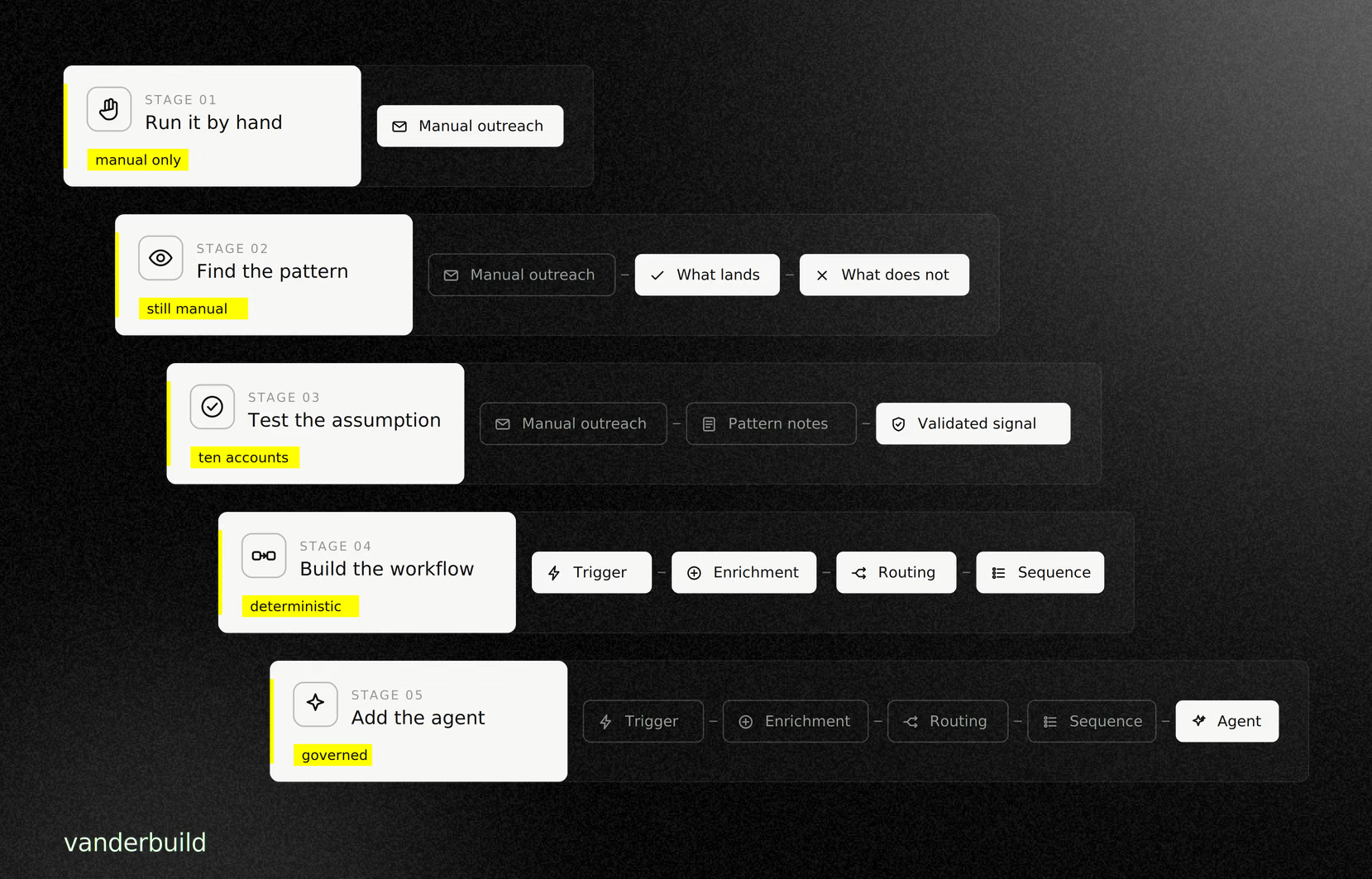
Never automate something you have not first done manually.
Automation encodes a process, which means a repeatable sales process has to exist before there is anything to build on.
The reason has nothing to do with discipline or caution, and everything to do with the fact that you cannot know how many options exist until you have tried them. Run a play by hand ten times and you discover eight ways to phrase the opening, three moments when it lands, and two segments where it never does. Automate before that and you build one path out of ten, permanently, without knowing which nine you skipped.
This applies to everything, and it bites hardest on signals, because signals feel like they should obviously work.
Map the Sales Process Before You Automate It
Before designing anything, talk to the reps who close the most and look at the accounts that closed fastest. Most of what you need is already in how they work, and it is rarely the version written in the playbook.
Five questions worth asking:
- What do you actually do, step by step? The written process and the real one are usually different, and that gap is the part worth automating.
- Why do you think it works? The answer may be wrong. It still produces a hypothesis you can test in a week.
- When does it convert? Which point in the buyer's quarter, budget cycle or situation. This is rarely written down anywhere.
- Where do you get the best responses? A specific community, an event, a channel. Worth checking before assuming email.
- What have you stopped doing? Dropped approaches tell you what has already been tested, which saves you testing it again.
An example of what comes out of a conversation like this. On a cyber security programme, contacting a company during a breach produced nothing, because everyone inside was busy handling it. Waiting a month or two changed the response completely. That came from a rep in passing, and no dashboard would have caught it.
A readiness check from the same conversation
There is an indicator here that has nothing to do with your tooling and is more reliable than any of them.
If nobody on your sales team is asking to have work taken off their plate, hold off. A rep who has run the same play often enough to feel the pattern starts asking for automation without being prompted. They know which twenty variations matter out of the hundred they tried, and that knowledge is the spec. Someone who is not asking either has not run the play enough times to see the pattern, or is not running anything repeatable.
The sequence that works: a rep runs campaigns manually, starts to feel what lands, gets faster at it, and at some point the repetitive part becomes obviously repetitive. That is the moment, and what you are building in is their judgement rather than their keystrokes.
The Ten-Contact Test
Here is the alternative to a six-week build, and it takes an afternoon.
You already know which companies had the triggering event last month. Take ten of them. Have someone write to those ten by hand, every way they can think of, and find out whether the signal performs.
Three outcomes, all of them useful.
It performs. Now build the recurring system, and build it around the phrasing that actually got replies rather than the phrasing you assumed would.
It performs for one segment only. You just avoided routing the whole market through a filter that works for a fifth of it, and you learned something about when to time the outreach along the way.
It does nothing. Three weeks spent rather than a quarter, and you know something about your market that no report would have told you.
There is an efficiency argument here that gets missed. A thousand prospects with a generic message might convert ten. Ten prospects with a validated signal and a good rep behind them can convert five. The second run took someone five extra minutes per contact and no infrastructure at all.
Building a system feels like progress and sending ten manual emails feels like admitting you do not know yet, which is why teams reach for the build even though the ten emails are what produce the answer.
What Outbound Sales Automation Produces at Scale
Numbers help, so here are ours from a programme running in cyber security.
The pipeline pulls from RSS feeds rather than a commercial database, because in that market companies are required to report breaches to specific aggregators, and those reports rarely reach the usual data providers. Roughly twenty sources feed one table.
Over about two months:
- 10,500 signals collected and processed
- 894 companies pulled out of those signals, after removing duplicates
- ~500 companies qualified after checking existing accounts and open opportunities
- 1,600 contacts enriched and cleared for outreach
Two things decide whether an account gets contacted. Either the combined signal score passes a set level, or the account has not been contacted in three months. That second rule matters more than it sounds, and in some industries it should be stretched further.
What that produces, across the campaigns we run on validated signals:
- LinkedIn, signal-based: around 8% reply rate
- Cold email, signal-based: 3.5% to 5.5%, depending on the signal and the market
- Event-based personal signals: 15% to 25%, which is the highest-converting category we have
Two notes on those last figures. Event signals convert because they follow attention that already exists rather than creating it. And job-change signals, the most commonly used trigger of all, are a way into someone's inbox rather than a reason for them to buy. Treat them as awareness, and the numbers stop being disappointing.
The mechanics of building this out sit in our guide to implementing intent signals.
Eight Sales Automation Mistakes That Cost a Quarter Each
Roughly in order of how expensive they are.
1. Building the system before validating the assumption
Everything else on this list is fixable. A team that builds on an untested assumption gets a clean system producing nothing, rather than a partial result that would at least point at the problem, and it takes a quarter to notice.
2. Automating on data nobody trusts
Three columns holding the same attribute, each partially filled, force the automation to guess which to read. It will pick one and be confidently wrong at scale. Structure, then cleanup, then enrichment, then workflows, and enrichment fails most often because teams treat it as a one-off import.
3. Starting with scoring instead of qualification
Qualification is binary and asks whether an account clears the bar at all, while scoring is a gradient that ranks the ones that do.
Build the gradient without the binary layer underneath and you get a beautifully ranked list of people you should not be contacting. Automated qualification is the layer that comes first.
4. Treating every signal as a trigger
Someone visits your pricing page once, and that could be an accident. The same person returns three times in two weeks and reads the same two articles, and that is worth acting on.
Signal strength should accumulate before it fires. A minimum score and a minimum gap between contacts do most of that work.
5. Using only external signals
External signals tell you when to reach out. Internal ones, already sitting in your CRM, tell you who to reopen: a deal lost eight months ago, a contact who went quiet at proposal, an account whose champion just changed jobs.
Most teams build only the first kind, which is odd, given the second is free and already qualified.
6. Skipping the deduplication and CRM check
Before enriching a company, check whether it already exists as an account. Before contacting it, check for open opportunities. Reaching out to a live deal or an existing customer costs more goodwill than any campaign returns, and it is a five-minute step at build time.
7. Building agents on top of unvalidated workflows
Deterministic processes come first and agentic layers sit on top of them. An agent wrapped around a process nobody has proven makes the not-knowing autonomous and faster, which matters more each quarter as agents get easier to deploy than the workflows underneath them.
8. Solving the same problem from scratch every time
If you have built a working motion for one client or one segment, the second and third versions should take a fraction of the time. Teams that treat every build as bespoke pay full price repeatedly and never compound.
Nine things to confirm before you automate
Sales Process Optimization: What to Automate First
The order is boring and it is the order.
Start with what happens most often and varies least. Data entry after a form submission. Enrichment on record creation. Routing based on a rule that has not changed in a year. Boring work, and it frees the most hours per unit of build effort.
Then take on what a person keeps forgetting. Follow-up after ninety days of silence. Flagging a job change. Checking for a duplicate before someone creates one. Software is good at remembering and people are not, so the division of labour is clean.
Then build in judgement, where it has already been proven. Qualification against criteria a person has applied consistently. Prioritisation based on a pattern someone can explain out loud. Agents belong here, at the end.
Leave alone anything that changes every time. If the right action depends on context a human reads in five seconds and a system would need twenty rules to cover, those twenty rules will be wrong in a way nobody notices.
FAQ
What is sales process automation?
Handing repeatable steps in the revenue process to software: enrichment, qualification, routing, triggered outreach, reactivation. It sits inside RevOps and is usually built by whoever owns the technical layer.
When should I automate a process?
When it has been run manually enough times that someone can describe the variations, when it happens often enough to justify the build, and when the data underneath it is trustworthy. Missing any of the three means automating an assumption.
What is the most common sales automation mistake?
Building before validating. It looks like diligence, produces a clean system, and fails quietly for a full quarter before anyone traces it back to the assumption.
How do I know if a buying signal is worth automating?
Contact ten accounts where it recently fired, by hand, every way you can think of. If it performs, build the system around the phrasing that worked.
How often should the same prospect be contacted?
We work to a three-month minimum between touches on the same contact, adjusted up or down by industry. Signal strength can override it, though rarely on a single signal.
Should I build workflows or AI agents?
Workflows first. Agents operate on processes that already exist and already work.
Before You Build the Next System
Most automation projects fail on an assumption that was never tested rather than on execution, and the test usually costs an afternoon.
Book a 30-minute call. No pitch. We will look at what you are about to build and tell you which part of it should be run by hand first.