.webp)
Every GTM team now has the same shopping list: an agent that qualifies, an agent that writes, an agent that books meetings. The demos work. Then the agent goes into a real pipeline, produces forty pages where five would do, emails the wrong segment with confidence, and someone quietly turns it off.
The agents are rarely the problem. What they were given to work with usually is.
What is agentic GTM, and how does it differ from AI GTM?
Agentic GTM is the use of AI agents that act autonomously inside sales and marketing, triggered by an event or by a scheduled routine, executing predefined actions on the basis of your own knowledge base.
Three parts of that definition do the work. Autonomously, meaning nobody presses start. On a trigger or a schedule, so the agent runs when a signal fires or at a set time rather than when someone remembers. Predefined actions on your knowledge, which is what separates it from a generic assistant.
The broader terms, AI GTM and AI for GTM, cover everything from a copy assistant to a reporting bot. Agentic GTM is the subset where the software acts on its own and you are accountable for what it did, which makes it the next layer of GTM engineering rather than a separate discipline. That accountability is why the setup underneath it matters more than the model.
Under the hood, an agent is automation with a more complicated backend and a much simpler front end. You give an instruction, the agent executes the steps. The usual sales process automation rules still apply, and the first one is that a process nobody has run by hand is not a candidate.
Agentic marketing and agentic sales stand on the same layer
What is agentic marketing? The same model applied to campaigns, content and reporting: agents that assemble a brief, draft in your format, prepare the report, and hand a human the final call. Agentic sales is the sibling motion around research, outreach, replies and offers.
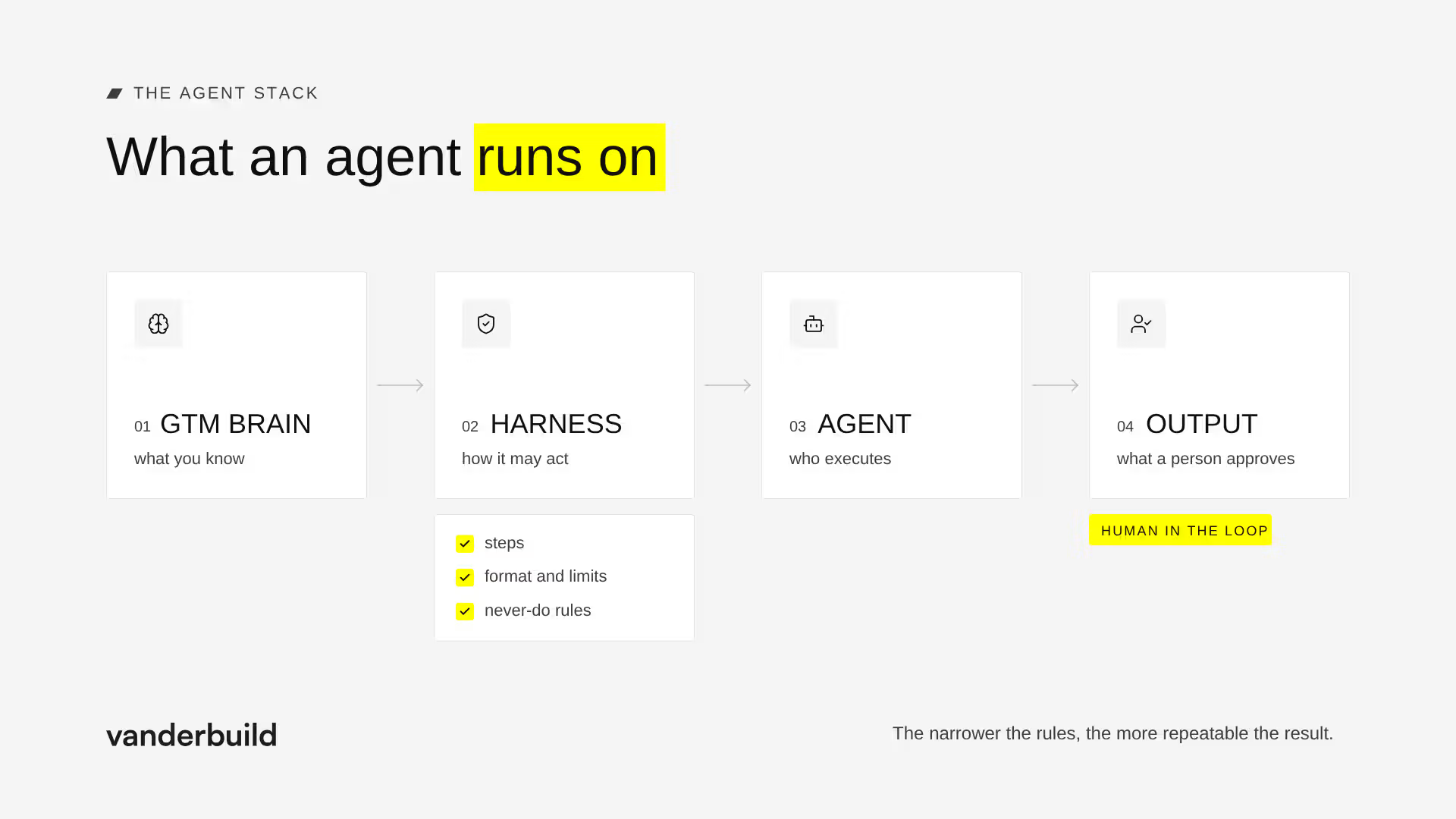
Both run on one thing, and it is not the model. It is the context they read before they act: what you sell, to whom, in which words, and by which rules. That context is the GTM Brain, and without it an agent produces plausible output about a company that does not exist.
There is a reason the context has to be narrow rather than broad. Given room, a model covers every angle it can imagine, because nothing told it which one matters. You get the forty-page report that paraphrases itself, when the expert version is five pages and says the same thing. Expertise is explaining something complicated simply, and an unconstrained model does the opposite.
Agent guardrails: the harness that makes output repeatable
The brain holds what you know. The harness holds how an agent may act on it: the steps, the format, the length limits, the things it must never do. Those rules are your agent guardrails.
The trade is direct. The more specific the rules, the smaller the chance of an error and the more repeatable the output. Repeatability is the entire reason to put an agent on a process, so loose instructions defeat the purpose before the first run.
Two practical consequences:
- Write the process step by step before you write the prompt. If you cannot describe it as a list of steps, an agent cannot execute it.
- Only automate what you have already run manually. The manual run is where the steps come from, and it is the same principle that keeps lead qualification automations honest.
Which GTM agents to build first, and why repeatability beats pain
The instinct is to start with whatever hurts most. The better filter is what you do most often, because that is where the hours are.
A practical build order for a B2B team starts with five: research before outreach, message copy in your frameworks, campaign setup and sending, reply drafting with a person approving anything that leaves, and monitoring of the sending infrastructure. After those come sales offers built from the call, meeting analysis, discovery briefs assembled from CRM stages, support responses, and eventually agents covering first calls when volume outgrows the team. We break that order down agent by agent in a separate piece.
There is one more category that gets overlooked, and it is often the highest-value one: moving and tidying data between systems. Pulling numbers out of the sending tool, reconciling them in one table, and pushing a single dashboard for a client is a lot of manual work and exactly what an agent does well. The same logic sits behind choosing your data orchestrator.
For teams building toward AI agents for lead generation, the first three on that list produce most of the time saved. The best AI GTM agent is the boring one that runs a confirmed process every day.
What agentic GTM gives you, and what it costs
It forces your knowledge into order. You cannot deploy agents on undocumented processes, so the cleanup that keeps getting postponed happens as a precondition. Many teams get more value from this than from the agents.
It gives time back. The repetitive work stops eating the calendar.
It frees your best people. Your strongest seller should be selling, not assembling reports. Reports can generate themselves, and that is a better use of the same hour. The wider case for that sits in the revenue engine model.
Three costs worth naming before you start:
- Skills fade. When agents handle the simple work, people stop practicing it. A year later, the manual fallback is slower than it used to be.
- Trust without checking. "AI wrote it, so it is fine" is how quality drops without anyone noticing.
- Models move. Model behavior changes between versions, so a workflow tuned today can drift after an update. Keep your knowledge outside any single tool, and treat a new version as a change to validate.
Human in the loop is the answer to the middle one. Anything going to a client gets read by a person, at least until the output is standardized enough that only the numbers inside it change.
How to build agentic GTM in five steps
- Build the knowledge base. Plain text, in a repo agents can read, holding company knowledge, personas, frameworks and task instructions. This is the GTM Brain, and everything else depends on it.
- Pick the repetitive tasks. The ones you run often and have already run by hand.
- Choose the framework and tools. Agent frameworks from the major labs are the simplest entry, and a small always-on server covers scheduled routines. Keep the knowledge outside the tool so switching costs an afternoon.
- Keep a human in the loop. Approval before anything reaches a client.
- Close the loop. Subagents that audit the main agent's output, catch wrong formats and send work back for correction. Few teams are here yet, and steps one and two carry most of the value anyway.
On tools, the honest answer is that the leading coding agents deliver similar value and the model underneath them decides the quality in any given month. Which one gives you more usage before the paywall matters more than the brand. What does not change is the rule in step three: knowledge lives outside the ecosystem.
FAQ
What does agentic GTM mean?
AI agents acting autonomously inside sales and marketing, triggered by an event or a schedule, executing predefined actions based on your own knowledge base.
What is agentic marketing?
The marketing half of the same model: agents that build briefs, draft in your formats, prepare reports and pass the final decision to a person.
What is agentic AI in sales?
Agents that run defined parts of the sales motion, such as research, outreach, replies and offer preparation, on rules you wrote, with a person approving client-facing output.
How do I build agentic AI workflows for sales?
Write the process step by step, run it manually until it repeats, put the knowledge in a repo, then give an agent that process with explicit rules and a review step.
Do I need a GTM engineer for this?
For the first agents, a documented process matters more than a hire. The role becomes worth it when several processes need building and maintaining, which is the question behind the hiring mistakes we see most often.