My go-to-market strategy framework starts with one number. At any moment, only 5 to 10% of your market is buying, and everything in the framework follows from that.
Below are the four stages I take companies through, from the first closed deal to a CRM full of warm people you can come back to. I'm the GTM strategist at Vanderbuild, and this is how I usually map a company's GTM maturity.
The rule behind every go-to-market strategy framework
On average, 5 to 10% of a market is buying at a given moment. It varies by industry, but 100% of a market never wants to buy from you at the same time. That is physically impossible.
Turn it around and the rule gets its second half. Most of the market, at the moment you are selling, is not ready to buy. That does not mean it never will be. When a company reaches its buying moment, it takes the path of least resistance. It remembers that this firm does GTM engineering, that one builds CRMs, and another one ships parcels.
So a strategy has to be long term. Whether it works is rarely clear within a month. A good strategy gets confirmed over time, and a weak one does not show itself fast either.
What your strategy does with the other 90%
Active campaigns, even one-off ones, reach the 5 to 10% who are buying now. The long-term strategy activates channels that keep addressing the other 90% of the people in your market.
That means educating everyone who fits your profile, whether they want to buy from you or not. If they fit, the day comes. If not now, then in three years, and if not in three, then in five. They come back and ask: "We saw you built voice bots for someone. How would we solve this problem?"
You want them to remember you, so that when they open a buying window you are already on their list of vendors. Most of that work is B2B lead nurturing.
The four stages of a go-to-market strategy framework
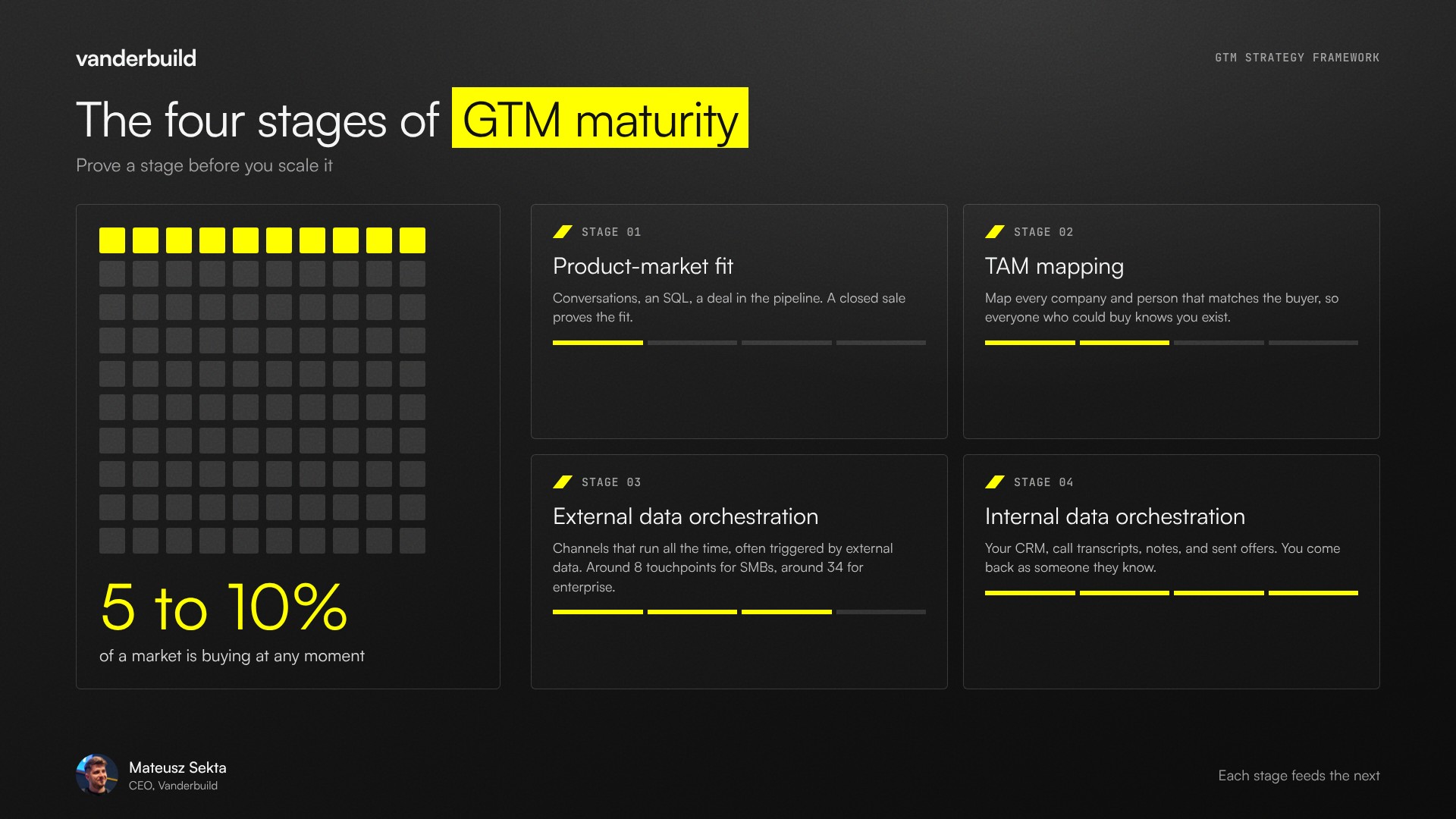
I see GTM maturity as four stages. Each one builds on the one before it, and a company can only scale the stage it has already proven.
Stage 1: Product-market fit
Everything starts with proof that the product fits the market. Fit means conversations started, a sales-qualified lead (SQL), a deal in the pipeline, and best of all a closed sale. Once one company like this has bought from you, the chance that similar companies in that market will buy is very high. If you have not reached that point yet, start by learning how to validate product-market fit.
Stage 2: Total addressable market mapping
In the niche, segment, and persona that bought, you move from single conversations to the whole market, your total addressable market (TAM). You map every company and person that matches. The goal is that every company and every person who could buy from you knows you exist, what problem you solve, and what you sell, ideally in two words. We cover the method in our guide to total addressable market.
Stage 3: External data orchestration and funnel scaling
Appearing on a buyer's radar once is nothing. With small and mid-sized buyers, you need around eight touchpoints on average. Enterprise buyers need far more, around 34. Someone sees your post. You write to them with a question. They see you at an event, or watch your talk. Those touchpoints build trust, and they have to repeat. This stage runs channels that work all the time, often triggered by external data such as buying signals.
Stage 4: Internal data orchestration
Stage 3 works like water on a mill, and the mill starts producing flour. The flour is your internal data, starting with the people in your CRM you have already interacted with. They started cold on your TAM list and are now warm. You can ask them deeper questions and show up for them more often. Every piece of information in the company counts here. Names and company names count, and so do call transcripts and notes passed between a salesperson and the founder. So do market observations, and even an offer sent to a company that later asked about another problem. All of it lets you come back to these people at a different level, as someone they know. Start by recovering lost leads from your CRM.
The four stages at a glance
Each stage builds on the one before it.
Scroll the table sideways to see every column.
| Stage | What it means | You are there when | It feeds |
|---|---|---|---|
| Stage 01: Product-market fit | Conversations, an SQL, a deal in the pipeline, a closed sale. | A company like your target has bought from you. | TAM mapping in that niche. |
| Stage 02: TAM mapping | Map every company and person that matches the buyer. | Everyone who could buy knows what you sell. | Recurring touchpoints. |
| Stage 03: External data orchestration | Channels that run all the time, often triggered by external data. | Small and mid-sized buyers meet you around eight times. | Warm people in your CRM. |
| Stage 04: Internal data orchestration | Work with your CRM, call transcripts, notes, and sent offers. | You come back to people who know you. | Deeper conversations with warm people. |
Only 5 to 10% of a market is buying at any moment.
What to do when the board wants leads now
Pressure for leads is normal. The board should also understand what your channels produce, and a head of growth should come to that conversation with options ready. Each option costs money.
Some periods bring plenty of leads. In others there are none, and none will come. That is how the market cycle works. So keep channels that run all the time and repeat, and track the metrics month over month. Is the company growing, and how fast?
When you need more leads, there are two paths:
- Push the existing channels. Spend more on ads, contact more people, publish more content. It may turn into leads, and it may not.
- Open new channels. Go to an event, start talking to people, look for partners.
In a larger company, check the trend first. If your followers or your interactions with the market are not growing month over month, your actions are not working. Look at each existing channel's performance, work out why, and change what is not working.
Push or open?
Two ways to get more leads when the board asks. Both cost money.
- More ad spendPut more money behind the ads that already run.
- More people contactedReach more of the same audience.
- More contentPublish more on the channels you have.
- EventsGo to an event and start talking to people.
- PartnersStart looking for partners.
In a larger company, first check that your followers and interactions grow month over month.
Steps of a GTM strategy, in order
The framework turns into a sequence you can follow:
- Define what you sell as a one-liner, the target groups, the personas, and the channels you will use. These are the components of a GTM strategy, and I cover what each one should look like in what GTM consulting should deliver.
- Rank the channels by time to value, or by impact versus effort.
- Find your stage and prove it before you scale it.
- Keep a long-term channel running for the 90% who are not buying yet.
- Choose the tools last, from the strategy.
For startups, we wrote a separate guide to a B2B go-to-market strategy for startups.
For larger companies, read our enterprise GTM strategy framework.
How to choose your GTM tech stack from the strategy
Pick tools from the strategy, the channels you are opening, and where you are heading. For every tool, you should know why you are buying it, why it matters for this channel now, and what you want to do with it.
I split every tool stack into three layers, and the same frame has held in nearly every case I have worked on:
- Data sources. When you define who you sell to, start with niche sources that few others can reach. Turn to the widest open lists after that.
- Data orchestrators. Today the main orchestrator should be AI, meaning LLMs.
- Data activators. Sequencers, ads, newsletter tools. Pick vendors that fit your orchestrator, for example tools you can plug into Claude. Check whether they have an MCP server or an open API, how they process data, where their servers are, how they support customers, and how they are developing. For outbound, check coverage: email only, or LinkedIn and calling too. An all-in-one tool can replace several subscriptions.
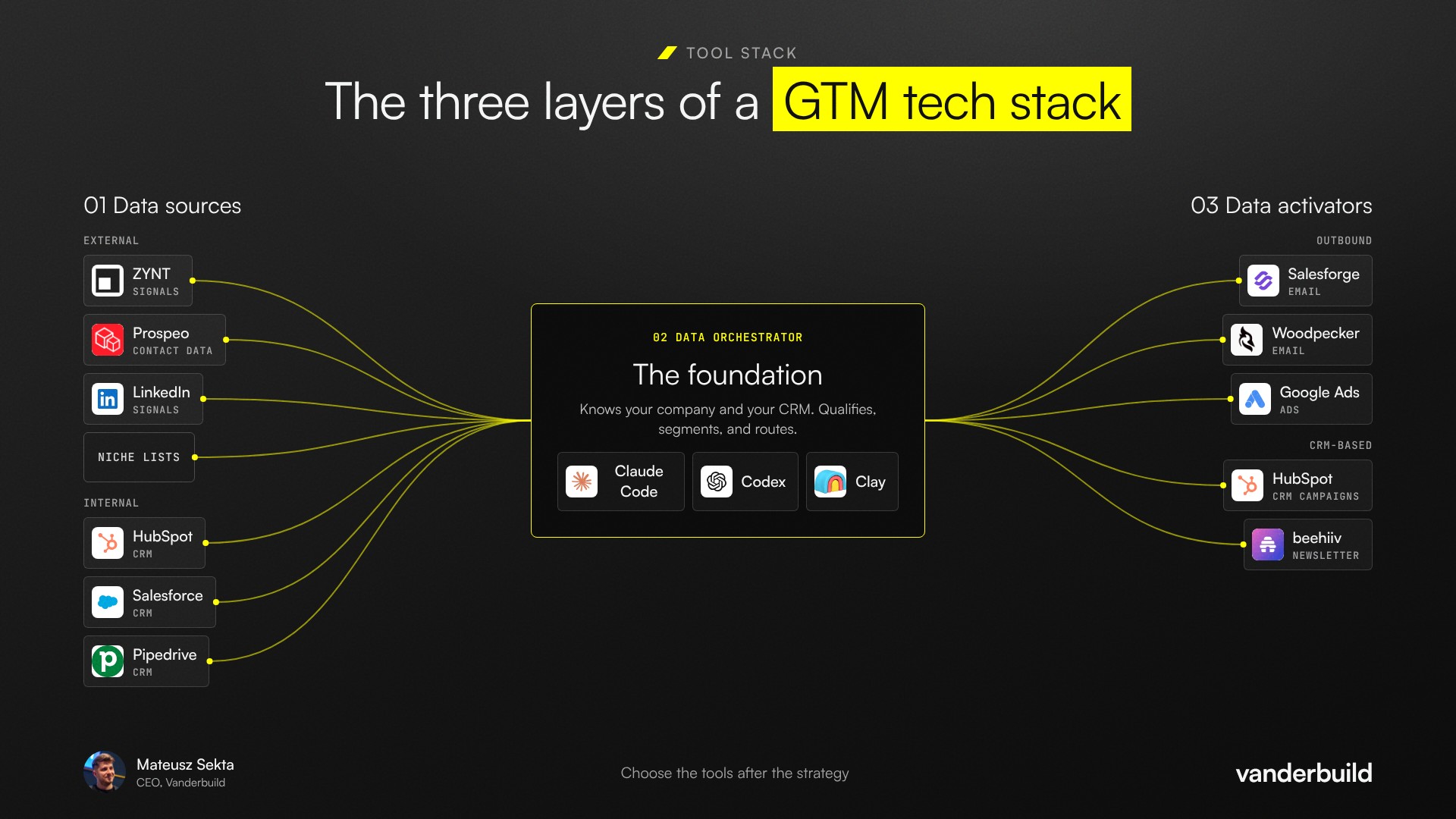
The orchestrator is the foundation. It should know your company, what you sell, and how you sell it. The orchestrator also needs to see what happens in your data sources, with the CRM first among them. Then it can qualify an incoming lead and spot a budget that does not fit. It can assign the segment, route the person to the right owner, and flag the more lucrative deal. Our post on the GTM Brain shows one way to build that knowledge.
For the full picture of the layers and tools, read what a sales tech stack is.
Strategy comes first, then the stage, then the tools. To work through your own framework with us, start with our GTM strategy workshops.
FAQ
What is a GTM strategy framework?
A GTM strategy framework is the sequence of stages a company goes through to enter its market and grow in it. Mine has four stages. They are product-market fit, total addressable market mapping, external data orchestration and funnel scaling, and internal data orchestration.
What is the best GTM framework?
The one that matches your stage. A company without a closed deal needs to prove product-market fit before anything else. A company with a full CRM gets the most from the data it already has.
Why does only 5 to 10% of a market buy at once?
Companies reach their buying moment at different times. The rest of the market is not ready yet, so a long-term strategy keeps reaching them until they are.
How many touchpoints does a B2B buyer need?
For small and mid-sized companies, around eight on average. For enterprise buyers, around 34. A post, a message, a meeting at an event, and a talk all count, and they need to repeat to build trust.
What should a head of growth do when there are no leads?
Push the channels that already work, or open new ones such as events and partnerships. In a larger company, first check whether your followers and interactions with the market grow month over month.
When should you choose GTM tools?
After the strategy. Split the stack into data sources, orchestrators, and activators, and pick each tool for a channel you are opening.