A founder pays for a go-to-market audit and gets a long PDF back, with no GTM roadmap anyone can act on. It says sales isn't working and lists a dozen ideas. The founder ends up where they started, with less money and more to read.
Good GTM consulting ends with a plan you can act on, and with the first test already running. I'm the GTM strategist at Vanderbuild, and below is what I think a founder should demand from a GTM consultant.
Why an audit alone changes nothing for a company of 10 to 20 people
An audit will never create value for you in the form of extra cash flow. What it gives you is more reports and more text to read, and you are still the one responsible for implementation.
For an early-stage B2B company, that is the wrong trade. I compare a startup to a bicycle. When the chain comes off, anyone can see it, and it is quick to fix. An auditor looks at the bike, tells you the chain is off, and proposes an electric motor you don't need. In sales, someone studies your process and reports that your sales aren't working. You already knew that.
A team of 10 to 20 people usually has little cash and needs value fast. What helps is rapid iteration and fast testing of sales theses. In a 10-hour engagement, I would rather spend one hour with the client talking about what the company does. In the second hour, we pick up the phone together. Or we set up a LinkedIn campaign and ask real people whether the offer makes sense.
When an audit is worth paying for
Audits earn their fee in large, complex organizations. The image I use here is a combine harvester, where every variable can affect whether the field gets cut on time. Or a container ship that loses millions for every day it sits in port.
In a company like that, one small change affects how 50 other people work. Salespeople there might handle, say, 10 leads a day at half an hour each. You can't pull them off that work to try something new. A careful report lets leadership make decisions that pay off over the long term. It spells out the pros, the cons, and the reasons. Someone who knows exactly where to strike with the hammer can charge a high fee for it.
So the question to ask first is which one you are running, a bicycle or a combine harvester. A bicycle needs a working session with someone who fixes things as you talk.
Audit or working session?
What each format gives a B2B company, and which size of company it fits.
Scroll the table sideways to see every column.
| Aspect | Full audit | Working session |
|---|---|---|
| What you get | Reports and more text to read. You still own the implementation. | A one-liner, a channel review, a ranked roadmap, and a first test already sending. |
| When value arrives | After your team finds time to implement the findings. | In the first hours, when you start talking to the market. |
| When the chain is off | It tells you the chain is off and proposes an electric motor. | It puts the chain back on, then plans the next channel. |
| Who it fits | Large organizations, where one change affects how dozens of people work. | Teams of 10 to 20 people with little cash and a need for fast value. |
A bicycle needs a quick fix. A combine harvester needs a careful report.
The 7 outputs to demand from GTM consulting
These are the outputs I expect a GTM consultant to leave behind at a small or mid-sized company. They apply to a larger one launching a new business line too. The first three describe where you stand. The last four change what happens next.
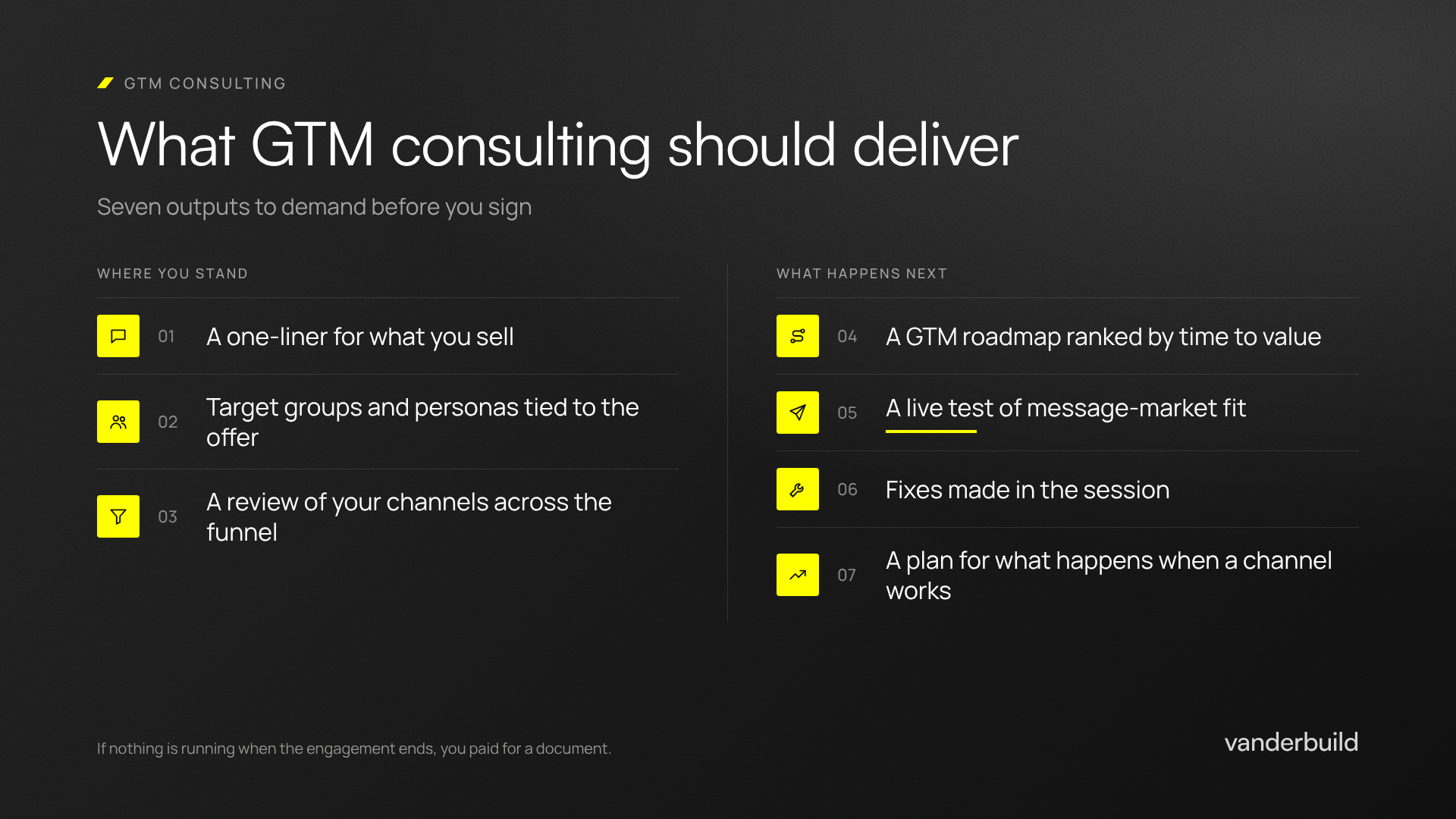
1. A one-liner for what you sell
The simplest way to describe what you sell, and how customers understand it.
2. Target groups and personas tied to the offer
Who you sell to, defined as target groups and the personas inside them. The one-liner is mapped to each persona. A full list of target accounts comes later, once the offer has proven itself. That step is total addressable market mapping.
3. A review of your channels across the funnel
Which channels already bring you into contact with customers, and what has been tried on each. Ideally the review covers every funnel stage. How are first leads generated? What happens once they are on your radar? How do deals get closed? For each stage, check whether you have a specific tool or tactic that works.
4. A GTM roadmap ranked by time to value
Every channel, persona, and target group goes on an impact-versus-effort matrix, or gets ranked by time to value. Time to value means how quickly each one can deliver something real. The section after this list covers what the roadmap should contain.
5. A live test of message-market fit
Advice on which channel to launch, followed by launching it. Say the recommendation is an outbound campaign. The next three hours go to building the list, writing the copy, and starting the send. Then you are talking to the market. Our working bar is 300 to 500 contacts per sales thesis. One "tell me more" per about 300 contacts confirms it. A product-market fit validation campaign is this step run at full size.
6. Fixes made in the session
If the advice is to rebuild your LinkedIn profile, you should leave the session with the profile already changed. My estimate is two hours with someone who tells you exactly what to change and why. It costs a bit more, and you walk out with the work done. If the advice is to start posting, you should leave with examples of people in your industry who post well. Learn their frameworks first, then build your own.
7. A plan for what happens when a channel works
Strategies often run out at the point where a channel starts working. Once a channel works, the plan should already say whether you scale it or open the next one. Nobody should have to stop and ask "now what?" just as things start to move.
What a good GTM roadmap looks like
A go-to-market roadmap orders the work by time to value. It answers four questions. Which channels will you use? How fast does each one launch? How will you know it is working? What happens after that?
In my experience, the fastest time to value comes from your network. That means people who pass your name on, contacts you reach through your network, and direct conversations. I call it a snowball. Before it can roll, you have to pack the first handful of snow. In practice, that means winning your first evangelists for what you sell.
From there, the roadmap takes one channel to the point where it is stable. Then you either scale it or start the next one. Decide that in advance. Teams often see a channel working and only then ask what to do next. The answer should already be written down.
Location changes the plan too. A GTM strategy differs from one market to another, so build the roadmap per market.
Everything above depends on the offer being simple. The roadmap maps channels and personas to one clear one-liner, which is why output 1 comes first.
Three red flags in a GTM consultant
Before you sign, check the person behind the slide deck. These are the three red flags I look for.
- No case studies, or a consultant who won't share any and hides behind NDAs.
- No background in execution. If someone advises you on cold email, ask whether they have run a good cold email campaign themselves. Then ask for proof. The same applies to outbound lead generation as a whole.
- No record of the result they are selling. If someone advises you on scaling a business from 10 million to 100, ask whether they have ever done it themselves.
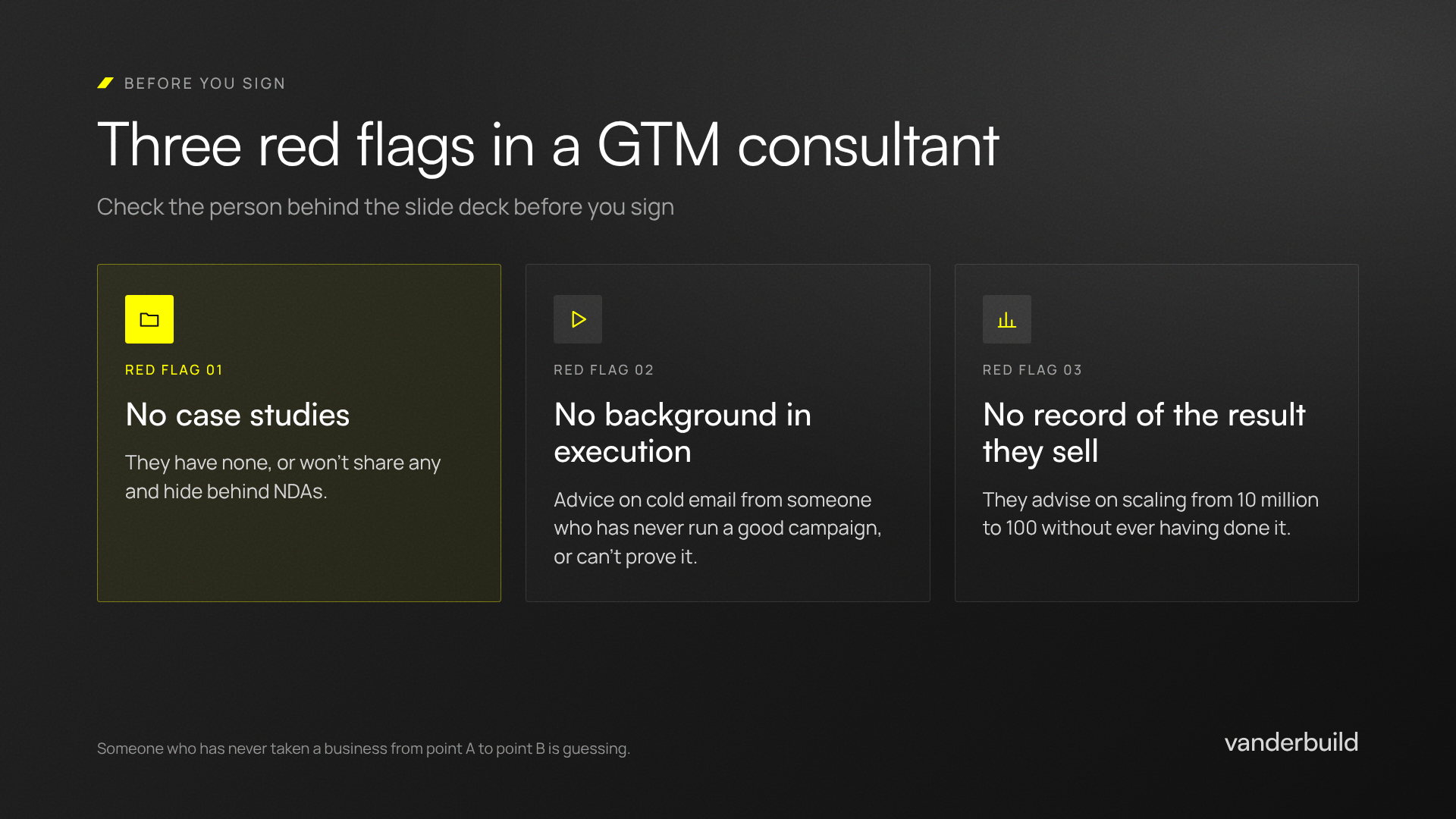
All three come down to real social proof. Someone who has never taken a business from point A to point B is guessing. Your company becomes their test. Our projects always pair a strategist with someone who builds and runs the systems. We describe that role in what GTM engineering is.
How fast a GTM roadmap should show results
Time to value is the whole argument for consulting at this stage. The people who know what works can save you the three to six months you would otherwise spend getting there yourself. If you are a small company, you don't have those three to six months.
So measure an engagement by what is running when it ends. For our outbound campaigns, first replies come within 2 to 3 weeks of launch. Qualified meetings typically follow in weeks 4 to 6, and we review the results at day 90. If, after a strategy engagement, nothing has launched, you have paid for a document.
Leads make you money, and so do people who start recommending you. Pay a consultant for the work that gets you there. To build your GTM roadmap with us, start with our GTM strategy workshops.
FAQ
What is a GTM consultant?
A GTM consultant helps a company decide how it enters its market. That covers what it sells, to whom, through which channels, and in what order. A good one also launches the first test with you.
What are standard GTM consulting services?
I expect a one-liner for the offer, target groups and personas, a channel review, and a GTM roadmap. On top of that come a live test of the first channel and quick fixes made during the session.
How do I choose a GTM consulting firm?
Ask for case studies and check that the people advising you have run campaigns themselves. Then ask whether they have achieved the result they are selling. Without proof, they are guessing.
How do you create a GTM roadmap?
Define your offer, target groups, personas, and channels. Then rank every channel by time to value or by impact versus effort. Take one channel to a stable state. Decide in advance whether you will then scale it or open the next channel.
Is a GTM audit worth it for a startup?
For a team of 10 to 20 people, fast testing of sales theses usually delivers more than an audit. Audits pay off in large companies, where one change affects how dozens of people work.
How long until GTM consulting shows results?
The first test should start during the engagement. For our outbound campaigns, first replies come within 2 to 3 weeks of launch. Qualified meetings typically follow in weeks 4 to 6.