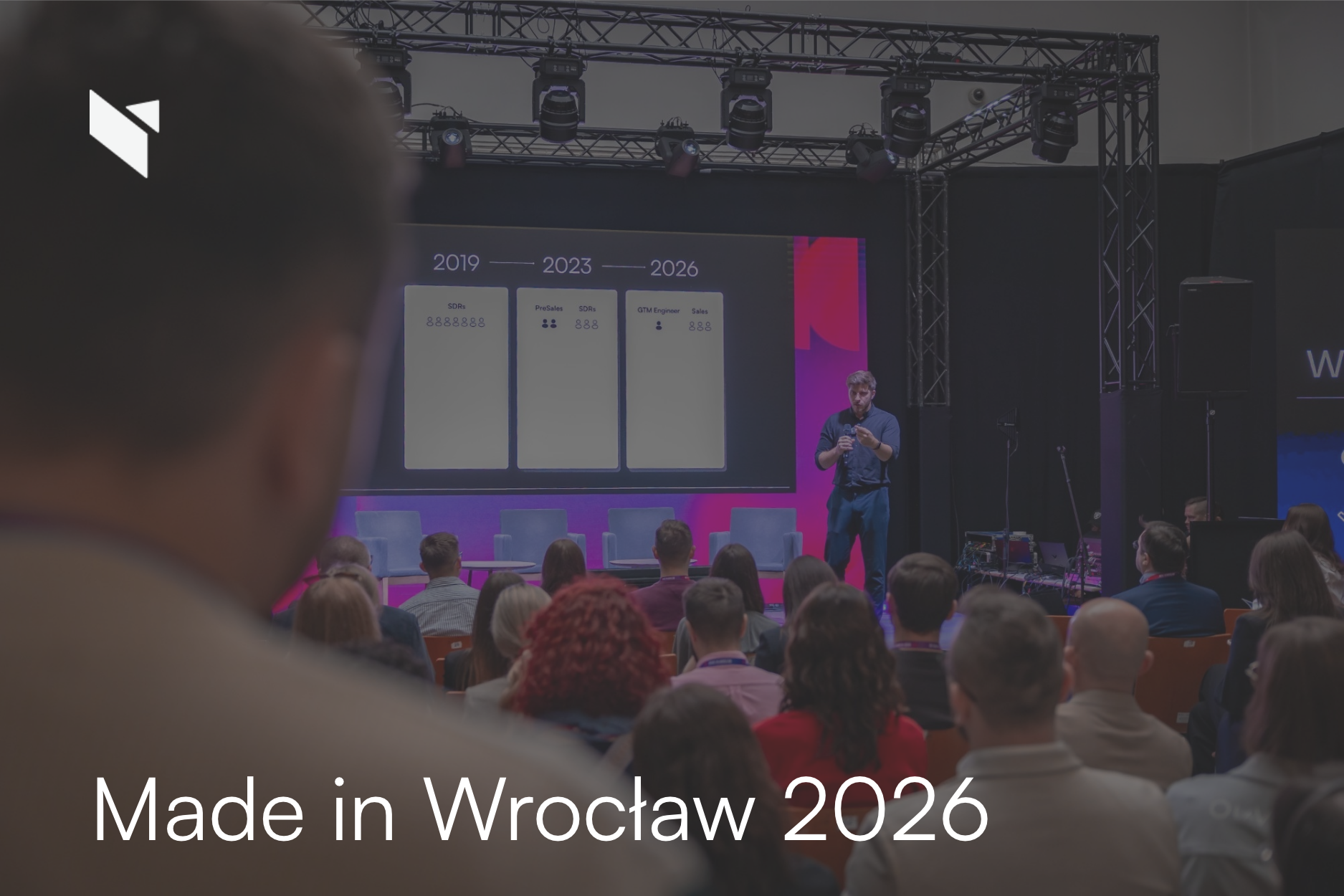
In The Hunger Games: The Ballad of Songbirds & Snakes, the arena of the Tenth Hunger Games is a real building in Wrocław. On 28 October our founder, Mateusz Sekta, gave a talk inside it.
The building is Centennial Hall, and the occasion was Made in Wrocław 2026, the tenth edition of the city's business and innovation event. It ran for two days, and we were there for both.

What Made in Wrocław is
Made in Wrocław brings startups, investors, scientists, and companies from Wrocław and Lower Silesia together once a year. The Wrocław Agglomeration Development Agency (ARAW) organizes it. The 2026 edition was the tenth, under the theme "ADAPT. LEAD. REPEAT."
Day one, 27 October, was VC Demo Day for startups and investors. Day two, 28 October, took place in Centennial Hall, with the conference and a free EXPO open to everyone. The first Synergy Awards gala followed in the evening. VC Demo Day and the conference were both by invitation, and we were invited to both.
Day one: VC Demo Day
VC Demo Day took place at The Bridge Hotel in Wrocław. The day was built around investors and the VC community. It was good to sit in the room with so many well-known names from that world.
Around 300 people came. The panels covered the future of the startup ecosystem in Wrocław and Lower Silesia, how Polish and European startups can compete with US companies, and how young companies win their first clients and investors. Guests from Germany, the United States, South Korea, and Turkey talked about how startups work in their countries.
The day closed with the first regional final of the Startup World Cup held in Wrocław. Ten startups from Lower Silesia pitched. TatraSpace won a trip to San Francisco, 3 to 7 November, for the grand final, where the prize is a $1 million investment.
For a GTM agency, a day like that shows what startups hear before they raise. It also shows what they will need once they have to find customers.
Day two: Centennial Hall
On 28 October the event moved to Centennial Hall, its first edition in that building.
The hall has a story of its own. Max Berg designed it, and it was built between 1911 and 1913 as a milestone of reinforced concrete architecture. Its dome is 65 meters across and 42 meters high, and the hall holds up to 10,000 people. It has been on the UNESCO World Heritage List since 2006. In 2023 it played the arena of the Tenth Hunger Games in The Ballad of Songbirds & Snakes.
The conference ran in three blocks: Knowledge, People, and Innovation. Jacek Sutryk, the Mayor of Wrocław, Michał Rado, Deputy Marshal of Lower Silesia, and Dr. Magdalena Okulowska, CEO of ARAW, opened it. Mikołaj Jan Piskorski of IMD Lausanne gave the first keynote, titled "Adapt or fall behind, because today one person can do what once took a hundred." Later speakers included Szymon Marciniak, the UEFA Elite referee, on leading people under pressure, and Miron Mironiuk of Cosmose AI. Prof. Witold M. Orłowski of PwC gave the closing keynote, which asked why the Polish economy has to innovate.
The EXPO next to it was free and open to everyone. Robo Friends Tech showed an autonomous robot that looks after seniors at home. Flow AI brought Adam Kowalski, a humanoid robot that talked to visitors. NJORD Energy showed its airborne wind energy system. Student teams from the Wrocław University of Science and Technology brought rockets and an electric racing motorcycle. Drones raced one level below the main floor.
The EXPO had two stages. WRO-HUB hosted startup presentations and contests. WRO-LAB hosted expert talks, panels, and fireside chats, with speakers from Brand24, Startup Poland, MadMountain, and KRUK. Mateusz had the second slot there, at 10:20, with "GTM Engineering: Modern Sales Processes."
The talk: why GTM engineering, and why now
Mateusz opened with a show of hands: who had heard of GTM engineering? About one in five people in the room raised a hand, and he sees more at every event.
His first claim was that sales has changed more in the last three years than in the previous 20. Since 2019, B2B databases have grown from 50 million to 500 million contacts. The same $50 a month now buys about 22 times more verified contacts than in 2018.

Cheap data lowers the barrier to entry, so more companies send the same campaign to the same people. On his slide, mass outreach converts at 1 to 1.5%. Signal-based outreach, built on data that is harder to get and to correlate, converts at 5 to 7%.

The team is changing with it. In 2019 a sales team was a row of SDRs. In 2026 it is one GTM engineer plus salespeople. The GTM engineer picks the data sources and connects them in an orchestrator such as Clay. The result then goes to the channels where it turns into action. Clay's founders named the role in 2024, and Mateusz knows it from the inside. He finished #1 in Europe and #2 in the world at Clay Cup 2025, Clay's global GTM engineering tournament.

Only 5 to 10% of the market is ready to buy
The second half started from the rule Mateusz called the most important in B2B. At any given moment, only 5 to 10% of a market is ready to buy. The rest needs educating, with enough touchpoints that you become the name people think of first. A GTM engineer builds those touchpoints in three ways.
Market observation. Signals give you a reason to write. They show up at the level of the industry, the company (a new office, a new director, new funding), and the person. Mateusz asked the room to be curious about the people they write to and to share an insight, instead of a hard pitch. Our recurring campaigns built this way bring around 160 new conversations in about three months.

CRM activation. People who already know you reply more often. One reheating campaign on his slide went to 50 past contacts, and 43.5% of those it reached replied.

Network activation. Mateusz has his whole LinkedIn network tagged as potential clients, partners, investors, or experts, so he knows who to reach for what.

His takeaways were short. Only part of the market is ready to buy at once, so your activities have to repeat. A smaller company needs at least 8 touchpoints before it buys, and an enterprise needs 42. Visibility and education beat direct selling in B2B, and they build up like a snowball. And keep your data in one source of truth, to act on it now and to build AI agents on it later.

One event QR code, 49 visitors
The last slide had a QR code. It led to a page with Mateusz's LinkedIn, the slides from the talk, our Plug & Play e-book of GTM strategies, the free GTM Tools Database, and a Skill.md file for Claude or ChatGPT that helps you choose which GTM scenario to implement.
In the hour of the talk, 49 people opened that page. By the end of the day the count was 64 visitors. Most of them came with no referrer, which is how a scan from a phone camera shows up in analytics.
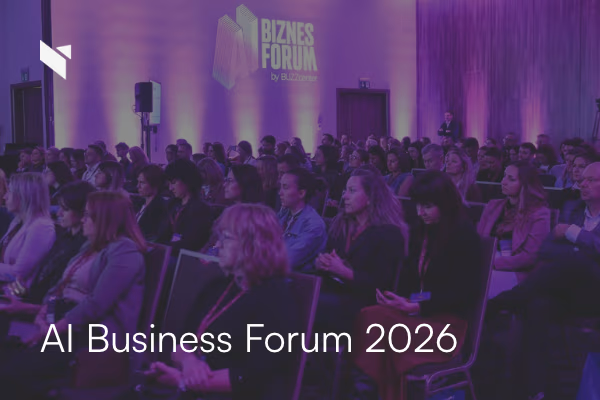
For conference speaking, that visit count is the number we watch. A talk ends when the speaker leaves the stage, and the page is what people take home. We gave two talks that week, at AI Biznes Forum in Warsaw and at Made in Wrocław. After both, we saw a wave of new newsletter sign-ups through the form at the bottom of the event pages.
What speaking engagements give a B2B company
For a company like ours, speaking engagements can bring three things.
A room full of the right people. A stage at a startup event puts you in front of founders, investors, and the people who run startup programs. They hear how you work in your own words.
Something people can act on later. A QR code to a page with the materials turns a talk into visits, sign-ups, and conversations after the event.
Content for the weeks after. One talk gives a blog post, LinkedIn posts, videos and photos for social media.
Thank you, Made in Wrocław
Thank you to ARAW and the Made in Wrocław team for both invitations and for the slot on the WRO-LAB stage. Thank you also to everyone who scanned the code. Congratulations to TatraSpace, and good luck in San Francisco.
New to the topic? Start with what GTM engineering is.