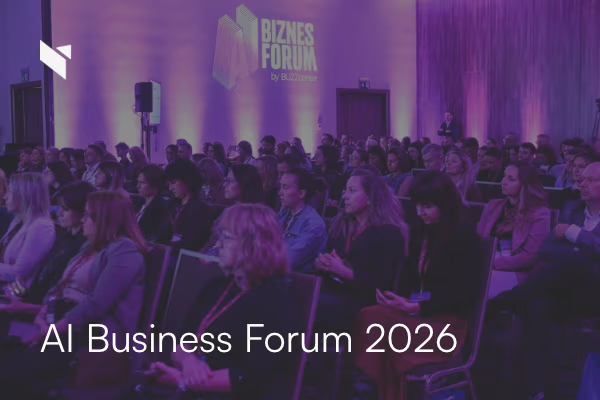
A room full of B2B marketers, at a conference about AI. We came to talk about how a message gets through when everyone writes with AI.
On 26 October 2026, our founder, Mateusz Sekta, spoke at AI Biznes Forum, the Marketing edition, in Warsaw. The talk was titled "Signal-based marketing. Jak przejść od masowych kampanii do komunikacji opartej na sygnałach zakupowych." In English, roughly: signal-based marketing, or how to move from mass campaigns to communication based on buying signals.

What AI Biznes Forum is
AI Biznes Forum is a series of conferences on using AI in business, organized by BUZZcenter, a Polish company that runs AI training for organizations. In 2026 it has four themed editions: HR, Sales, Marketing, and Business. All of them take place at Airport Hotel Okęcie in Warsaw. Across its past editions, the forum has brought together more than 840 participants and over 80 expert speakers.
Each edition runs for two days. The first day is talks from practitioners, and the second is hands-on workshops with AI tools. The Marketing edition, on 26 and 27 October, focused on AI in B2B marketing: content operations, personalization, AI search, and lead generation.
That made it the right room for our topic.
Why mass campaigns stopped standing out
We opened with the numbers we also showed at Useme Skills. Between 2018 and 2026, available B2B contact data grew about 18 times. The cost of one verified email fell about 8 times. The number of martech and sales tech tools grew 2.5 times. We cover the full numbers in our Useme Skills recap.
More data at a lower price did not make campaigns easier. When data is cheap and easy to get, everyone sends the same campaigns to the same people. The slides compared the two approaches:
- Mass campaigns target groups of companies. The barrier to entry is low, the market is saturated, and it is hard to stand out. Conversion sits around 1 to 1.5%.
- Signal-based campaigns target readiness to buy. The data is selected and harder to get, and it takes investment in tools and skills. Fewer people do it, so precision is higher. Conversion sits around 5 to 7%.
Then came what we called the most important rule of B2B. At any moment, only 5 to 10% of your market is ready to buy. The other 90 to 95% is not. If marketing and sales are about appearing and staying on the radar of your target customers, the work has to be repeatable.
The slides also gave three reasons signals matter right now:
- You need to show up when buyers are looking for a solution.
- The volume you can send through cold email keeps getting more limited.
- Everyone writes with AI now, so only a message that makes sense gets through.
Which B2B buying signals to watch
We split B2B buying signals into three levels of observation:
- Industry. Macro events, competitor moves, changes in law, market trends, and mass layoffs.
- Company. Company growth, a new office, a hiring surge, strategic changes such as a new board, funding, and visits to your website.
- Person. A promotion, a job change, interaction with your posts, content downloads, and visits to your website.
Each level needs its own list to start from: the sources to listen to, the accounts to watch, and the people who matter in those accounts.
The slides then showed the flow from signal to message: watch for signals, qualify the signal, find the right person in the company, enrich the data, write the message, and activate it in outreach.
We closed this part with five rules for working with signals:
- The starting point is watching the market, the company, and the person.
- One signal can work, but several signals together work better.
- A signal and its strength fade fast.
- A signal does not mean a company is ready to buy. It means the probability of readiness is higher.
- In an ideal setup, you collect signals in your CRM and use each company's history to understand the account better.
For a step-by-step build, read our guide to buying signals campaigns for outbound.
Which intent data tools to start with
One slide asked which tools to start with. It showed four intent data providers: Bombora, 6sense, Demandbase, and G2. Each tells you, in its own way, which companies are researching a topic or a product category right now.
Intent data is one source of signals. The slides split the whole stack into three layers:
- Data sources. For example, RB2B for identifying the people and companies that visit your website, Clay for job postings, new hires, and job changes, news portals and company websites for real-time events, and LinkedIn for prospects posting on relevant topics.
- Orchestration. Clay and ChatGPT, to enrich, analyze, qualify, and segment the data, then clean it and push it to activation.
- Activation. HeyReach for LinkedIn outreach, Instantly for cold email, and Salesforge for multichannel outreach.
We explain how intent signals fit into outbound in The Signal Revolution.

Your CRM and LinkedIn network are signal sources too
Then we turned to data a company already owns.
The CRM is the biggest unused source of leads, and the base for any work with signals. A lead nobody contacted for six months is not dead. Since then, the company may have opened a new office, hired a new director, raised funding, or started a new project. The contact may have been promoted, changed jobs, joined a webinar, or downloaded your material. Previous interest, a lost deal, and a meeting at an event count as well.
Three rules for reheating a CRM:
- Fix the data first. If your CRM looks like it was shot to pieces, clean and organize it before anything else.
- Look in the inbox. A lot of data hides in email. The CRM lists one contact, while four people joined the meetings and two more were mentioned in them.
- Remind, don't ask. Send an industry report, an interesting insight, or an invitation to an event, so people remember that you exist.
The same goes for LinkedIn. We asked the room how many of their LinkedIn contacts are potential clients, partners, or evangelists of their offer. The method: export your contacts, then categorize them as complementary experts, partners, potential clients, or investors. Add their function, seniority, industry, and the products they sell, tag each stakeholder, and only then start outreach.
If your CRM needs that cleanup first, start with our CRM Data Hygiene Manifesto.
Where this is heading
We ended with a look ahead. In our picture of the near future, one super agent works on top of a company's meeting transcripts, files, CRM, and conversations. Smaller agents handle sales, marketing, and administration. The work gets easier, and the team's skills get a boost.
The key slides, in English
The talk was in Polish. Below are eight of its slides, translated: the title, mass versus signal-based campaigns, how much of the market is ready to buy, the stack, the three levels of signals, the rules for working with signals, and the two slides on the CRM.
Everyone in the room also got a set of extra materials through a QR code on the last slide. Those stay with the attendees. One of them is open to everyone. Our Sales Tools Database is a curated list of GTM tools, from orchestrators and data sources to sales and CRM tools.

Thank you, AI Biznes Forum
Thank you to BUZZcenter for inviting us, and to everyone who came to the talk. If you want the tools behind the signals we talked about, browse the Sales Tools Database.