.webp)
Ask an experienced salesperson how they wrote a message that landed, and you get a shrug. They know who they are writing to, what that person's day looks like, which objection comes third, and which of ten openings fits this account. That knowledge sits in their head, unwritten, and every AI tool in your stack is locked out of it.
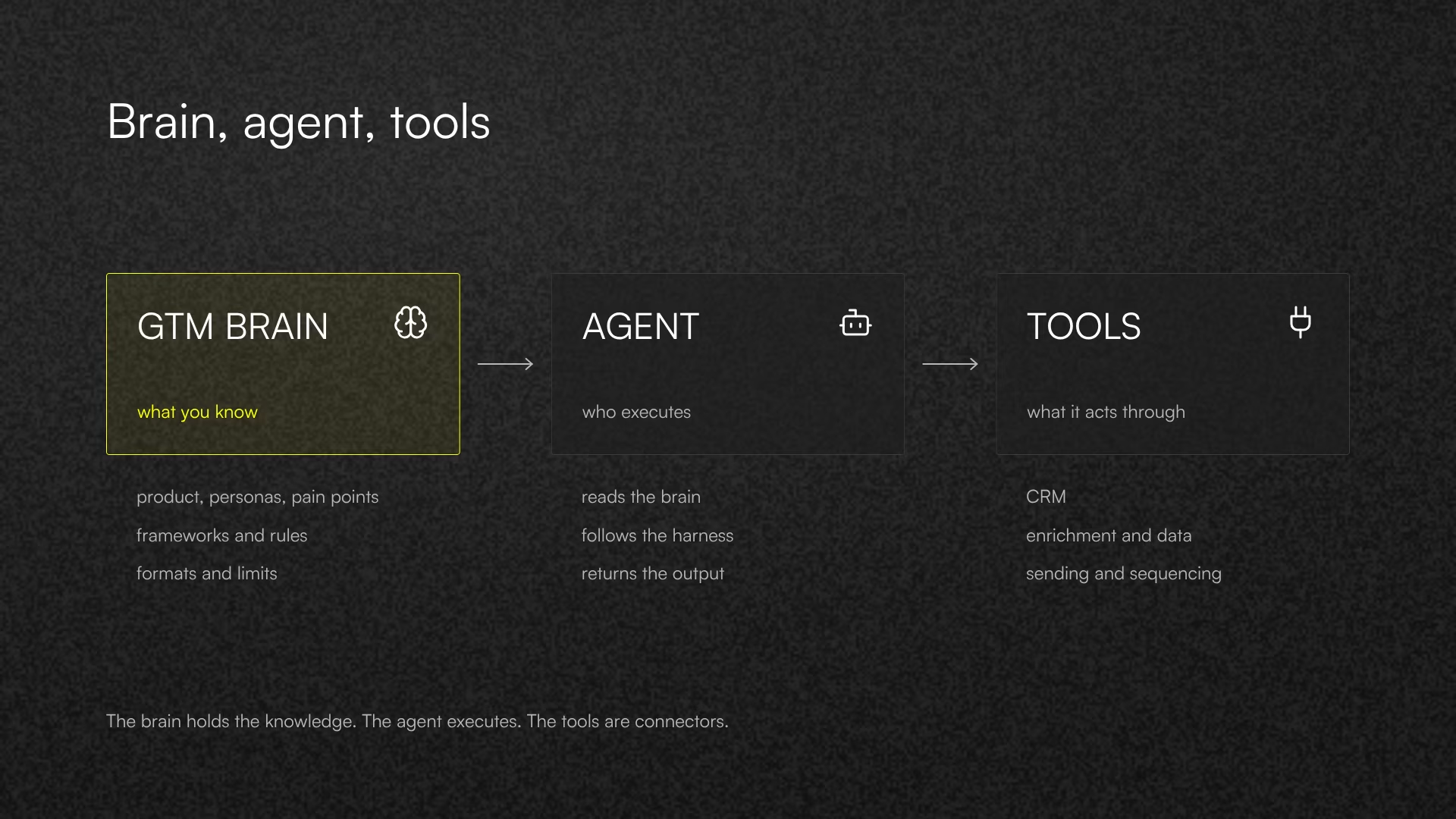
A GTM Brain is that knowledge, written down in a form an agent can read. It is the difference between an agent that produces plausible output at volume and one that produces your output.
What is a GTM Brain, and why is it more than an AI knowledge base?
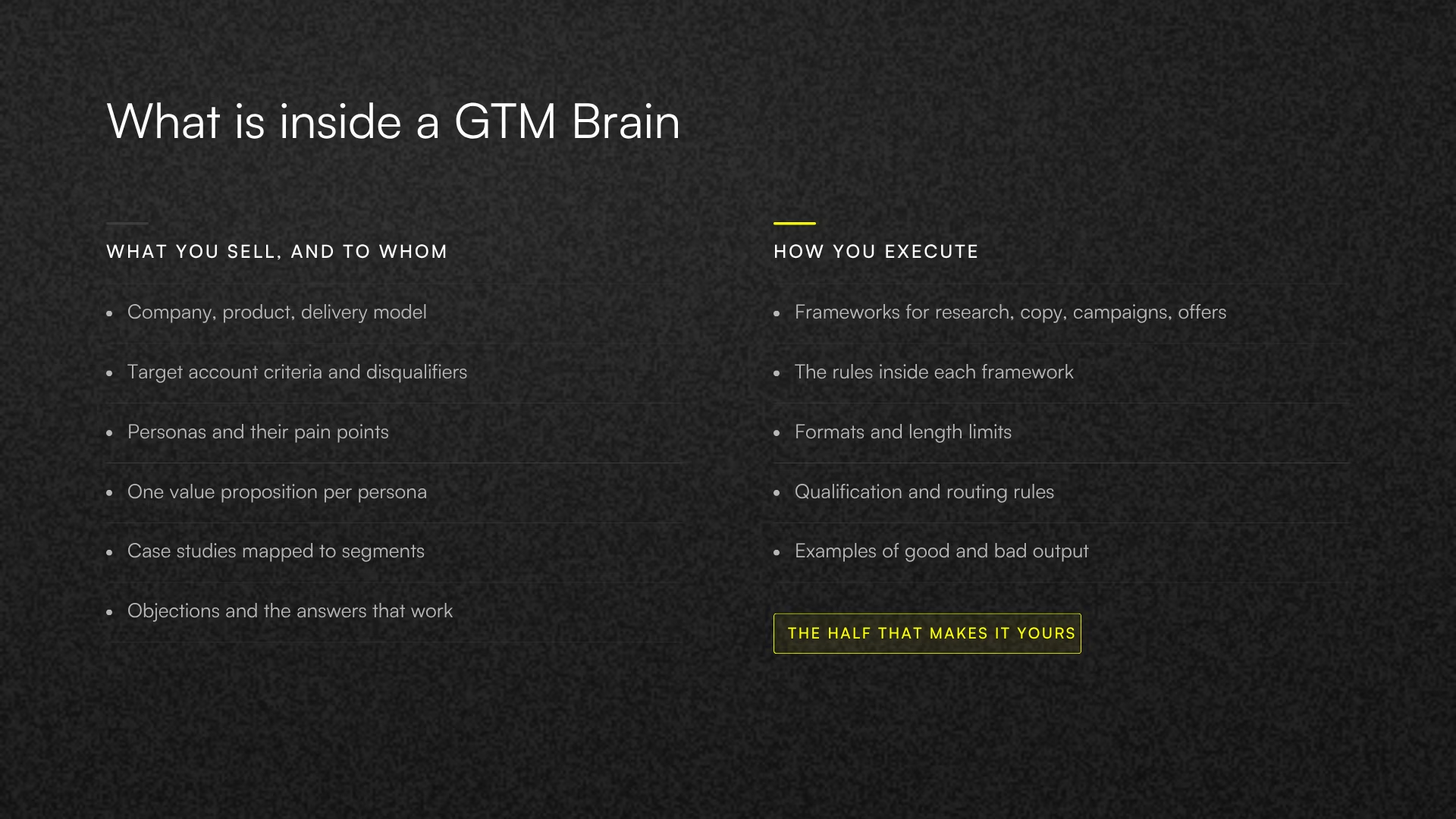
A GTM Brain is a structured AI knowledge base for go-to-market work. It holds two things: what you sell and to whom, and how you execute.
The first half is descriptive. Your product, your company, the problems you solve, your target accounts, your personas, their pain points, the solutions you put in front of each one. The second half is the part almost nobody writes down: the frameworks you use to turn that information into a message, a campaign, or an offer. Your rules, your sequence of steps, your reasons for each.
Everything a GTM team does is a list of steps executed in order. The more precisely you write down what you do, how, and why, the more of your expertise the brain carries.
Three problems it solves, in the order teams feel them:
- Time. The repetitive part of the work stops consuming your best people.
- Archiving. Knowledge that lived in one person's head survives their notice period.
- Order. You cannot write a brain without first organizing how you actually work.
That third one arrives as a side effect and often outweighs the rest. Nobody deploys agents on top of undocumented processes, so the act of building the brain forces the cleanup that should have happened anyway.
GTM Brain vs an internal knowledge base: one is written for people
Most companies already have an internal knowledge base: a wiki, a shared drive, a folder of decks. It was written for humans, who fill the gaps themselves, skip the outdated page, and ask a colleague when something is unclear. An agent does none of that. It reads what is there and acts on it.
Three differences decide whether your existing docs can serve as a brain:
- Specificity. "We target mid-market SaaS" is a note for a colleague. An agent needs the account criteria, the disqualifiers, and the persona split.
- Execution rules. A wiki records decisions. A brain records methods, step by step, with the reasoning.
- A single source of truth. One place a fact lives. When three documents disagree, the agent picks one, and you will not know which.
The brain is also the layer that makes your channels consistent, which is the same argument behind a revenue engine built as one system rather than four disconnected motions.
What goes inside a GTM Brain: knowledge base AI can actually use
Practical AI knowledge base examples for a B2B team, split by the two halves:
What you sell, and to whom
- Company, product, delivery model, and what you decline to do
- Target account criteria, with the disqualifiers written out
- Personas, their responsibilities, their pain points, the words they use
- One value proposition per persona and account type
- Case studies mapped to segments, with the numbers you are allowed to quote
- Objections and the answers that worked
How you execute
- Your frameworks for research, messaging, campaign setup, and offers
- The rules inside each: what always happens, what never happens
- Formats and length limits for every output
- Qualification and routing rules
- What a finished piece of work looks like, with examples of good and bad
The second half is what makes the brain yours. The first half is available to anyone who reads your website.
Context engineering vs prompt engineering: why better prompts do not fix this
Teams reach for prompts first. A prompt is one instruction at one moment. Context is everything the model knows when it reads that instruction, and that is what decides whether the output is right.
Agentic context engineering is the work of deciding what an agent sees, when it sees it, and what it does with it. A perfect prompt on top of no context produces confident output about a company that does not exist. Adequate instructions on top of real AI agent context produce work you can send.
There is a second reason prompts are the wrong lever. Without narrow context, AI covers every angle it can think of, because it has not been told which one matters. The result is the 40-page report where 5 pages would do. Expertise is the ability to explain something complicated in simple terms, and a model given room will do the opposite: paraphrase, add metaphors, and hedge.
Agent guardrails: the harness that keeps GTM agents inside the lines
The brain says what you know. The harness says how an agent may act on it. The rules the agent follows during execution are its agent guardrails: the format, the limits, the steps, the things it must never do.
The relationship is simple. The more specific the rules, the smaller the chance of an error, and the more repeatable the result. Repeatability is the whole point of putting GTM agents on a process in the first place.
The same rule decides which processes qualify. Automate what repeats and what you have already run by hand, which is the principle behind validating a sales process before automating it. Keep the creative, custom, workshop-style work with people, where a human brain still wins.
In practice, an agentic GTM setup covers research, message copy, campaign setup and sending, reply handling, sending infrastructure, sales offers, meeting analysis, discovery briefs from CRM data, and support. The tasks worth starting with are the ones you do most often, not the ones that annoy you most. Volume is where the hours are, and the agents already running in B2B sales and marketing clusters in exactly those places.
How to build a GTM Brain: five steps of GTM engineering
.avif)
1. Build the knowledge base first. Put it somewhere agents connect to easily. A GitHub repository or a similar versioned repo works better than a document tool, because it is plain text, it has history, and every agent can read it. Company knowledge, personas, frameworks, task instructions.
2. Choose the tasks to automate. Take the repetitive ones, the ones you run often enough that a written rule set is worth the effort. If a process has never been run manually, it is not a candidate yet.
3. Choose the framework and the tools. Agent frameworks from OpenAI or Anthropic are the simplest entry point, and agents can also be deployed on your own server to run around the clock. Keep the knowledge outside the tool's ecosystem, so switching tools costs an afternoon rather than a rebuild.
4. Keep a human in the loop. Anything that goes to a client gets read by a person before it goes out, at least until the output has been standardized long enough that only the data inside it changes.
5. Close the loop. Add subagents that audit the output of the main agent, catch bad syntax and wrong formats, and send the work back for correction. Few companies have reached this step, and it is fine to be one of them: steps one and two carry most of the value.
The order matters more than the speed. Each step assumes the one before it exists, the same dependency logic that decides where a GTM engineer is worth hiring.
Where a GTM Brain goes wrong: three failure modes to watch
People stop practicing. When agents handle the repetitive work, the simple skills underneath it fade. Ask someone to do the task manually a year later and the answer may be a blank look.
Trust without verification. "AI wrote it, so it must be fine" is how quality drops without anyone noticing. Human in the loop exist for this, and it costs a minute per output.
The models move. Model quality shifts between versions, and a workflow tuned to one model can behave differently after an update. Keep the knowledge outside the tool, test the output on a schedule, and treat a new model version as a change to validate rather than a free upgrade.
Is a GTM Brain the future of GTM engineering?
Everything a company does today involves moving knowledge from one head into another: onboarding, briefing an agency, training a new rep. A GTM Brain is a substitute for that transfer. It backs up expertise, shortens onboarding, works around the clock, and costs less than the alternative.
Few teams have it fully in place, which is exactly why it is worth starting now. Write down the ten things you explain most often to new people. That is the first page of your brain, and every agent you build afterwards reads it.