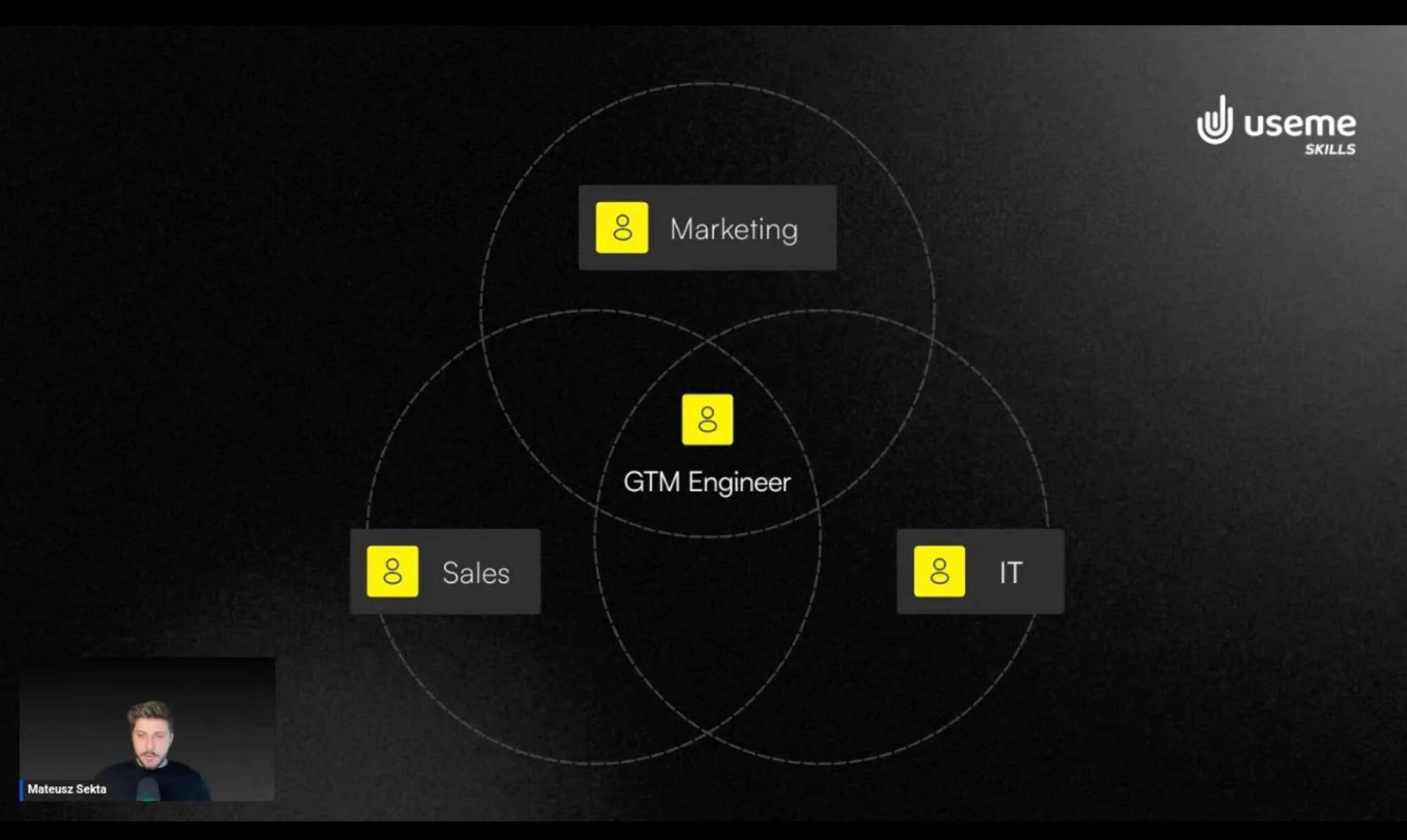
"Who here has heard the term GTM Engineer?"
That was the first question on Mateusz's slides on 22 October 2026, at 8:30 in the morning. The audience was freelancers, marketers, automation specialists, and salespeople. The webinar was part of Useme Skills, a series of live sessions where practitioners teach a skill people can use the next day. Earlier editions featured speakers from Lovable and Canva.
Useme is a Polish platform that connects freelancers with clients and handles settlements, invoices, and taxes between them. It does this even for people who don't run their own company. The title Useme chose was "Dodaj GTM engineering do swojej oferty," in English roughly: add GTM engineering to your offer, a new profession on the border of sales, marketing, and IT.
The format was 60 minutes of presentation and demo, then 30 minutes of questions from the chat. Kamil Pelcer from Useme opened the session with Mateusz. Useme told us 306 people registered.

The market changed faster in three years than in the previous 20
We opened with data, because GTM engineering exists for a data reason.
In 2018, $50 a month on an entry-level email finder (Hunter Starter or Snov Starter, one data source) got you about 500 contacts. Roughly 45% of them were verified. That is around 225 usable emails. In 2026, the same $50 on a plan with waterfall enrichment (Apollo Pro or Hunter Unified, several sources checked in sequence) gets about 5,500 contacts at roughly 90%. That is around 4,950 usable emails, about 22 times more for the same money.
The price of one verified B2B email fell from about 10 cents to about 1.5 cents over the same period. The number of martech and sales tech tools in Scott Brinker's landscape grew from 7,040 to 15,384.
We called this the data paradox. There is more data than ever, and it costs less than ever, yet connecting it into something useful keeps getting harder. Someone has to join the sources, clean them, and decide what to do with them. That someone is the GTM engineer.
How the GTM engineer role grew out of sales
The role grew out of the sales team. In 2019 outbound ran on SDRs with about 6 tools and about $380 a month in tools per person. By 2023 presales and SDRs worked with about 9 tools at about $670 a month. In 2026 the GTM engineer works with about 11 tools at about $1,670 a month per person.
Our definition from the webinar:
A GTM engineer is a person who can connect data, analyze it, and activate it automatically, at scale, while understanding the business context.
The role sits where marketing, sales, and IT overlap. We gave three reasons it is in demand right now:
- AI and agentic tools can connect data across systems, which was manual work a few years ago.
- Few people combine sales and marketing with technology. Most know one side well.
- Founders want growth without growing the team.
For the full answer to what a GTM engineer is and does, read our guide What is GTM Engineering?
“Yesterday I was at an event about GTM where the GTM Engineer role came up, but I left really unsatisfied, with the feeling that the topic had been oversimplified to the max. With you I got good context, some practice that left me wanting more, and frameworks I want to implement. To the point. Thanks.”
Translated from Polish.
GTM engineering starts with how B2B buying works
At any moment, only 5 to 10% of your target market is ready to buy. The other 90 to 95% is not. If marketing and sales mean showing up and staying on your buyers' radar, the work has to be repeatable. A GTM engineer has to know how to do that, which is more than building processes.
We showed four ways to stay on the radar:
- Market awareness and education, so buyers know who you are before they need you.
- Signal-based outreach: watch the market and contact people when something has just happened.
- CRM activation: recycle the data you already have and stay in touch.
- Mapping your business environment: activate the network you already built.
What signals can you watch?
We split signals into three levels:
- Industry: macro events, competitor moves, changes in the law, market trends, mass layoffs.
- Company: growth, a new office, a hiring spree, a change in the leadership team, a funding round, visits to your website.
- Person: a promotion, a job change, a reaction to your post, a content download, activity on your site.
The data flow behind a signal campaign starts with signal sources and signal qualification. Then come company extraction, finding the right people for your ideal customer profile, enrichment, and finally activation in outreach. Five rules decide whether it works:
- Start by observing the market, the company, and the person.
- One signal can work, but several signals together work better.
- Signals lose their strength fast.
- A signal does not mean the company is ready to buy. It means the odds are higher.
- Ideally, you collect signals in your CRM and use the account's history to understand it better.
We cover the method in more depth in The Signal Revolution.
Your CRM is the biggest unused source of leads
Picture a lead nobody has contacted for six months. Then the company opens a new office, hires a new director, or raises money, and the person gets promoted or changes jobs. Add what you already know: earlier interest, a lost deal, a meeting at an event. Put that context together and the old record becomes a reason to reach out again.
Three rules for reheating a CRM:
- Fix the foundations first. If your CRM looks like it was shot to pieces, clean and organize it before anything else.
- Look in the inbox. A lot of data hides in email. The CRM may list one person, while four people joined the meetings.
- Remind them you exist. Send an industry report, a useful insight, or an event invitation.
If your CRM needs that cleanup first, start with how to organize your CRM and recover lost leads.
GTM engineer skills: what 739 job postings ask for
To show what the market expects, we used our own analysis of 739 GTM engineer job postings on LinkedIn, the GTM Engineering Jobs Report.
- Clay is the number one tool. It is required in 60% of postings.
- The role is AI-native by default. AI or LLM skills appear in 86% of postings. Of all postings, 49% explicitly want someone who builds AI agents. Claude is named in 33% of postings, more often than GPT (22%).
- Technical skills matter. APIs and webhooks come up in 66% of postings, Python in 41%, and SQL in 35%.
- The work itself: 84% of postings mention automating processes, 65% enriching lead data, 61% powering outbound at scale, and 57% dashboards. Lead scoring and routing (42%), tool integrations (37%), and ICP segmentation (36%) follow.
- Pay: in the US, the typical range is $130K to $180K a year, with a median of about $160K and an average of about $153K.
- Location: 43% of demand is in the United States, led by San Francisco and New York.
Only 10 of the 739 postings were junior roles, a number that stood out for this audience. There is no clear entry path into the profession yet. For a freelancer, a working project you can show matters more than a job title. Clay is the right first tool to learn, since most postings ask for it.
Where AI takes GTM engineering next
We closed the presentation with a look ahead at the future of GTM engineering. Today, a team's knowledge is spread across meeting transcripts, files on a drive, the CRM, and conversations. The next step is one super agent that reads all of it and hands work to specialized agents for sales, marketing, and administration.
For the people on the team, that means their skills go further and the work gets easier. Someone still has to connect the sources and design how the agents work, which is GTM engineering again.
How to become a GTM engineer: three first steps
Here are three steps anyone can take this week:
- Check what the market wants. Read the jobs report and write down the tools and skills that repeat in the postings. Compare them with what you already know.
- Start without a budget. Many sales tools have a free plan, a trial, or starting credits, so your first project can cost nothing. Our Sales Tools Database lists 1,163 sales tools by category.
- Build your first portfolio project. Build one simple GTM engine before you contact your first client. Then show it in your offer.
Our free GTM engineering course: Become a Junior GTM Engineer
With so few junior roles, almost nobody trains people into this job. That is why we launched a free GTM engineer course on Mateusz's YouTube channel, one day before the webinar.
The first lesson, "Why GTM Engineer Earns $160K and How to Become One," went live on 21 October 2026. It explains the job, what companies ask for, and what they pay. Each lesson after it stands on its own and covers one part of a GTM engine. Until a lesson is out, our blog post on the same topic, where we have one, is a good place to start:
- Cold email infrastructure (start with email deliverability)
- LinkedIn infrastructure
- List building and signals (see buying signal campaigns)
- Copywriting (see how to write a B2B cold email)
- Clay and enrichment (see waterfall enrichment in Clay)
- Campaign management (see how to create a cold email campaign)
- Automation (see sales process automation)
- Monetizing your skill set
A new lesson comes out every week. Start with the first lesson:
Alongside the course, Clay University and the Clay Club community are good places to keep learning.
“I took part in today's Useme webinar that you led. A great presentation and a huge amount of valuable knowledge, thanks. I also looked at your YouTube channel, and I'll definitely stay longer: great content and great editing, it's a pleasure to listen to and watch.”
Translated from Polish.
Thank you, Useme
Thank you to the Useme team for the invitation, the rehearsal, and the smooth organization. We also thank everyone who joined at 8:30 in the morning with questions.
“Thanks again for today's webinar. I'm hearing it was really substantive and charismatic, which I can confirm, because I watched it too.”
“A very charismatic guy. We want more like him.”
“A very good live session, thanks for sharing your knowledge and materials.”
Translated from Polish.
Everyone who registered got a page with the materials from the session: the jobs report, the skill file from the live demo, a list of sales tools and what each one offers for free, and the slides.