.webp)
The question comes up in every GTM conversation now, usually framed as a choice. Which one should we build on. Which one replaces the other. Which one is the orchestrator.
The framing is what makes it hard to answer. These two do different jobs, and teams that pick one end up rebuilding the other badly.
Here is what each is actually for, where each wins, and the order that makes them work together.
What you'll learn:
- Where each tool sits in a sales tech stack
- Clay vs Claude, side by side
- Where each fits in the process, stage by stage
- What Clay does better, and what that control costs
- What Claude does better, and where it stops being safe
- What Clay pricing means for a smaller team
The Role of Clay and Claude in a Sales Tech Stack
Both tools sit in the same part of a GTM stack, between your data sources and your sequencer, which is why teams assume one has to win. A comparison makes the split easier to see.
A library holds things in a fixed order. Every item has one place, the catalogue tells you where it is, and anyone walking in can retrace how something got filed. That predictability is the whole point of a library, and it comes from giving up flexibility.
A researcher works differently. They read across shelves, notice that two sources contradict each other, walk outside to find a third the library never held, and come back with a summary nobody had written before. Fast, adaptable, and harder to audit afterwards.
Clay is the library. Claude is the researcher.
You would not ask the library to write the summary, and you would not ask the researcher to guarantee that every item goes back in the same slot every time. Most of the confusion in this comparison comes from expecting one of them to be the other.
Everything below is an elaboration of that.
Clay vs Claude, Side by Side
Clay vs Claude
 Clay Clay |
 Claude Claude |
|
|---|---|---|
| Role in the stack | Structured storage and repeatable operations on it | Processing, reconciling and reasoning across sources |
| How the logic reads | Visible column to column, table to table | You see the result rather than the path |
| Predictability | Same input, same output, every run | May take a different route without telling you |
| Best at | Enrichment waterfalls, qualification, joining providers | Messy sources, formats that do not match, one-off analysis |
| Reaches | The providers it integrates with | Anything you can point it at, including pages and PDFs |
| Small tasks | Needs a column and a credit | Seconds, no setup |
| CRM connection | Gated behind a higher tier | Works on effectively any plan |
| Where it fails | Sources that were never designed to fit together | Processes that must run unattended against live records |
The row that matters most is predictability. Clay gives up flexibility to buy certainty, and for a process running a thousand times a week against your own database, that certainty is the product.
Where Each One Fits in the Data Flow
Once you stop asking which one wins, the arrangement is obvious.
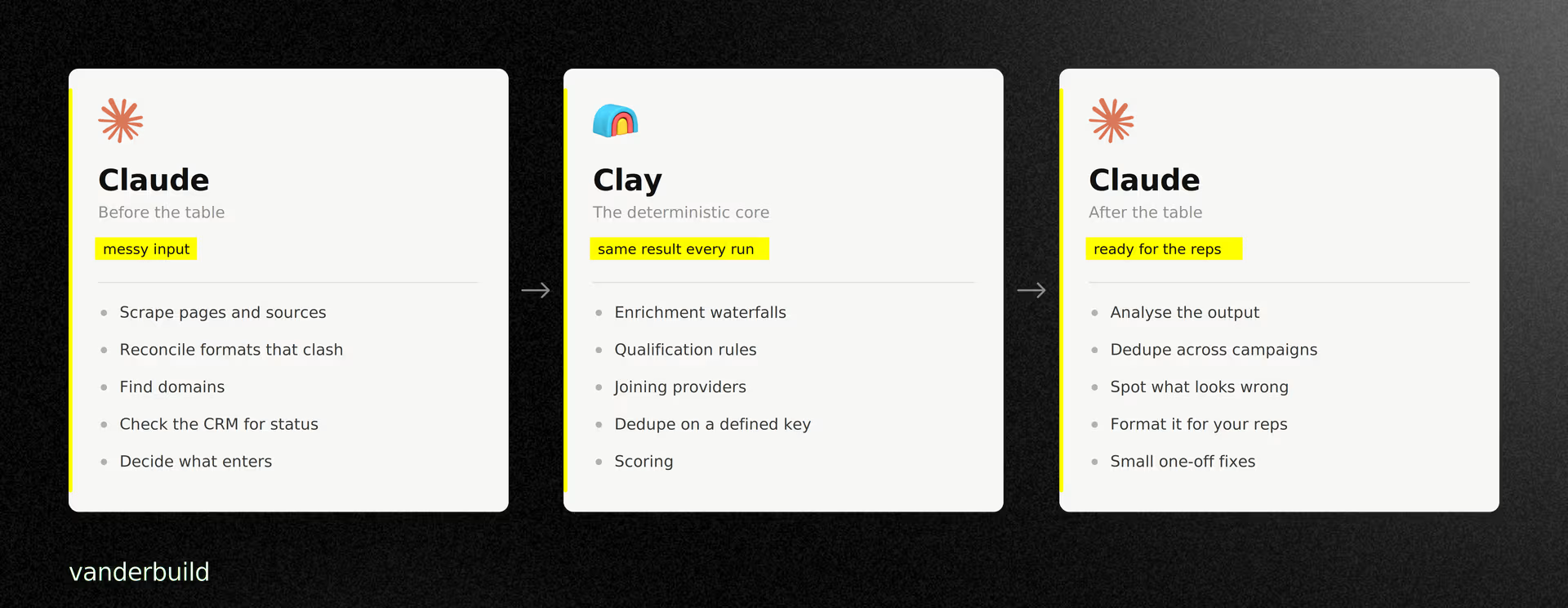
Claude before. Scraping, reconciling sources, structuring raw input, CRM lookups, deciding what should even enter the pipeline. Take a campaign built off a conference attendee list. Half the work happens before anything reaches a table: pulling every company from the event page, finding their domains, capturing the logos, and checking each one against the CRM for existing status. That output is the input to Clay.
Clay in the middle. Enrichment waterfalls, qualification, scoring, joining providers, deduplication on defined keys. Everything that has to run identically every time. This is the deterministic core, and our waterfall enrichment guide covers the mechanics.
Claude after. Analysing what came out, deduplicating across campaigns, formatting the final list so the reps working it can read it. Whoever built the table knows what every column means, and the person picking up the list at nine on Monday does not.
There is a design principle underneath the sequence. Build the deterministic layer first, then wrap the flexible layer around it. An agentic process built on top of an unproven workflow makes the not-knowing autonomous, and faster.
What Clay Does Better
You can see the logic. Click a cell and the path is there: which enrichment ran, what conditions applied, what came back. When something breaks, you can find where. In Claude the same process gives you the output and keeps the route to itself.
It behaves the same way every time. Given the same input and the same setup, you get the same result. For anything running unattended, that repeatability is worth more than cleverness.
Standard operations at scale. Enrichment waterfalls, qualification rules, joining several providers, dedupe on a defined key. These are solved problems in Clay and they run without supervision. If you are setting this up for the first time, the ten most common setup mistakes are worth reading before you build anything you plan to keep.
The case against handing full orchestration to a language model comes down to control. Claude can decide something differently than you intended, and you may not find out. That is fine in an exploratory task and a problem in a process running against your CRM at three in the morning.
What Claude Does Better
Reconciling sources that were never designed to fit together.
This is the biggest single time saving and it is easy to underestimate. Say you are building a list of manufacturers. One source has excellent company data and no LinkedIn, so LinkedIn comes from somewhere else and the two tables have to be joined. Then a third attribute means a third source, structured differently again.
Doing that by hand means matching columns, reconciling formats and checking joins. That is a two-hour job, and it takes two minutes in Claude. The work does not disappear, it just happens to be the exact thing a language model is good at: pattern-matching across data that describes the same thing in three different ways.
Working before anything reaches a table. Scraping a page, pulling entities out of it, finding domains, checking the CRM. Half the pipeline can happen here.
Analysing what came out. Export a table as JSON, hand it to Claude, ask what looks wrong. You get an assessment with the whole table as context rather than eyeballing rows, and that loop is how prompts get fixed.
Small tasks that would be silly to build a column for. Deciding whether a contact is a Mr or a Ms. Handling grammatical cases in inflected languages. Rewriting a job title into something readable.
Cross-campaign deduplication. Running three campaigns at once means avoiding two people from the same company inside the same week, which is the check nobody remembers to build until a prospect points it out. Claude handles that comparison at the end of list building, and there are more of these small workflows in how we use Claude in our sales pipeline.
Clay Pricing and the Detail That Changes the Maths
One practical asymmetry worth knowing before you plan a stack, and it sits in the pricing rather than the feature list.
Clay gates CRM connection behind a higher tier. On an in-house budget that is a real line item. Claude connects to HubSpot on effectively any plan.
That changes the calculation more than it first appears. You can run Clay on a cheaper tier for the deterministic work and handle CRM reads and writes through Claude. Orchestration lives at the Claude layer, and Clay does the enrichment it is best at.
It also says something about where Clay is heading. Clay increasingly behaves like a customer of the language models rather than a competitor to them. It calls out to them for the parts that need judgement and keeps the structured, repeatable layer for itself. That is a sensible division, and it suggests the two are converging on complementary roles.
Other Data Orchestration and Prospecting Tools
The Clay conversation is loud enough that it hides the rest of the market. If someone on your team suggests a different platform, it helps to know what they mean.
Cargo positions as a GTM orchestration platform, sitting between sources and destinations with workflow logic in the middle. Common Room is signal-first, aggregating intent and engagement across channels rather than focusing on enrichment. Unify combines intent data with automated sequencing, closer to end-to-end than to a data layer. n8n and general automation platforms cover the plumbing without the sales-specific enrichment.
A team that knows one platform will recommend that platform for everything, which is worth remembering when you read any comparison in this category, including this one. We work in the Claude, Codex and Clay environment and say so rather than claiming to be tool-agnostic. The concept underneath all of them is covered in what is data orchestration.
Which One Should You Learn First?
Depends on what you already have.
No structured data process at all: learn Clay. It forces you to think in columns, conditions and waterfalls, and that discipline transfers to everything else. Start with what is Clay.
Clay already running, still doing manual work around it: learn Claude. The two hours a week someone spends reconciling exports is the fastest available return, and these workflows are a reasonable place to start.
Neither, and your CRM is a mess: neither tool solves that. Structure comes first, and the order is in what is RevOps.
FAQ
Can Claude replace Clay entirely?
For exploratory work and one-off list building, often yes. For processes running unattended against live records, the visibility you lose is exactly the thing you need when something goes wrong.
Can Clay replace Claude?
Not for reconciling inconsistent sources, and not economically for CRM connectivity on lower tiers. Clay also calls out to language models internally, which tells you where the boundary sits.
How does Clay pricing work?
Clay bills on credits, with the tier deciding how many you get and which features unlock. The one that catches teams out is CRM connection, which sits on a higher plan than most people expect when they budget.
Does Clay connect to my CRM?
Yes, on the tiers that include it. Below that you can still move records through another layer, which is the workaround described above and the reason the pricing question and the architecture question end up being the same question.
Which is cheaper overall?
Depends on volume and tier. The asymmetry that matters is CRM connection.
Is this the same as data orchestration?
Data orchestration is the category. Clay and Claude occupy different layers within it, alongside Cargo, Common Room, Unify and others.
What about Codex or other coding agents?
They sit alongside Claude for the parts that are genuinely code rather than data reasoning. The split is fluid and depends on the task.
Do I need both?
If your team runs campaigns continuously, yes. If you build one list a month, Claude alone will get you further than you expect.
Not Sure Which Layer You Are Missing?
Most teams have one of these and are doing the other one by hand without noticing.
Book a 30-minute call. No pitch. We will look at your stack and tell you which layer is missing, or that neither is your problem right now.