.webp)
Read five guides on revenue operations and you will get five identical definitions, followed by five different frameworks.
One says the pillars are process, platform, people and performance. Another says plan, perform, pay and performance. A third says data, process, technology and enablement. A fourth adds governance and makes it five. All of them are defensible. None of them tells you what to build on Monday.
That gap is the reason this article exists. The definition is settled. The question worth answering is what RevOps consists of in practice, and that answer looks different depending on whether you are describing an organisational principle or a system somebody has to implement.
What you'll learn:
- The definition the industry actually agrees on
- Why every framework lists different pillars, and what they have in common
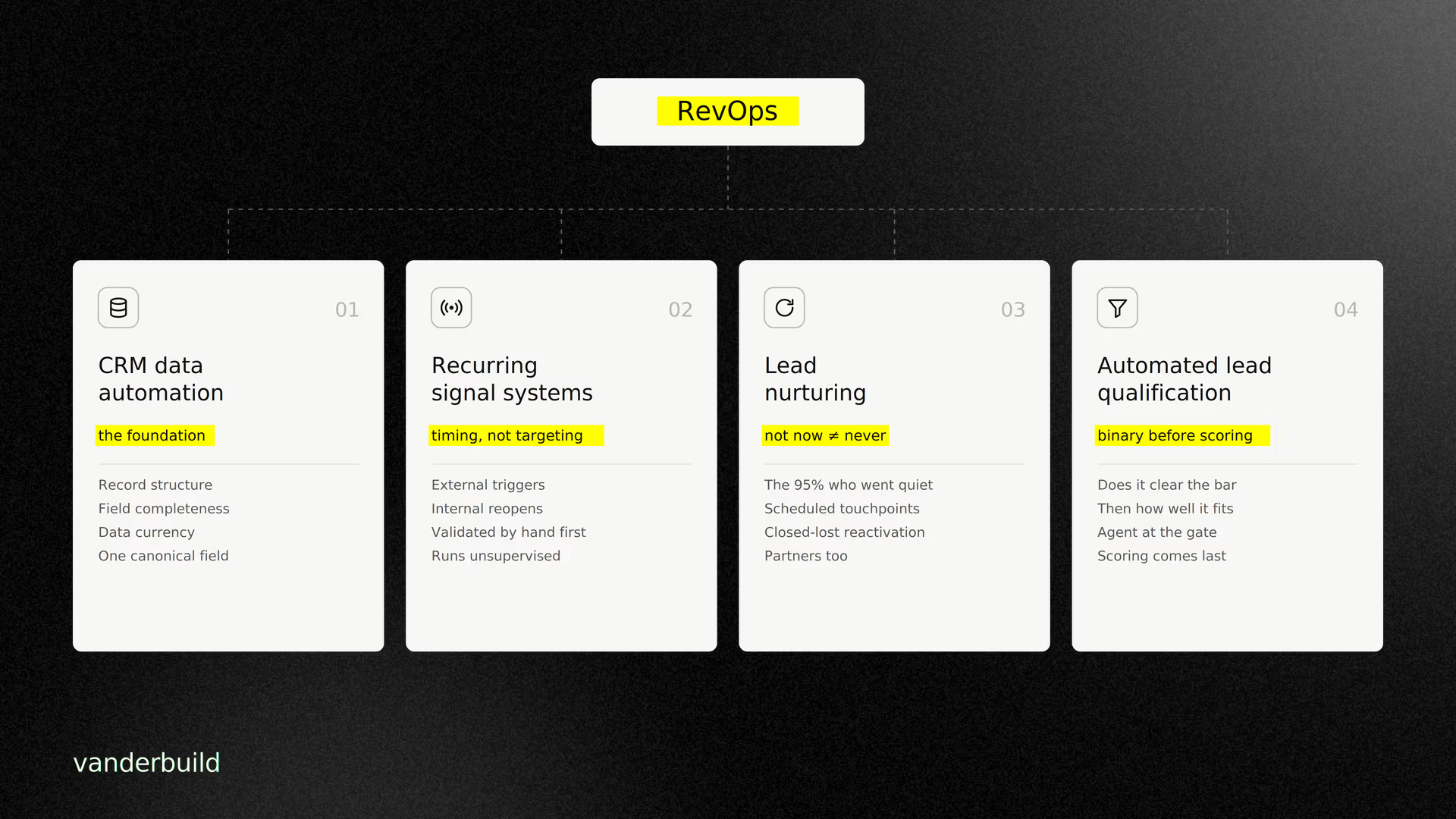
- The four systems we build under RevOps, and what each one does
- How RevOps differs from GTM engineering
- Where to start when everything looks broken at once
What Is RevOps?
RevOps, short for revenue operations, is the function that aligns sales, marketing and customer success around shared data, shared process and shared technology. It breaks down departmental silos and creates a single, end-to-end revenue process running from first customer touch through renewal and expansion.
That is the consensus, and it holds across every serious source. The word doing the work is "unified": for years B2B companies ran sales, marketing and customer success as functionally separate units, each with its own tools, metrics and goals.
The cost of leaving them separate is measurable. Poor alignment between marketing and sales can cost more than 10% of revenue, and companies with aligned revenue teams report roughly 36% higher revenue growth and 28% better profitability than siloed peers. Gartner projects that 75% of the highest-growth companies will run a RevOps model by the end of 2026.
So far, so agreed. Now look at what happens when the same sources try to break RevOps into components.
Every framework lists different pillars
Ask five sources what RevOps consists of and you get five answers. DealHub settles on process, platform, people and performance. Fullcast prefers plan, perform, pay and performance. Mountainise goes with data, process, technology and enablement, while others add governance and make it five.
The overlap between those lists is real but partial, and something more interesting is going on underneath the disagreement.
Every one of them is a category of concern rather than a thing you build. Process, people, platform and performance describe what a healthy revenue organisation has, without describing what a team implements on a given Tuesday, which is how two companies can both claim to be doing RevOps and share almost no actual work.
One point of consensus does survive across all of them, and it is the most useful sentence in the category: the biggest mistake is buying tools before fixing the data model. Everything below is arranged around it.
The 2026 shift
One more thing the sources agree on, and it changes the sequencing. RevOps has moved past being a title change or a CRM cleanup role, and is becoming the layer that governs the AI agents doing the work: agents that update records, route leads, flag deal risk and take action inside a governed workflow.
The operative word is governed, because an agent can only run a process that already exists and already works. Deterministic workflows come first and agentic layers sit on top of them, since an agent wrapped around an unvalidated process simply makes the not-knowing autonomous, and faster.
The Four Systems We Build Under RevOps
Those frameworks are accurate as far as they go, which is one level above anything a team can act on this week.
What follows is the same territory described as systems rather than principles. Four of them, in the order they have to be built, because each one depends on the one before it.
CRM data automation
The foundation, and the one companies skip because it demos badly.
This covers the structure of your records, the completeness of your fields and whether the data is current. Nothing above it works without it. A scoring model built on stale records scores stale records, confidently, at scale, which is the argument we made at length in the CRM data hygiene manifesto.
The work runs in four phases and the order is not negotiable.
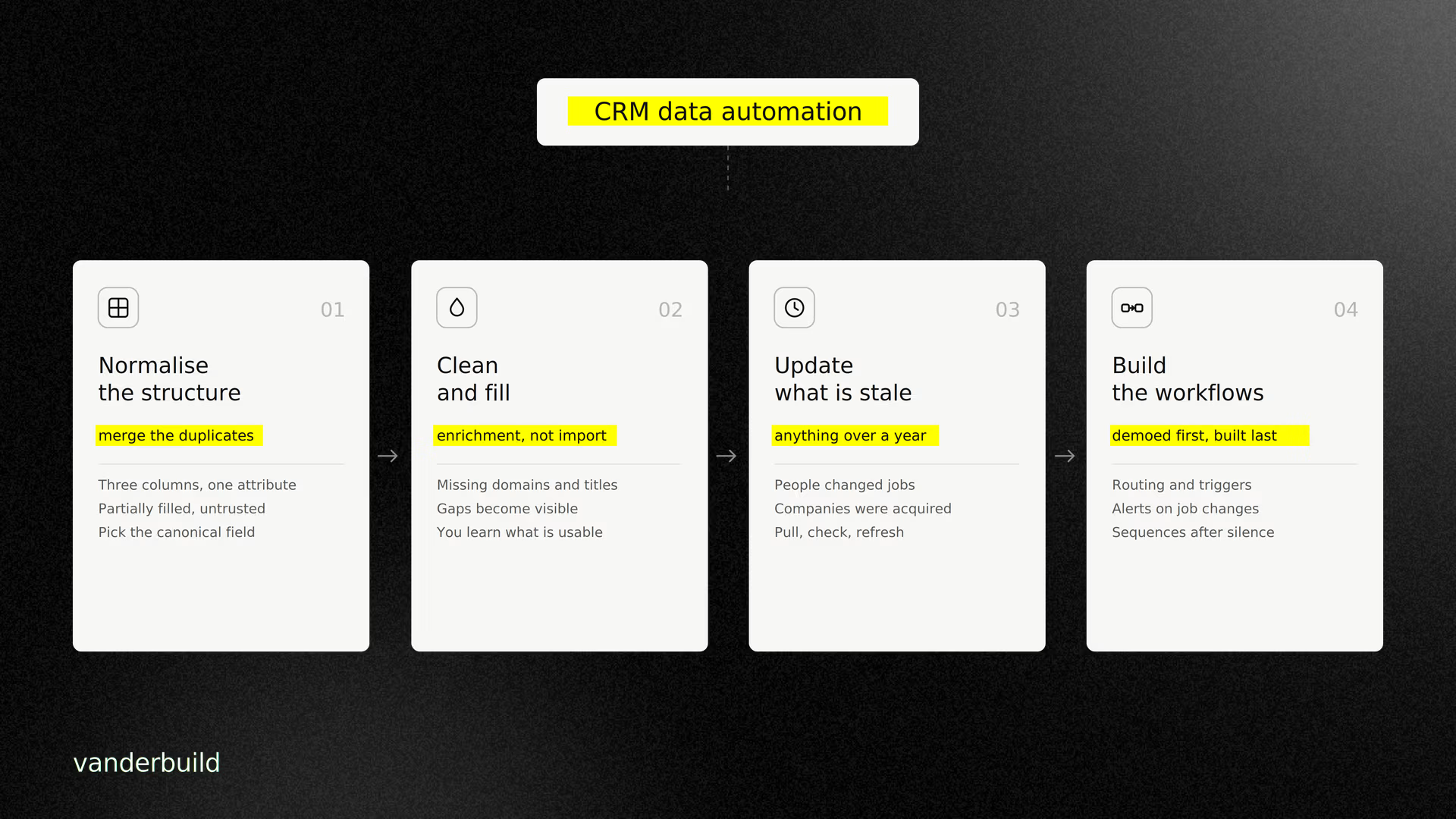
Normalise the structure. The most common problem is duplicated fields. One company record ends up carrying Company Profile, LinkedIn URL and LinkedIn Company, all describing the same attribute, all partially filled, none trustworthy. Merge the columns and decide which field is canonical.
Clean and fill. With the structure fixed, the gaps become visible. This is enrichment, and it is also where you learn how much of your database is actually usable, which is usually less than anyone expected. Most teams treat it as a one-off import rather than a standing process, and that single assumption is behind most of the failures we see.
Update what is stale. A ten-year-old CRM contains ten-year-old records. People changed jobs, companies were acquired or closed. The working rule: anything older than a year gets pulled, checked and refreshed. Done properly, this phase recovers leads you had written off rather than just tidying rows.
Build the workflows. Only now. Routing, triggers, alerts, sequences after periods of no contact. This is the part every vendor demos first, which is why so many companies own it and never did the other three.
Recurring signal systems
Once the data is trustworthy, it can react to the outside world.
A signal is something that happened at an account: funding, a leadership change, a new office, a tender published, a competitor's tool appearing in their stack. The useful thing about a signal is that it answers a question of timing, telling you when an account is worth contacting rather than which accounts belong on the list in the first place.
Two kinds, and most companies only use one.
External signals come from the market and are what timing your outreach usually means in practice. Internal signals are already sitting in your CRM and tell you who to reopen: a deal lost eight months ago, a contact who went quiet at proposal stage, an account whose champion just changed jobs. The second kind is free and already qualified, and it is the one that gets ignored.
The word that matters here is recurring. A one-off signal campaign is an experiment. A recurring system is infrastructure, and the difference is whether it keeps working when nobody is watching. We built one for a client in the tender space that runs end to end without human intervention: it monitors published tenders, qualifies them against criteria, and drops the qualified ones straight into the CRM as opportunities. Nobody opens a portal in the morning.
Validate before you build. This is the most expensive lesson in the category. Teams spend six weeks designing a system to capture and route signals without ever testing whether the signal predicts anything. The alternative takes an afternoon: you already know ten companies where the triggering event happened last month, so write to those ten by hand, every way you can think of, and find out whether the signal performs. If it does, build the recurring system. If it does not, you saved six weeks.
Lead nurturing
At any moment a small fraction of your market is ready to buy. Call it five percent. Everything else received your message, formed an impression, and went into a bucket labelled no reply.
That bucket is either a graveyard or a pipeline, and the nurturing system decides which.
The argument for automating it is arithmetic rather than ideology. Give one SDR a hundred accounts and tell them every account matters equally. They will not get through it in a day and will forget most of it by Friday. That is not carelessness. A person cannot hold a hundred relationships in working memory and also do their job.
A system remembers who has not been contacted in three months. It notices when a company you spoke to last year raises a round. It reaches the second, third and fourth person at an account rather than the one contact you happened to have. It does the same for partners, not just prospects.
There is a second reason this pays first. If someone is in your CRM, something happened once. That is a starting point you cannot buy, and it makes the revenue sitting in there closer than any revenue you can source cold.
Automated lead qualification
The last system, and the one companies ask for first.
Conflating qualification with scoring causes most of the mess in this layer. Qualification is binary and asks whether an account clears the bar at all, while scoring is a gradient that ranks the ones that do. Build the binary layer first, because scoring an unqualified list gives you a neatly ordered list of people you should not be contacting.
The order that works:
- Clean data, per the four phases above
- All sources unified in one place
- Everything entering through the same framework, in the same structure
- Enrichment at the point of entry, not in batches afterwards
- Automated qualification, ideally an agent evaluating whether a lead clears the bar
- Only then, fit scoring
Any firmographic attribute can feed a score, and no universal model exists, because the weighting depends on your organisation and your closed-won data. If you are building this for a SaaS motion specifically, we wrote up the full blueprint separately.
When it is too early. With twenty deals across all stages, a scoring model is a solution looking for a problem. Fix the data, keep it clean, and revisit when volume justifies the build.
RevOps vs GTM Engineering
These two get used interchangeably, and the confusion is expensive because they command different salaries and get hired for interchangeably.
RevOps vs GTM Engineer vs GTM Strategist
| GTM StrategistDecides where to point | GTM EngineerBuilds what does not exist | RevOpsOwns what already runs | |
|---|---|---|---|
| Owns | The concept of entering a market | The technical layer, built from scratch | The processes you already run |
| Asks | Which segment, which message, which motion | How do we build it | How do we keep it working and improve it |
| Delivers | A go-to-market plan | Automations, integrations, data flows | A functioning revenue operation |
| Horizon | Before launch | A project with an end date | Continuous |
| Fails when | The plan meets no market | The build has no strategy behind it | There is nothing built yet to operate |
A strategist decides where to point, a GTM engineer builds what does not exist yet, and RevOps owns whatever is already running.
The practical consequence: a company with no systems hiring a RevOps manager gets someone who maintains nothing. A company with working systems hiring a GTM engineer gets a rebuild it did not need.
The two overlap in practice, and the same person often does both in a company under fifty people. But the sequence matters. Engineering builds the machine, RevOps owns it afterwards. We covered the building side in what is GTM engineering.
There is a related distinction worth knowing, because it explains where tooling fits. Data orchestration is the technical layer that moves and reconciles data between systems. It is a component inside all of the above, not an alternative to any of them.
Where to Start When Everything Looks Broken
The answer is the same in almost every engagement, and it is unsatisfying.
Start with the data model, not the tool. Both the industry consensus and our own experience point the same way: technology bought before the data model is fixed adds speed to a broken process.
Six signals that the foundation is the problem rather than the tooling:
- Marketing and sales report different numbers for the same month, and both are right according to their own definitions
- Nobody can say how many usable records are in the CRM, only how many records
- A lead came in, nobody followed up, and nobody noticed
- Reps maintain private spreadsheets, which means the CRM does not do what they need
- Closed-lost deals never get contacted again
- Every new automation breaks an old one
Three or more of those and the first project is a cleanup, not a build.
What you do not need is a perfect CRM. Nobody has one. You need one clean enough that phase four does not amplify the mess.
FAQ
What does RevOps stand for?
Revenue operations. The function that aligns sales, marketing and customer success around shared data and shared process, optimising for total revenue rather than any single department's target.
What are the pillars of RevOps?
It depends who you ask, and that is the honest answer. Most published frameworks list three to five abstract categories such as people, process, data, technology and performance. Those describe what a healthy revenue organisation has. In practice, the systems that get built are CRM data automation, recurring signal systems, lead nurturing and automated lead qualification.
Is RevOps the same as marketing automation?
No. Marketing automation is one part of the workflow layer, covering lifecycle sequences and routing. RevOps also covers data structure, enrichment, qualification, signal handling and the reactivation of lost opportunities.
What is the difference between RevOps and sales ops?
Sales ops optimises the sales department: territories, quotas, forecasting, CRM hygiene for the sales team. RevOps spans the whole lifecycle across marketing, sales and customer success. Sales ops is effectively a subset.
Do I need RevOps if I already have a CRM?
A CRM is where the data sits. RevOps is what makes it useful. Most companies with a messy CRM do not have a tooling problem, they have an ownership problem, because nobody is responsible for the structure.
Should I build agents or workflows first?
Workflows. Deterministic processes come first and agentic layers go on top once the rules are proven. This is also where the industry is heading, with RevOps becoming the layer that governs the agents rather than the layer that replaces them.
When should I hire for RevOps versus outsource it?
Hire when the work is continuous and the systems are yours to maintain. Outsource the initial build when you need someone who has done it before to set the foundations, then bring maintenance in-house. Buying both from the same vendor indefinitely is how dependency happens.
Turn the Data You Already Have Into Revenue
The nearest revenue you have is already in your CRM. It is just not structured, current, or acted on.
Book a 30-minute call. You will leave knowing which of the four systems is missing, and whether it is worth building now or later.