.webp)
Most companies start outbound at the wrong end. They pick a tool, buy a list, write a sequence, and wait. Three months later the campaign is dead and the conclusion is always the same: "outbound doesn't work."
Outbound worked fine. The company was never a candidate for it.
There is a step that almost nobody runs before spending money on infrastructure, data, and copy. We call it outbound validation: a structured check on whether outbound can produce any value for your business before you commit a budget to it. This article is that check.
If you need the mechanics first - infrastructure, sequencing, data sourcing - start with our complete guide to outbound lead generation. This piece assumes you already know how outbound works and want to know whether it fits.
What you'll learn:
- Three conditions that disqualify your B2B outbound sales strategy entirely
- What ICP means in sales, and how to build one from closed-won data
- The three axes that decide which outbound motion you should run
- What counts as a small total addressable market size and what counts as large, in actual numbers
- Why B2B buying signals, personalization, and TAM mapping belong in one system
- How inbound vs outbound really compare, and how outbound builds B2B brand awareness
What Is Outbound Sales? Strategy, Campaign, and Channel
Outbound sales is the practice of initiating contact with buyers who have not raised their hand. An outbound sales strategy is the layer above it: the set of decisions that determine who you contact, why you contact them now, and what a response is supposed to mean.
Most teams confuse three things. A channel is email or LinkedIn. A campaign is a sequence sent to a defined list. A strategy is the reasoning that produced the list, the timing, and the message in the first place.
Outbound prospecting is the execution layer: finding accounts, enriching contacts, sending messages. It is downstream of strategy, and it inherits every mistake made upstream.
The gap matters because most failed outbound is not a copy problem or a deliverability problem. It is a fit problem that copy and deliverability were asked to solve.
Outbound Validation: The Question Nobody Asks First
Every agency will tell you how to run outbound. Almost none will tell you whether you should.
That is a commercial incentive problem, and it produces a specific pattern. A company with a genuinely bad outbound fit runs a campaign, sees a 0.2% reply rate, blames the agency, hires a second agency, and repeats. Two years and six figures later they conclude the channel is broken.
Outbound is conditional, not universal. Some businesses can build a predictable pipeline from cold outreach within eight weeks. Others will never make the math work, no matter who runs it.
The validation question is simple to state and uncomfortable to answer honestly: can a stranger understand what you sell, believe you can deliver it, and recognize that they need it - inside one short message?
What follows breaks that question into criteria you can actually check.
Three Conditions That Disqualify Your B2B Outbound Sales Strategy
Start with the disqualifiers. If any of these three describe your business, no amount of budget, tooling, or copywriting will fix the outcome.
1. Your product is not operationally critical to the buyer
Outbound interrupts people. To justify the interruption, the thing you sell has to sit close to how the buyer actually makes money or avoids losing it.
If your product improves something the buyer already tolerates, cold outreach will not create urgency. Internal budget conversations for non-critical tools happen once a year, and they do not start with a cold email.
Test it this way: if the buyer stopped using your category tomorrow, would anything in their operation break? If the honest answer is no, outbound will underperform every other channel you have.
2. You have to convince the market that the problem exists
This is the most commonly broken condition, and the most expensive.
If your first message has to establish that a problem exists, then convince the reader they have it, then position your solution, you are running a market education program. Outbound is a poor delivery mechanism for market education, because you get roughly two sentences of attention.
Categories that need education work through content, community, conferences, and partnerships. Outbound comes later, once the category is understood and you are competing on execution rather than on awareness.
3. You are the implementer, not the vendor
A subtle one that catches a lot of service businesses.
Say you are a certified implementation partner for a data enrichment platform. Your outbound cannot sell that platform. Prospects who do not use it yet are not your buyers - the platform's own sales team owns that motion, and you would be doing free demand generation for someone else.
Your actual outbound target is companies that already bought the tool and are underusing it. That changes everything: your data requirement is no longer firmographics, it is technographics. You need to know who already has it before you write a single line of copy.
Any business built on top of someone else's product has this constraint. Implementation partners, agencies specializing in one platform, integration builders. The outbound motion depends on detecting existing adoption, not on creating it.
Two Conditions That Make Outbound a Strong Fit
Clear the disqualifiers and two positive conditions decide how well outbound will perform.
1. Your offer lands in one message
The strongest outbound businesses share one trait: a stranger reads one sentence and knows exactly what is being offered.
Take a hypothetical vendor that supplies certified calibration crews for industrial sensor networks. They sell to plant operators in three specific manufacturing verticals. Their entire opening message can be a single question: "Do you have a vendor covering annual sensor calibration across your sites?"
That is the whole campaign. No value proposition to unpack, no framework to explain, no education. The reader either has that vendor or does not, and both answers are useful.
Simplicity here is not about short copy. It is about how many concepts the reader has to accept before your offer makes sense. One concept is excellent. Three is difficult. Five and you are back to market education.
2. ICP Meaning in Sales: Build It From Closed-Won Data
Here is the failure mode we see most often in audits.
A company sells successfully to mid-market logistics operators, entirely through referrals. Their strategy deck says the target market is enterprise SaaS. They run outbound to enterprise SaaS, get nothing, and cannot explain why.
They targeted who they wanted their customers to be, not who their customers are.
Your ICP is an observation, not a decision. It comes from closed-won data, from deal velocity by segment, from which accounts renew and which churn. Ambition belongs in the roadmap, not in the target list.
This is exactly what a structured product-market fit validation process produces. You run a set of sales hypotheses, and the market tells you which segments respond. The output is a target list you can defend with evidence.
If you cannot name the three attributes your best customers share, using data rather than intuition, you are not ready to buy a lead list.
The Outbound Fit Matrix: Three Axes That Decide Your Approach
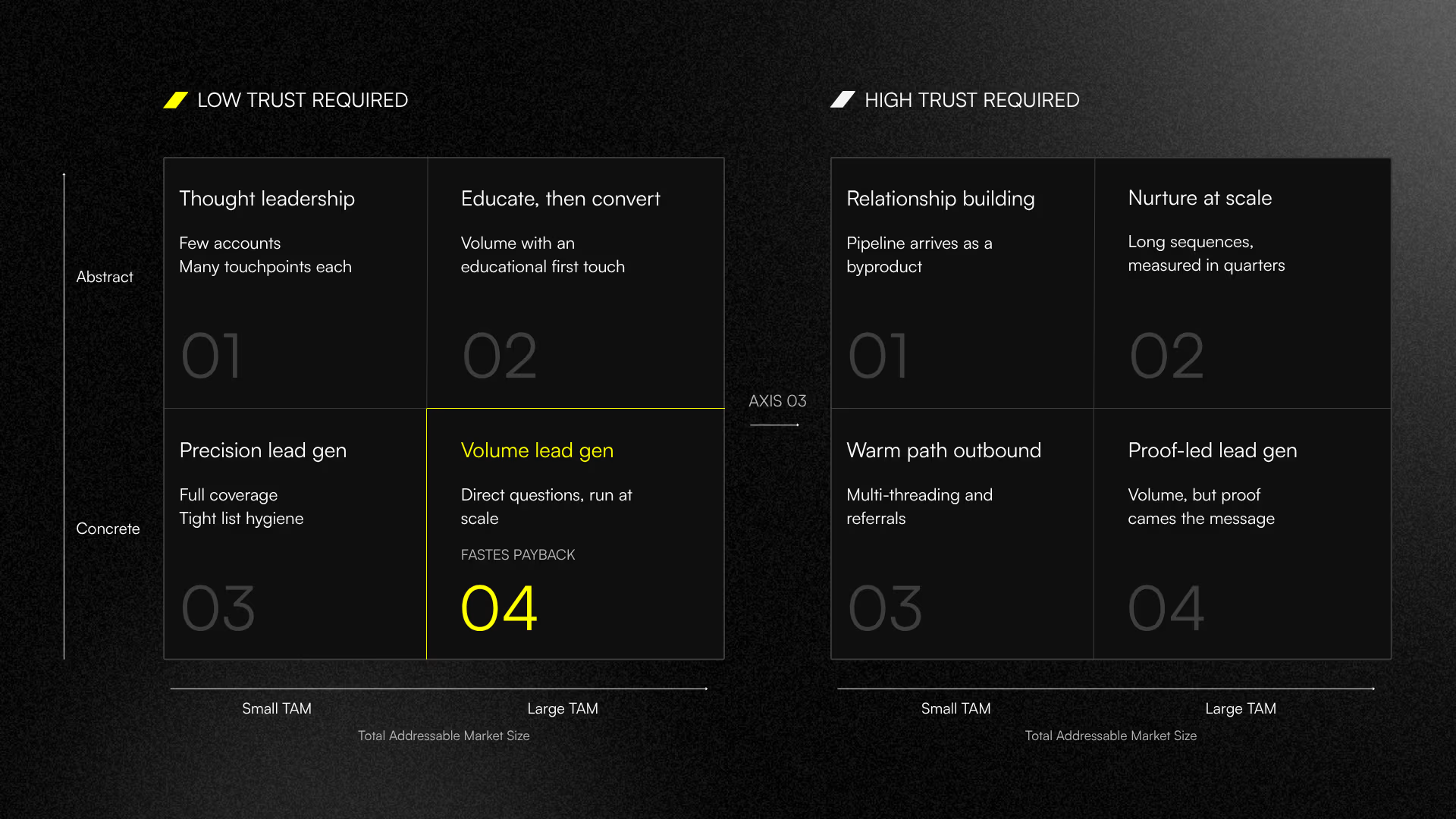
Passing validation tells you outbound can work. It does not tell you what kind of outbound to run. Three variables decide that.
Axis 1: How abstract is your value proposition?
Concrete offers name a thing the buyer can picture. Crews, capacity, units, a specific system, a named deliverable. The buyer evaluates them against a known internal need.
Abstract offers promise a change in an outcome the buyer already owns. Consider a firm that claims it can lift your win rate by 15% by restructuring how your team qualifies deals. The claim may be true. It is also unbelievable in a cold message, because the reader immediately asks how a stranger could possibly know enough about their pipeline to promise that.
The more abstract the offer, the more prior context the reader needs before the message resonates. That context takes time to build, which pushes the offer toward a long-term motion.
A useful proxy: count how many things the reader has to already believe for your first line to make sense. Concrete offers need zero. Abstract ones often need four or five.
Axis 2: Total Addressable Market Size, and What Counts as Big
Most TAM discussions produce a dollar figure. For outbound, the dollar figure is useless. What matters is the account count, because accounts are what you actually contact.
Here are working reference points:
A specialist consultancy serving one function in one industry might have 18,000 addressable companies worldwide. That is small. You can contact the entire market in a year, and once you have burned it, you have burned it.
A vendor selling an operational tool across healthcare, wellness, and adjacent categories has hundreds of thousands of accounts regardless of company size. That is large. At that scale, a 1.5% reply rate produces enough conversations to sustain a pipeline without ever needing a clever angle.
For a full breakdown of how to size this properly, see our guide on how to calculate total addressable market.
Axis 3: How much trust does a purchase require?
The third axis is the one teams forget, and it is often the binding constraint.
Some purchases carry almost no risk. A niche industry newsletter offers a free guest column, and the reader's downside is an hour of writing. The sender's reputation does the work, and the ask is small enough that trust barely enters the equation.
Other purchases require the buyer to expose something. Access to their revenue data. Admission that an internal process is broken. Budget reallocation that has to be defended to a board.
The higher the trust requirement, the more touchpoints are needed before a conversation is even possible. That is not a copywriting problem. It is a physics problem, and no subject line solves it.
A fourth consideration sits alongside this one: how sensitive is the area you are touching? Messages that imply the reader is doing something wrong raise the trust requirement instantly, which brings us to a common copy mistake covered further down.
Small TAM vs. Large TAM: B2B Market Segmentation Decides Your Motion
The TAM axis produces the sharpest practical split, so it deserves its own treatment.
Small, saturated TAM. You cannot outrun the math. If your entire market is 18,000 companies and half of them have already been contacted by three competitors this quarter, volume works against you. The motion becomes thought leadership, awareness, and education delivered through outbound. Fewer accounts, more touchpoints per account, longer horizon, higher quality per message.
Large TAM. Critical mass changes the strategy. You have enough accounts that statistical outcomes stabilize, and a modest reply rate returns the campaign. The motion becomes volume with disciplined segmentation. Test angles fast, kill what fails, scale what works.
One correction to the obvious reading of that table. These are not two separate worlds. Every company runs some of both, and the table describes where you start and what you prioritize, not what you are allowed to do. A small-TAM business still books meetings. A large-TAM business still builds positioning.
The Myth: B2B Buying Signals vs. Personalization vs. TAM Mapping
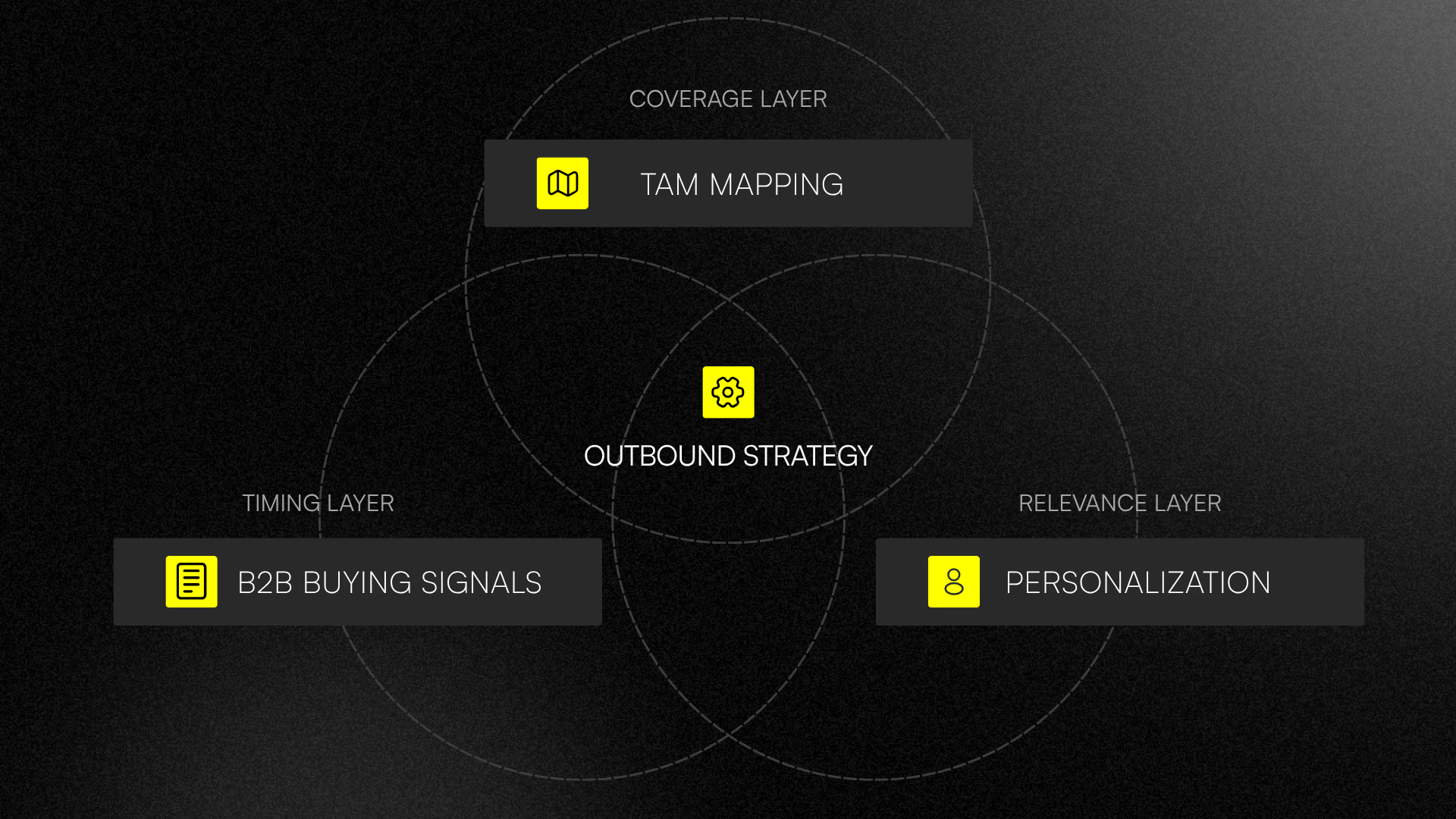
Open LinkedIn on any weekday and you will find three camps arguing.
The first says volume wins: map the TAM, contact everyone, let the numbers work. The second says signals win: only contact accounts showing intent, everything else is spam. The third says personalization wins: research every account, write every message individually.
All three are right about their own case and wrong about everyone else's.
TAM mapping is the coverage layer. It defines the universe of accounts that could ever buy from you. Without it, signals are noise, because you will chase intent from companies that were never a fit.
Signals are the timing layer. A funding round, a leadership change, a new office, a competitor's tool showing up in their stack. Signals do not tell you who to contact. They tell you when a contact is worth making. Our breakdown of B2B intent signals in outbound campaigns covers the tiers in detail.
Personalization is the relevance layer. It converts a mapped account and a detected signal into a message that reads as though it was written for one person.
Remove any one layer and the system degrades in a predictable way. TAM without signals produces well-targeted messages sent at random moments. Signals without TAM produce perfectly timed messages to accounts that will never buy. Personalization without either produces beautifully written irrelevance.
They belong in one system. The argument only exists because each camp is describing the layer that happened to be their bottleneck.
The Cold Email Personalization Mistake That Kills Reply Rates
Personalization built on assumptions about a company's internal operations tends to backfire.
Writing to a CTO that "most engineering teams ship AI-generated code without review guidelines" tells that CTO you think they are one of them. Writing to an agency owner that "most outbound agencies don't run enough A/B tests" does the same thing. Nobody replies to a message that opens by implying they are careless.
Assumptions based on external, verifiable facts work differently. A regional infrastructure investment was announced, and you build products for that sector. A new compliance requirement takes effect in their market next quarter. Those are observations about the world, not accusations about the reader.
The rule: personalize on what is visible from the outside, not on what you are guessing about the inside.
Inbound vs Outbound: Both Are Long Games, Only One Gets Treated Like It
Compare how the two channels get judged. On the inbound side, everyone accepted years ago that SEO is a long game. Nobody expects a blog post to convert on day one.
Outbound gets held to a completely different standard. Send messages, get leads, this month, or the channel failed. That expectation is the single biggest reason outbound programs get killed prematurely.
Most companies treat outbound as binary. Either a lead appeared or it did not. Very few use it as what it actually is: a system that manufactures touchpoints on demand.
At any given moment, a small fraction of your market is ready to buy. Call it 5%. Traditional outbound targets that 5% and discards the rest. The remaining 95% received your message, formed an impression, and went into a bucket labeled "no reply" - which almost always means "not right now."
The teams that get the most from outbound treat the 95% as the actual asset. Those accounts receive a second touchpoint in six weeks, a third in three months, each carrying something useful. When their situation changes, you are the vendor they already recognize.
That is lead nurturing, executed through an outbound channel rather than a marketing automation platform. The best-run enterprise sales organizations have operated this way for years. Most mid-market teams still treat every non-reply as a loss.
The more abstract your value proposition, the longer this process runs, and the more the 95% matters relative to the 5%.
Why Outbound Builds B2B Brand Awareness, Not Just Pipeline
Everyone accepts that inbound builds visibility. Content gets read, brand gets recognized, credibility accumulates.
Nobody applies the same logic to outbound, and the reason is arbitrary.
Credibility comes from being seen repeatedly while providing something useful. Inbound achieves that by publishing and waiting. Outbound achieves it by arriving directly, which is faster and more targeted, provided the message earns its place in the inbox.
The distinction worth drawing is between visibility and connections. Visibility is passive - the market knows you exist. Connections are specific - named people at named accounts have a real association with your company. Outbound produces the second kind, which is more valuable and much harder to buy.
In saturated categories, this is often the only realistic path. When ten competitors are publishing the same content and bidding on the same keywords, direct contact that delivers genuine value cuts through faster than another blog post.
The condition is that the message has to be worth receiving. Outbound that provides nothing builds nothing. Outbound that consistently delivers something useful builds a market position, one account at a time.
The Outbound Sales Process: PMF, TAM, Signals, and Nurturing
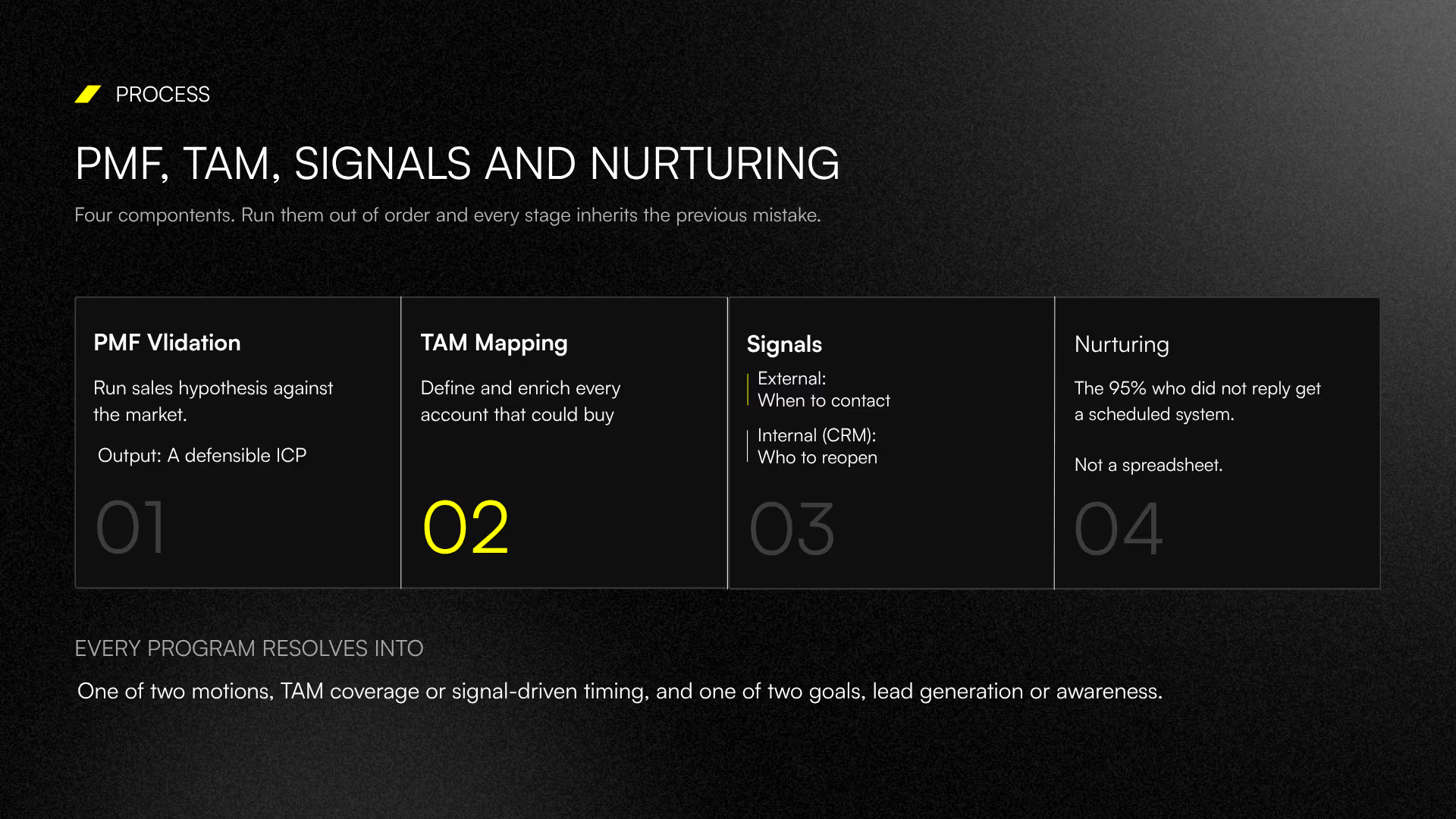
Everything above resolves into four components.
1. PMF validation. You run a set of sales hypotheses against the market and let responses tell you which segments are real. The output is a defensible ICP and a set of messages that have already survived contact with buyers. See our detailed process for validating product-market fit with an outbound campaign.
2. TAM mapping. You define and enrich the full universe of accounts that could buy. This sets the ceiling on everything downstream.
3. Signals. External signals tell you when an account becomes worth contacting. Internal signals - data already sitting in your CRM, past conversations, closed-lost deals, churned accounts - tell you which existing relationships are worth reopening. Most companies run the first and ignore the second, which is strange, because internal data is free and already qualified.
4. Nurturing. The 95% gets a system rather than a spreadsheet. Touchpoints are scheduled, sequenced, and measured on a horizon that matches your trust requirement and your TAM size.
One honest note on this framework. We have been debating internally whether PMF validation is a genuine fourth step or something upstream of the whole model. Every outbound program eventually resolves into one of two motions - TAM coverage or signal-driven timing - and into one of two goals: direct lead generation or awareness. PMF validation is where you extract the sales hypotheses that feed both. Whether that makes it a step or a precondition is a live question, and we would rather say so than present a tidier model than we actually believe.
FAQ
What is the difference between inbound and outbound sales?
Inbound sales works with buyers who initiated contact, usually through content, search, or referral. Outbound sales initiates contact with buyers who have not raised their hand. The practical difference is intent: inbound leads arrive with a problem already defined, outbound leads have to be shown that the problem is worth solving now.
How do I know if my TAM is too small for outbound?
Under roughly 20,000 addressable accounts globally, volume-based outbound stops working. That does not disqualify you. It changes the motion from lead generation to positioning and education, with far more touchpoints per account.
How do I build an outbound sales team?
Sequence matters more than headcount. Validate fit first, build infrastructure second, hire third. Teams hired before validation spend their first six months discovering that the target market was wrong, which is an expensive way to run a research project.
How can I improve outbound sales performance?
Check fit before checking copy. Most underperforming campaigns fail on targeting or timing, not on wording. Verify that your ICP comes from closed-won data, that your list matches it, and that you have a reason to contact each account now. Copy is the last variable to tune, not the first.
What outbound sales tips actually matter for a small team?
Cut the list before you improve the copy. A team of two working 300 well-qualified accounts will outperform the same team working 3,000 loosely matched ones, every quarter. After that, fix timing. Copy comes third.
Does outbound still work in 2026?
Yes, under conditions. It works well for concrete offers in large addressable markets with low trust requirements. It works slowly for abstract offers in small markets with high trust requirements. It does not work at all when the buyer has to be taught that the problem exists.
Run the Check Before You Run the Campaign
Three disqualifiers. Two qualifiers. Three axes. Roughly two hours of honest internal discussion.
That is what stands between a company that builds a working outbound program and one that spends two years concluding the channel is broken.
If you want a second opinion on where your business lands, book a 30-minute call. No pitch. You will leave knowing which motion fits your business, or that none of them do.