.webp)
There were 739 GTM Engineer job postings in the sample behind our jobs report, and hundreds of the companies placing them had posted one or two roles each.
That fragmentation is the reason this decision is hard. The role is barely two years old, almost nobody is hiring for it a second time, and there is no shared practice to copy. Most companies are making this call once, without a reference point.
This is the honest version of the comparison, from an agency that does this work and still tells about half the companies who write to us to hire instead.
What you'll learn:
- What the market pays, and what sits around the salary
- What an in-house hire gives you that an agency never will
- What an agency gives you faster, and where it falls short
- The hybrid model, and the one condition it depends on
- Five questions that answer this for your company
What the Market Pays
US median total compensation for a GTM Engineer is $160K, with a typical band of $130K to $180K, based on the 63 postings in our sample that disclosed salary. That is roughly $13,300 a month. In Central and Eastern Europe the equivalent role sits closer to $5,000 a month.
The salary is the part everyone budgets for. What follows is the part that usually gets discovered mid-process.
A job listing runs around $250 a month for as long as the search takes. Add HR screening time, a technical person on every second-round call, and founder time on finals. Then add the onboarding month, because a GTM Engineer realistically takes about four weeks to become useful in a company whose data and processes they have never seen.
And then the part that appears in no budget at all. One recruitment process we watched ran for eight months and ended without a hire. Every candidate who cleared the technical bar was either counter-offered by their current employer or hired away mid-process. The pool of people who genuinely do this work is small, and everyone is fishing in it.
That risk is a reason to price the attempt honestly before you start rather than a reason to avoid hiring.
What You Get In House
Three things, and the first one is the one agencies cannot replicate.
Context that nobody can brief. Someone inside your company knows the product, the customers, and the history behind decisions that look strange from outside. Why that segment was abandoned, why that integration exists, which client will churn if you touch their onboarding. None of that fits in a brief, and all of it changes what should be built.
Availability measured in hours. An internal person reacts to a problem the same morning. An agency reacts inside an agreed cycle, which is usually a week.
Knowledge that compounds where you need it. Every system built, every dead end found, every play that failed stays inside your company and informs the next decision.
The cost nobody mentions
That person needs someone to learn from, and needs verifying before they start.
86.3% of postings ask for AI or LLM skills, 65.9% for APIs and webhooks, 40.6% for Python. If nobody in your company can evaluate those answers in an interview, you are hiring on impression. We covered that trap in more detail in the five expensive mistakes when hiring for this role.
Then there is the succession problem. Only 10 of the 739 postings were junior roles. The market is not training anyone into this job, so if your one person leaves, you restart the eight-month search rather than promoting from within.
What You Get With an Agency
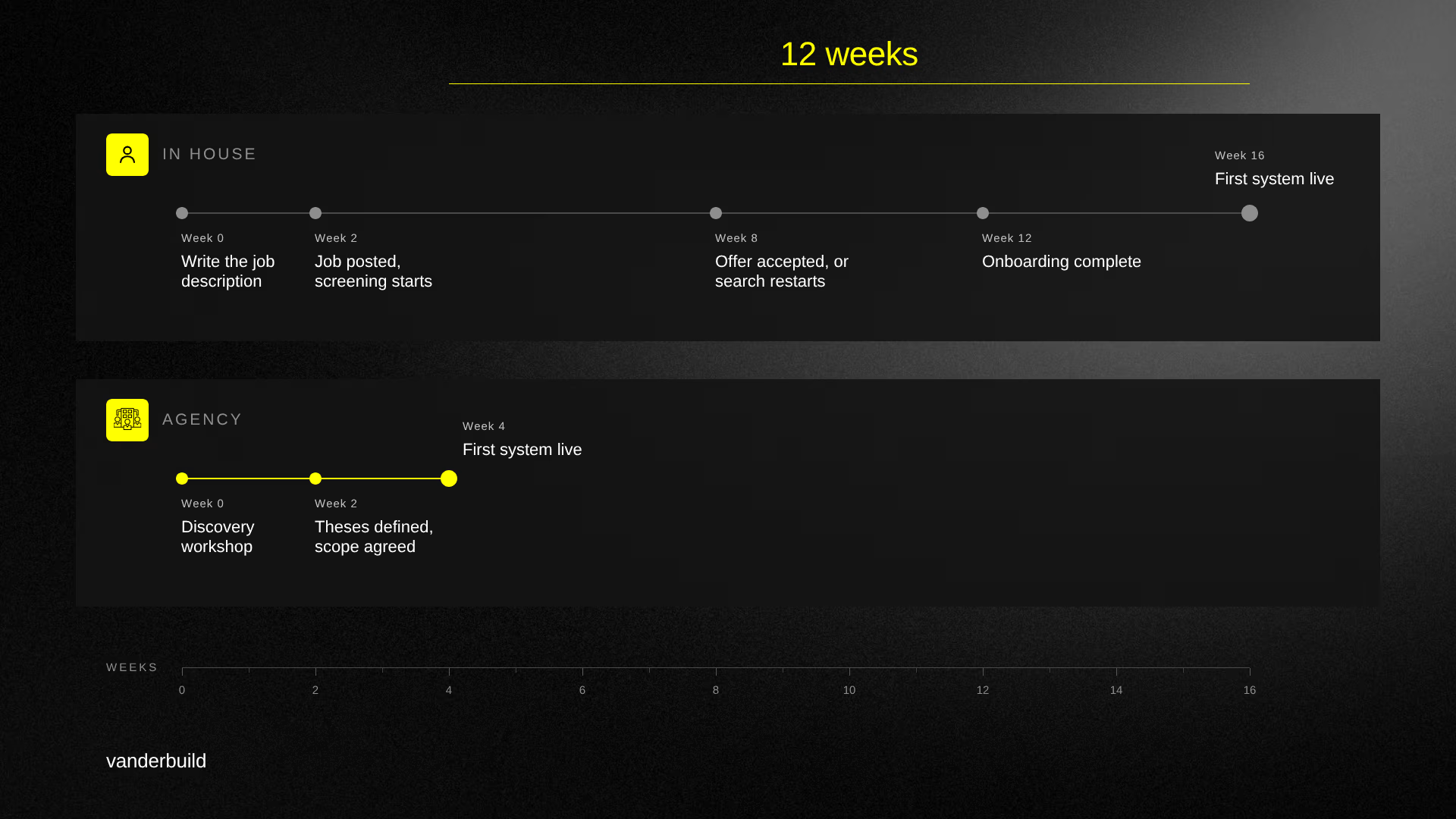
Time to first result. An agency starts in week one with systems that already exist. There is no build phase for the infrastructure, only for the parts specific to you. The typical shape of the first month is two weeks of workshops and thesis definition, then implementation.
A team instead of a person. The fourteen duties the report found in a single job description get split across people who each do their part daily.
A pattern library you cannot build alone. A framework that worked at a company like yours can be adapted rather than invented. That matters most when a thesis turns out to be wrong, because the cost of discovering that is much lower when the test takes two weeks instead of two months.
No rotation risk, and no gap when one person leaves.
Where an agency falls short
No product context on day one. The first two to three weeks go into understanding what you sell, to whom, and why previous attempts did not work. That time is real and it is billed.
Dependency, if nobody on your side follows what is being built. An engagement that ends with systems your team cannot maintain has moved the problem rather than solved it, and the guard against that is documentation from week one rather than at handover.
Slower on anything that needs a conversation with a customer. An agency cannot walk down the corridor and ask your best AE why a deal really stalled.
In House Against Agency
The row that decides most cases is time to first result. If you need pipeline moving this quarter, the eight to twelve weeks between deciding to hire and the new person producing anything is the whole argument. If you are building for the next three years, it stops mattering and context wins.
The Hybrid Nobody Writes About
There is a third option, and it is the one we recommend most often.
The agency builds, an internal person runs it. You hire an operator rather than an engineer, which is a cheaper and far easier search, and the agency designs the systems that operator executes. Over six to twelve months the operator absorbs the reasoning behind the design and grows into the engineering side.
This works only under one condition. Documentation starts in week one, not at handover. A system explained at the end of an engagement is a system your team will maintain badly. A system documented as it is built is one they can extend.
The model is more expensive than either option alone for the first quarter, and cheaper than both over two years.
How to Decide
Five questions. The first one you cannot answer is where your answer is.
1. Can you name the process this person owns in their first ninety days?
If not, you are hiring a capability rather than solving a problem, and that is how six months disappear.
2. Is your data in a state where a process could read it?
If records live in three places under three names, the first job is a data project, not a hire. Neither route fixes that faster, and the layer underneath decides everything above it.
3. Has anyone run this motion by hand?
Validation comes before the build, whoever does the building. An engineer hired into an unvalidated motion automates a guess.
4. Who verifies the work, internally?
For a hire, that is the person who evaluates the interview. For an agency, it is the person who reads what gets built. Without either, you are buying on trust.
5. Who maintains it in a year?
Building and maintaining are different jobs. RevOps is the function that keeps systems working once they exist, and it is worth knowing who fills it before you commission anything.
What We Charge, and Why We Are Telling You
Almost no agency in this category publishes pricing, which leaves you comparing a known salary against an unknown invoice.
Three models, because three different situations:
- Retainer, from around $5,500 a month, for ongoing campaigns and systems work
- Per lead, when volume is predictable and the motion is proven
- Per project, between $5,500 and $16,500, usually scoped to a quarter
Against $13,300 a month for a US hire, the retainer looks decisively cheaper. That comparison only holds for the first year. Over three years a retainer adds up to something close to a salary, and at the end of it you have systems but no person. Anyone telling you otherwise is selling.
Start with a discovery workshop either way. Most companies do not yet know what they need, and buying a month of implementation against an undefined scope is how both routes go wrong.
The Honest Closing
We are a GTM engineering agency. That shows in what we know and it should show in what we recommend, so here is the recommendation we give most often.
If you can afford a good GTM Engineer and you have someone who can verify one, hire. The context advantage is real, it compounds, and no agency relationship replaces it. Roughly half the companies that write to us about this get told exactly that.
The agency case is strongest in three situations: you need results before a hire could start, you do not yet know what to build and want the discovery done by people who have done it before, or you tried to hire and the search stalled.
FAQ
Is it cheaper to hire a GTM Engineer or use an agency?
For the first year, an agency, by a wide margin once recruitment and onboarding are counted. Over three years the gap closes and the in-house hire leaves you with a person as well as a system.
How long does it take to hire a GTM Engineer?
Longer than most teams plan for. One process we watched ran eight months without a hire, because candidates who cleared the bar were counter-offered or hired away mid-process.
What does a GTM agency actually do?
Builds the systems that connect data, demand generation and conversion: enrichment, qualification, routing, sequencing and reporting. The distinction from a lead generation agency is that the output is a working system rather than a list of meetings.
Can we start with an agency and move in house later?
Yes, and it is the model we recommend most often. The condition is documentation from week one, so the systems are maintainable by your team rather than only by ours.
What should we hire if we are not ready for an engineer?
An operator to run the motion manually while someone documents it, or a scoped data project. Both are cheaper, both are easier to hire for, and both create the conditions an engineer needs.
How much does a GTM engineering agency cost?
Ours runs from around $5,500 a month on retainer, or $5,500 to $16,500 for a scoped project. Most of the category does not publish pricing, so ask for a range before the first call rather than after.
Not Sure Which One Fits?
The answer usually becomes obvious once someone works through the five questions with you.
Book a 30-minute call. We will go through them, and if the answer is that you should hire rather than work with us, we will say so.