If your company is pre-product-market-fit with an unvalidated offer, exactly three of the 31 plays in this playbook apply to you.
The other 28 will fit in six to eighteen months. Running them today is the most expensive mistake in early-stage go-to-market, and it happens constantly, because founders pick plays based on what worked at a company they admire rather than on where their own company actually stands.
That is the problem this document was built to solve.
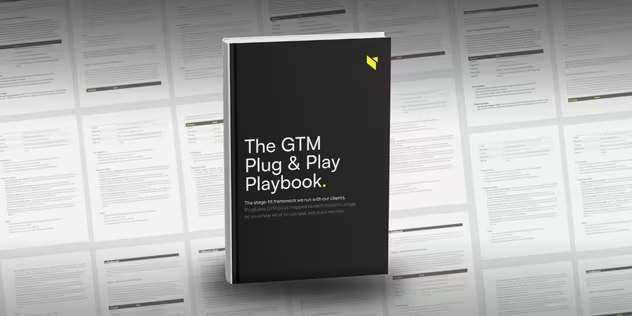
GTM Plug & Play is a free playbook containing 31 go-to-market plays, each mapped against four axes so you can tell at a glance which ones fit your situation. Every play includes a budget range, team size, timeline, effort level, prerequisites, six execution steps, four KPIs with target numbers, and a practical tip from running it. No form, no email required.
What follows is the framework that makes the plays usable, plus the parts most teams get wrong.
What you will find in this article
- Why the offer determines whether any play works
- The four axes that decide which plays fit you
- Six conditions that must be in place before any play runs
- What the 31 plays cover, by category
- Which plays to deploy at each growth stage
- The conversion multipliers that repeat across the playbook
The offer decides everything, and almost nobody tests it
A good offer converts three to ten times better than a weak one against identical traffic. Same list, same channel, same execution, three to ten times the result.
That single ratio outweighs every tactical decision downstream. Running TAM-scale campaigns, building signal systems, or activating CRM data on top of a bad offer multiplies the cost of failure without changing the outcome.
The playbook breaks an offer into five variables that all have to be right at the same time:
- The ICP, meaning the buyer genuinely has the problem you solve
- The pain, urgent enough that they act now rather than later
- The outcome, valuable enough that they would pay even without the sales conversation
- The price, positioned so that saying yes is the rational move rather than the brave one
- The risk reversal, giving enough certainty about delivery that they do not need a six-month evaluation
Pricing is the variable teams test least and should test most. Too cheap signals low value, attracts unserious buyers, and destroys margin. Too expensive drops conversion but raises per-deal margin, and the math sometimes still works. The optimal price is where price multiplied by conversion rate multiplied by margin peaks, which is rarely the highest number and almost never the lowest.
The uncomfortable part: you cannot know if the offer is good until prospects react to it. Internal conviction is unreliable. Existing customer testimonials do not predict new-buyer conversion. The only credible test is contacting the market at small scale and measuring what happens, which costs $5,000 to $20,000 and takes 8 to 12 weeks.
That is cheap compared to scaling a bad offer.
The four axes
Play selection rests on four dimensions. Five minutes of honest self-assessment here saves months of running plays that do not fit.
The data maturity ladder is the one most teams misjudge. L0 means no CRM at all, with GTM running on spreadsheets and founder memory. L1 means a CRM exists but the data is unreliable. L2 is clean and consistently segmented. L3 adds automated enrichment, lead scoring, and routing. L4 is a fully signal-driven motion where outbound is triggered by data rather than manual list pulls. L5 layers in product-usage data and predictive scoring.
The levels are cumulative, and the path between them runs through specific plays. CRM Data Cleaning gets you from L1 to L2. CRM Data Enrichment gets you from L2 to L3. Skipping those and jumping straight to signal monitoring produces a system that detects events it cannot act on.
Offer clarity is the most underrated axis of the four. If it reads Unvalidated, only the three validation plays are open to you regardless of how mature everything else is.
Six conditions before any play runs
Without these, well-chosen plays underperform by five to ten times. They cost less to fix upfront than to discover broken mid-campaign.
A documented ICP defined at two levels: account criteria (industry, revenue, headcount, tech stack, geography) and persona criteria (titles, responsibilities, reporting lines, KPIs owned). If you cannot list five account criteria and three persona criteria from memory, it is not documented enough.
An account-capable CRM that models accounts as first-class objects with mapped stakeholders and activity history. A spreadsheet cannot run signal, CRM activation, or account-based plays.
Tested core messaging: a value proposition, two or three differentiators, and two or three business outcomes, tested against at least 100 real prospects.
Sending infrastructure: dedicated warmed domains with SPF, DKIM, and DMARC configured for email plays. For LinkedIn, profiles that read as peers to the audience plus Sales Navigator seats.
A data tooling baseline: a prospect data source, an enrichment layer, a sequencing platform, and a CRM. Below that line, several categories of play do not run reliably.
Response capacity. This is the one teams skip. If a play generates 100 replies, who handles them? One dedicated person manages 30 to 50 active reply threads at a time. Sending 30,000 emails a month with two people to handle 200 replies produces nothing. Scale sending to match the humans.
What the 31 plays cover
The plays sit in seven groups.
Offer and thesis validation contains three plays for the stage before scale: testing three to ten sales theses in parallel, running LinkedIn awareness outbound that asks a market question instead of pitching, and offer validation sprints that change one variable at a time.
Targeted outbound at scale covers four plays for validated offers: TAM-based cold email, LinkedIn lead generation, a cold email bootstrap designed to hand infrastructure over to your team, and multi-channel sequences.
Signals and triggers holds four data-driven plays that need L3 maturity: custom buying-signal monitoring, job change and champion tracking, company event triggers, and web visitor de-anonymization.
Inbound-led outbound turns existing attention into pipeline through four plays: a lead magnet to newsletter funnel, scraping engagement on viral posts, scraping competitor engagement, and nurturing warm-but-stalled content leads.
Network and presence covers three infrastructure plays: LinkedIn network building, pre-booking meetings before industry events, and offline package sends timed to delivery confirmation.
CRM activation contains five plays that make accumulated data work: lost opportunity nurturing, account intelligence monitoring, data cleaning, data enrichment, and automated lead qualification and routing.
Enterprise account-based plays holds eight high-touch plays for $50K-plus ACV: co-hosted executive dinners, a podcast used as a relationship channel, hyper-researched cold calling, custom video audits, multi-touch account surround, Reddit monitoring for enterprise signals, a structured referral network, and a cultural affinity play.
Budgets across the set range from effectively zero for Reddit monitoring and the cultural affinity play, up to $3,000 to $12,000 a month for a full TAM campaign.
Which plays to run at each stage
Two rules govern the whole sequence.
Do not skip ahead. Each stage depends on foundations built in the previous one, and the dependency is real rather than advisory. Signal plays fail at L2 data maturity not because the signals are wrong but because nothing downstream can act on them within the window.
Do not run more than five plays at once. Most teams run two to five in parallel. Past that, attention spreads thin enough to break execution on all of them.
The multipliers that keep recurring
Read across all 31 plays and the same pattern appears: warmth and timing beat volume, consistently and by large margins.
Multi-channel sequences reach 4 to 8% qualified meeting rates against 1 to 3% for single-channel. Signal-triggered outbound converts three to five times baseline. Inbound-led plays outperform cold by three to eight times. Scraping engagement from a relevant viral post converts at four to eight times baseline, and competitor engagement at three to six times. Re-engaging warm-but-stalled content leads beats cold by five to ten times. Warm introductions convert at five to ten times cold outreach.
The most striking numbers sit at the high-touch end. Offline package sends with a follow-up timed to delivery confirmation produce 25 to 50% reply rates. Job change messages get 25 to 45% response. Co-hosted executive dinners run 40 to 60% invitation acceptance when the co-host has real credibility.
A few operational numbers worth memorizing:
One inbox safely sends 30 to 50 emails a day, so 1,000 a day means 20 to 30 inboxes across 5 to 10 warmed domains. Founder LinkedIn profiles outperform SDR profiles by three to five times on the same campaign. CRM data degrades 2 to 5% per month without active hygiene. Stacking two enrichment providers gives 15 to 30% better coverage than either alone. Sales teams waste 15 to 30% of capacity on leads that should never have reached them.
And the one most teams learn the hard way: the first 90 days of a TAM campaign exhaust the buyers who are already in market. The next 270 days are where the systematic prospects convert. Most teams quit at month three, right after the easy wins run out and right before the play starts working.
The two mistakes this framework exists to prevent
Running plays above your stage. A signal-based outbound system is correct at $5M in revenue with a validated ICP. The same system at $500K with no repeatable wins is an expensive distraction. The four axes exist to make that judgment mechanical instead of aspirational.
Scaling before validating. If the offer is good, TAM-scale outbound amplifies it. If the offer is bad, TAM-scale outbound amplifies the bad. Validation costs $5,000 to $20,000. Scaling a bad offer costs considerably more and takes longer to discover.
FAQ
Is the playbook free? Yes. No form, no email, no gate.
How many plays does it contain? 31, across seven categories, from offer validation through enterprise account-based motions.
What is included for each play? Budget range, team size, timeline, effort level, prerequisites, six execution steps, four KPIs with target ranges, and a practical tip.
How many plays should I run at once? Two to five. Beyond five, execution quality drops across all of them.
I am pre-PMF. Which plays apply? Three: offer validation sprints, multi-thesis outbound, and LinkedIn awareness outbound, with CRM data cleaning as foundational work alongside. The rest should wait six to eighteen months.
What does GTM validation cost? Roughly $5,000 to $20,000 over 8 to 12 weeks to know whether your offer works well enough to scale.
Does this replace the Enterprise GTM Playbook? No. The eight enterprise plays appear here at directory depth. The Enterprise playbook goes deeper on each with extended case studies and execution detail.
Do I need a specific tool stack? The plays are durable and the tooling rotates. The playbook names current tools per play, but the baseline is a prospect data source, an enrichment layer, a sequencing platform, and a real CRM.
What to take away
A good offer converts three to ten times better than a weak one on identical traffic. No play in the playbook rescues a bad offer, and several amplify the damage.
Place yourself on four axes before choosing anything: growth stage, data maturity, ACV band, and offer clarity. The last one is the most underrated and the most consequential.
If your offer is unvalidated, three plays fit and 28 do not. Running the 28 anyway is the standard failure mode.
Run two to five plays in parallel. Warmth and timing beat volume in every comparison the playbook makes, often by five to ten times.
Response capacity is the ceiling on everything. One person handles 30 to 50 reply threads. Size the sending to the humans, not the other way around.
We deploy these plays for B2B companies from pre-PMF through enterprise expansion. Most engagements start with a two-week audit that places the company on the four axes, identifies the three to five plays with the best return for that position, and produces a 90-day deployment plan.

.avif)
.avif)