Most cold email advice cannot be executed. It tells you to "be relevant" and "add value" and then leaves you staring at a blank draft with no way to tell whether what you wrote is good.
This playbook scores the email. Five criteria, zero to two points each. Below eight out of ten, you do not send it.
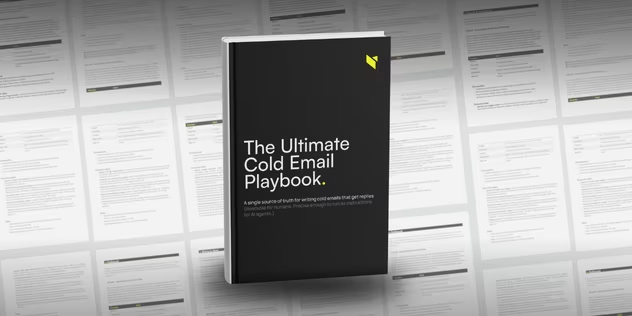
The Ultimate Cold Email Playbook is a free, ungated guide covering the rules, the eight frameworks worth using, a step-by-step process for writing the first email, three follow-up patterns, five copy-ready templates, and a quality gate that decides whether a draft ships. It is written to be read by a person and precise enough to run as a system prompt for an AI agent.
Here is the thinking behind it, and the parts that fix the most drafts fastest.
What you will find in this article
- The only job a cold email has, and the four questions it must answer
- The principles that do the most work, including the two-word trick that upgrades most value propositions
- Why picking one framework beats combining several
- The six-step process for writing email number one
- Three follow-up patterns, and the phrases to delete permanently
- The quality gate that decides whether a draft is finished
The only job of a cold email
Cold email copy has exactly one job: create enough relevance, trust, and curiosity that the prospect replies.
Not to tell your story. Not to educate. Not to pitch the product or list features. Reply, or nothing.
Every email has to answer four questions, in this order:
- Why you, why me? Personal relevance. What makes this email land in this inbox rather than 500 others.
- Why care? An expensive problem or a missed opportunity.
- Why believe? Specific proof.
- Why reply now? An easy, low-friction ask.
Read your last cold email against those four. Most drafts fail at one and three, and then compensate by making the ask bigger, which makes everything worse.
The principles that fix the most drafts
The playbook lists eleven non-negotiable rules. Five of them do the heavy lifting.
Sell the superpower, not the sword
Nobody wants your tool. They want what the tool makes possible. The formula is: you do X, so Y happens, where Y is the superpower.
"We provide a content system" describes the sword. "Turn LinkedIn posts into inbound leads without spending Sundays writing" describes the superpower.
Pick an expensive problem
If the problem is not intense and frequent, nobody replies. Anchor to lost revenue, wasted spend, missed pipeline, risk, churn, hiring pain, time drain, or missed deadlines.
A problem that is merely annoying does not clear the bar for a stranger's email.
Personalization means "why you," not "buddy-buddy"
This is the most misunderstood idea in outbound. Personalization exists to justify why this specific person received this specific email. It is not friendliness.
"Saw you're hiring three SDRs, teams hit routing bottlenecks at that stage" is personalization. "Go Lions! Loved your post!" is noise wearing a personalization costume.
The filter is a single question: does this line move them closer to saying yes to the CTA? If not, delete it.
The magic of "without"
A result paired with the removal of the thing that sucks is the strongest hook structure in cold email. "Book more qualified demos without adding headcount." "Reduce no-shows without ripping up your process."
The playbook recommends maintaining a library of 30 to 50 "without" lines per niche, because this is the construction you will reach for most often.
Be crispy
Specific is believable. Every email needs at least one concrete detail: a number, a timeframe, a named scenario, a constraint, an example, a metric, or a mechanism.
Vague proof is worse than no proof, because it signals that you have none.
Delete these words
The playbook runs two mandatory purges on every draft. One for fluff, one for jargon.
The test is whether the prospect would say the word over coffee. If not, it goes.
Fluff removal runs in two passes. The first deletes fillers. The second shortens sentences and removes claims you cannot back.
Eight frameworks, and the rule about using them
The playbook documents eight structures: AIDA, TIPS, the bottleneck email, the "three ideas" value-add, the champion or new-job angle, choice framing, content-in-outbound, and the napkin-math email.
The rule that matters more than any individual framework: pick one per email and do not mash them together. A draft that opens with AIDA, pivots into napkin math, and closes with a content offer reads as confused, because it is.
Two are worth knowing in detail.
TIPS works best for B2B. Trigger explains why now. Implication explains why it matters. Pain establishes the cost of inaction. Then social proof and the solution, followed by the ask.
The bottleneck email works on executives. You observe something about their scale, name the bottleneck that typically appears at that scale, offer proof, and ask whether you can send the detail. A postscript pointing at the next bottleneck up gives them a reason to keep reading.
The six-step process for email number one
Step one, the opener. One or two lines whose job is to prove relevance, not friendliness. Four opener types work: a trigger, proof of attention, a public artifact, or a pain proxy. The rule is that the opener must connect to the problem you raise next. An opener that goes nowhere is worse than no opener.
Step two, the problem statement. One line containing a credible guess about their world. "When AEs chase pipe, consistent posting is the first thing to slip" works. "You may be facing challenges with content strategy" does not, because it says nothing a stranger could not have written.
Step three, the value proposition. One or two lines in the shape of: we help people like you get this result without the thing that sucks.
Step four, proof. One line, one crisp detail. A metric with a timeframe and a comparable company, or a mechanism that is meaningfully different.
Step five, the offer. Keep it believable. Anything too generous reads as desperate or fake. A teardown, a 90-second Loom, two or three tailored ideas, or a relevant case study all work.
Step six, the CTA. This is where most emails break.
Email number one is an interest check, not a meeting request. "Want me to send it?" and "Worth a quick back-and-forth?" and "Open to a few details?" all outperform "Do you have 30 minutes Tuesday?" because the friction is lower and the prospect is not committing their calendar to a stranger.
Follow-ups: three patterns, no more
Follow-up one: same problem, new angle. Add exactly one new element. New proof, a new mechanism, or a new "without" line. Do not restate the first email louder.
Follow-up two: a stronger trade, not a longer email. Improve the offer rather than adding paragraphs. A 90-second teardown or three hooks tailored to their last post gives them a reason to reply that the first email did not.
Follow-up three: the routing question. Short and calm. "If this isn't your lane, who owns X?" People who cannot help you will often tell you who can, and this message costs them nothing.
Three phrases to delete from your vocabulary permanently: "just checking in," "bumping this," and "did you see my email." Each one communicates that you have nothing new to say and are asking for attention anyway.
The wider principle is detachment. No neediness, no guilt, no pressure. Sound calm and be genuinely fine with a no. Prospects can feel the difference, and the calm version converts better.
The quality gate
Before anything sends, it passes a skim test. If someone reads the email in ten seconds, can they answer: why me, what problem, what outcome, why believe, and what do you want me to do? If any of the five is unclear, rewrite.
Then the draft gets scored.
Ship only at eight out of ten or above. Below that, the fix is almost always the same: add specificity, tighten the CTA, delete fluff.
And the single rule that prevents most bad cold emails: if the prospect can read it and think "this could be for anyone," it is not finished.
Why it doubles as a system prompt
Most teams now generate some portion of their outbound with AI, and most of them get generic output because the instruction was generic.
This playbook was written with hard constraints an agent can follow. Email number one runs 70 to 140 words with sentences mostly between 10 and 16 words. It must contain a relevance line, an expensive problem, a superpower with a "without," one crisp detail, and a soft CTA. It must not contain fluff openers, jargon, a meeting ask, more than one compliment, or more than two unproven claims.
Then it runs the same scoring rubric a human would, and revises anything below eight.
The reason this matters: the difference between AI copy that works and AI copy that gets marked as spam is almost entirely in the constraints. Ask a model to "write a cold email" and it produces the average of every cold email ever written, which is exactly the email everyone ignores. Give it word counts, banned phrases, required elements, and a rubric, and the output changes completely.
What kills cold email in practice
Vagueness at every layer. Vague praise, vague proof, vague outcomes. The fix pattern is always the same: specific observation, specific claim, proof, soft CTA.
Asking for the meeting too early. A meeting is a large ask from a stranger. Interest checks convert better and cost the prospect nothing to answer.
Compliments with nothing attached. "Congrats on the raise" with no tie to a problem is a wasted line and marks you as one of forty vendors who saw the same announcement.
Mashing frameworks. One angle per email.
Sending before the purge. The fluff and jargon passes take two minutes and improve almost every draft.
FAQ
Is the playbook free? Yes. No form, no email, no gate.
How long should a cold email be? Seventy to 140 words for the first email, with most sentences between 10 and 16 words.
What should the CTA be in a first cold email? An interest check rather than a meeting request. "Want me to send it?" outperforms "Do you have 30 minutes?" because the friction is far lower.
How many follow-ups should I send? Three patterns are worth using: same problem with a new angle, a stronger trade, and a routing question. Adding more emails without adding new information does not help.
What is the best cold email framework? TIPS for most B2B situations and the bottleneck email for executives. The more important rule is to use one framework per email rather than combining several.
How much personalization is enough? Enough to answer "why you." One specific observation that ties directly to the problem beats three generic compliments.
Can I use this to prompt an AI agent? Yes, it was written for that. The playbook includes required inputs, hard output constraints, a deterministic build process, and a scoring rubric.
Does it include templates? Five copy-ready ones, covering TIPS, the "without" superpower, the bottleneck email, the poke-the-bear question, and the three-ideas value-add.
What to take away
A cold email has one job, which is to earn a reply. Every line either moves the prospect toward that or should be deleted.
Personalization answers "why you," not "we have something in common." That single reframe fixes more drafts than any template.
Result plus "without the thing that sucks" is the most reliable hook construction available.
The first email is an interest check. Asking for a meeting from a standing start is the most common reason good copy fails.
Score before you send. Five criteria, two points each, ship at eight or better.
Writing the emails is one part of the job. Infrastructure, data, sequencing, and reply handling are the rest, and copy cannot save a campaign that is broken underneath. If you want the whole system built rather than the templates borrowed, book a free consultation.

.avif)
.avif)