The largest community in this database has 98,939 members. It is a product support forum, and almost nobody in it is having a conversation you could learn from.
The smallest has 558 members. It is full of people who run cold email for a living.
Guess which one is more useful.
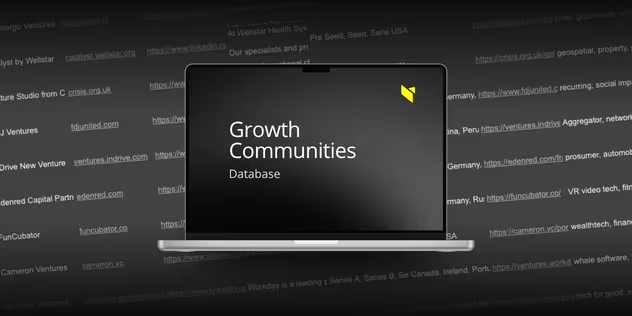
This is a free, ungated database of 39 B2B growth communities, covering GTM, sales, RevOps, marketing, customer success, and the vendor-run groups around tools like Clay, HubSpot, and Apollo. Seven fields per row: name, member count, URL, category, a description of who runs it, key insights, and any recurring events.
Below, the part that matters more than the list: how these communities actually differ, and how to pick two or three instead of joining twenty and reading none.
What you will find in this article
- The two categories of B2B community, and why the split changes everything
- Why member count is a misleading signal
- Where each GTM function actually spends its time
- How to get value from a community without getting thrown out of it
- Whether building your own community makes sense as a vendor
- FAQ on access, cost, and which ones are worth joining first
Two kinds of community, and the difference matters
Twenty-six of the 39 communities in the database are run by a software vendor. Thirteen are independent.
That split determines almost everything about what you get from being there.
Neither is better. They answer different questions.
If you are three hours into a Clay table that will not run, the Clay community will save you. If you are deciding whether Clay is the right purchase at all, the Clay community is the last place to ask. Go to RevOps Co-Op or RevGenius, where nobody is paid to like the answer.
Most people join the vendor communities because that is where the onboarding email points them, and then wonder why they never learn anything strategic. The independent ones require a deliberate decision.
Member count is a bad signal
The database shows sizes ranging from 200 to nearly 100,000. Twenty-nine of the 39 disclose a figure.
The five largest by listed membership: Miro at 98,939, Zapier at 65,180, RevGenius at 61,167, Pavilion at 50,000, and Friends of Figma at 32,589.
Look at what those actually are. Miro, Zapier, and Figma are product support forums for tools used by millions of people across every job function on earth. Their size tells you how many people use the product, not how much value sits inside the community. A design tool forum with 32,589 members has a lower concentration of GTM buyers than a Slack group with 600.
The small end reads differently. Outbounders HQ has 558 members and is specifically for cold email practitioners. Wiza's community has 252. The n8n community lists 200. In each case the density of relevant conversation per member is far higher.
CMO Coffee Talk is the clearest illustration. Five thousand members, invite-only, senior marketing leaders only. That is a fraction of Zapier's forum and worth considerably more to anyone selling into or working in marketing leadership.
Treat the member column as a filter for reach if you are running a campaign, and ignore it entirely if you are choosing where to learn.
One more caveat on the numbers: they are self-reported and overlap heavily. The same RevOps manager may be counted in six of these communities. Adding the column up gives a number over half a million, which describes memberships rather than people.
Where each function actually hangs out
The category column groups the communities by domain. Here is the practical version.
Two observations from building this out.
RevOps is the most fragmented category in the file, with four separate communities and no dominant one. That reflects a discipline still defining itself, and it means RevOps people usually need to be in two or three places rather than one.
Customer success sits at the opposite end. Both CS entries are leadership-oriented and access-controlled, one in-person and one private Slack. There is no large open CS community in this dataset, which is itself a useful signal about how that function networks.
Events are the highest-signal access point
Thirteen of the 39 communities list recurring events, and this is the column most people skip.
Clay runs the Clay Cup and Clay Club meetups. HubSpot operates more than 100 user groups worldwide with local sessions. n8n runs physical coworking meetups in Amsterdam, Berlin, Vienna, and Cologne. Miro hosts regular workshops. PhantomBuster runs an "Ask an Expert" series. Salesforce has Dreamforce, which needs no introduction.
An event converts a passive membership into an actual relationship. Reading a Slack channel for six months produces nothing. Showing up to one local meetup produces two or three people who will reply to your messages afterward.
If you are going to pick one thing from the database to act on, filter for communities with events near you and attend one.
How to actually get value without getting thrown out
Communities punish self-promotion faster than any other channel. The rules are simple and almost everyone breaks them.
Answer before you ask. Spend the first month replying to other people's questions in your area of expertise. This is not politeness, it is how you become recognizable. Nobody helps an unfamiliar name.
Post specifics, not requests for general advice. "How do I improve reply rates" gets ignored. "We sent 340 emails to Series A CTOs, got a 1.2% reply rate, here is the copy, what am I missing" gets ten thoughtful answers. Specificity earns attention in every community in this file.
Never pitch in the main channel. Not softly, not cleverly, not disguised as a question. Community managers see it immediately and members remember it longer.
Take conversations to DMs only after you have given something. The DM works when the person already recognizes your name from three helpful answers. It fails otherwise.
Pick two, not twelve. Membership costs nothing and attention costs everything. Two communities you participate in beat twelve you lurk in.
For anyone using communities as a sales channel rather than a learning channel, the same rules apply with one addition: the vendor communities are usually the wrong target. Their members are there for support, and the community manager's job includes keeping other vendors out. Independent practitioner communities with sponsorship or partnership programs are the legitimate route, and most of them will tell you the terms if you ask.
Should you build your own community?
Twenty-six vendors in this file decided yes. Before you copy them, look at the distribution.
A handful of vendor communities are genuinely active: Clay, HubSpot, Apollo, Make. Several others in the database do not even publish a member count, which is rarely a sign of a thriving space. Outbounders HQ has 558 members. Wiza has 252.
Building a community is a full-time job that shows no return for the first year. It works when your product has a genuine learning curve that users need help with, which is why Clay and Make succeed at it. It fails when the product is simple, because there is nothing to discuss.
The cheaper move for most vendors is to participate credibly in communities that already exist. It costs one person a few hours a week instead of a hire, and the audience is already assembled.
Four ways people waste communities
Joining and never posting. The most common outcome by far. A Slack you never open is not a resource.
Optimizing for size. Covered above. The largest groups in this file are support forums.
Treating it as a lead list. Scraping member directories and cold emailing them is the fastest way to get banned and to acquire a reputation that follows you across a small industry.
Ignoring the paid ones on principle. Pavilion charges, and the paywall is the product. It filters for people serious enough to expense it, which is exactly why the conversations are different.
FAQ
Is the database free? Yes. No form, no email, no gate. Open the sheet and make a copy.
How many communities does it include? Thirty-nine, spanning GTM, RevOps, sales, marketing, customer success, partnerships, data enrichment, automation, and vendor-run product communities.
Are all of them free to join? No. Most are, but some are paid, such as Pavilion. Others are invite-only or application-based, including CMO Coffee Talk and CXXchange. The database lists the URL so you can check the current terms yourself.
Which one should I join first? Depends on your function. RevGenius if you want breadth and it costs nothing. Exit Five for B2B marketing. RevOps Co-Op for revenue operations. If you run outbound, Outbounders HQ and the Clay community together cover most of what you need.
Are vendor communities worth joining? For learning a specific tool, yes, they are usually the fastest route to an answer. For deciding which tool to buy, go somewhere the vendor does not run the room.
Can I use these communities for lead generation? Not by scraping and emailing members. Sponsorship, partnership, and genuine participation are the routes that work, and several of these communities have formal programs for it.
How current is the member data? Member counts are self-reported and change constantly. Treat them as directional. Some rows have no count at all because the community does not publish one.
What to take away
Vendor-run communities outnumber independent ones two to one in this database, and they answer a fundamentally different question. Know which one you need before you join.
The largest communities here are product support forums. Size measures product adoption, not conversation quality, and the inverse is often true.
Thirteen of the 39 run recurring events. That column is where the actual relationships come from, and most people never look at it.
Two communities you participate in will do more for you than twelve you joined and forgot.
We spend a lot of time in these rooms, because that is where the honest opinions about tools, deliverability, and what is actually working in outbound get shared. If you want that translated into a campaign rather than a reading habit, book a free consultation.

.avif)