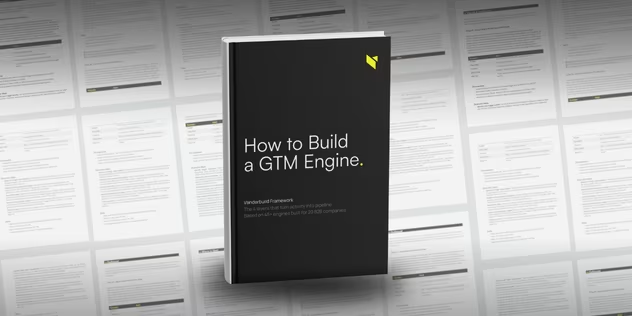
Most companies do not have a GTM engine. They have outbound, some SEO, and a few events a year, each run by someone different and each measured against a different definition of success.
An engine is what you get when those activities share one source of truth and reinforce each other. Outbound lands better when the prospect has already seen your ads.
That engine has four layers, not three departments: data, demand, conversion, and retention. Each layer runs on the one below it. Build them out of order and every layer above carries the gap.
Callout, Uncomfortable truth: A campaign launched on messy data defers the cost, with interest. Picture an event list where a third of the names are not fit to email: personal inboxes, or records with no company behind them.
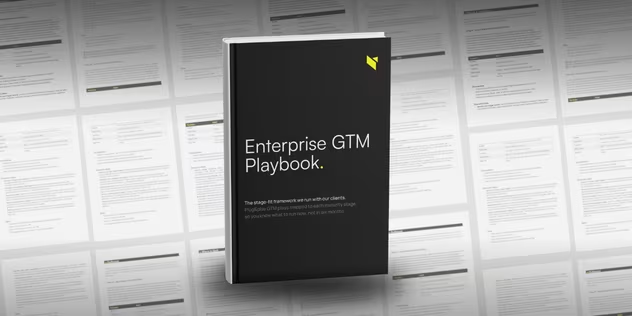
What is inside: the four layers, the build paths, and the first 90 days
- Nine sections, no theory chapters
- Four build paths compared side by side, with the tools behind each one
- The full cost model for all four paths, tools and hidden costs
- What each layer needs, and what breaks without it
- The 95/5 rule, four nurture types, and the signals that open an upsell
- A twelve-step rollout checklist from day 0 to day 90, each step with a control point
- Six control thresholds with the reaction when each is crossed
- Eight Vanderbuild rules, the short version of everything above
- Tool stack mapped per path: Clay, CRM, Make, Salesforge, HeyReach and the rest
A preview: how a GTM engine gets built
A preview: how a GTM engine gets built
Path 02 is where most teams start, because the tools work on day one. What is missing is the layer underneath: no normalized structure, no qualification rule, no check of what is still true. When reply rates fall, nobody can say which segment failed, because the segments were never defined.
Path 03 is the Vanderbuild standard. Deterministic means predictable: enrichment on entry, a binary qualification rule, routing by owner, follow-ups on schedule. When something breaks, you know which rule to fix.
Framing callout: You are not buying reach. You are buying someone else's idea of who your customer is.
What a GTM engine costs
Page 8 of the playbook prices all four paths at list prices, on ten sending mailboxes and about 6,600 campaign emails a month.
Path 03, the one we run, comes to about 896 USD a month in tools, roughly 10,816 USD in year one. Path 02 comes to about 201 USD a month, which looks four times cheaper until you count the hours of manual list work, the campaigns re-run on bad data, and the sending domains replaced after bounces.
The playbook breaks each line down per tool and names the four hidden costs that sit outside the tools line: team time, rework, maintenance and ownership.
The rollout, day 0 to day 90
Day 0 is the three questions and the choice of path. Days 1 to 14 are the workshop and the first domains warming up. Days 10 to 30 are structure, enrichment and the qualification rule. Day 15 is the first segment out, small, to validate the thesis. Days 45 to 75 are the inbound automations and the pipeline. Days 76 to 90 put lost opportunities back into the motion.
Twelve steps, each with a control point you can check before moving on. This is the sheet our team works from.
Who this is for: teams with activity that does not turn into pipeline
- Sends, list size and connections go up while pipeline stays flat, and nobody can say which segment works
- You are about to automate, and you are not sure whether the data underneath is ready
- You are briefing a partner or a GTM engineer and want to know what a correct build looks like
- Your lost opportunities sit in the CRM as an archive rather than as pipeline
If activity is rising and pipeline is not, the problem usually sits one layer below the one you are working on.
Build it yourself, or work with a GTM engineering partner?
The playbook is written so your team can run this alone. Plenty of teams should, and the in-house variant of path 03 is in there.
It stops making sense when the data layer becomes a standing job rather than a project: providers to keep in check, workflows to fix when a field or an API changes, thresholds to watch weekly, and an owner who is still there in six months. We compared both models, with the numbers behind each one, in GTM engineer: in-house or agency.
We have run 250+ campaigns and built 50+ revenue engines, with a 41.3% response rate on our best-performing campaigns. The engine in this playbook is the engine we build.
FAQ: building a GTM engine
What is a GTM engine?
Four layers that share one source of truth: data, demand, conversion and retention. Each layer runs on the one below it, so outbound, inbound, pipeline and nurturing reinforce each other instead of running as separate projects. The playbook covers how each layer is built.
How is that different from having outbound and inbound running?
Separate motions are measured separately and start from zero each time. In an engine, one contact record serves every motion, results are traceable to a segment and a signal, and a lost deal comes back into the pipeline instead of leaving the system.
Which layer do I build first?
Data, always. Structure, cleanliness, currency and qualification. Every automation above it runs at speed on whatever state the data is in, and you cannot unsend what already went out on bad records.
How long does it take to build?
The first layer takes two to six weeks. A working engine takes a quarter at minimum. Retention never stops, so the engine is never finished.
What does a GTM engine cost?
About 896 USD a month in tools on the path we run, plus the person or partner running it. The playbook prices all four paths and shows where the cheaper path becomes the expensive one.
Do I need a GTM engineer to build one?
Not for the data layer, which is a defined project. A GTM engineer becomes worth hiring when there is a repeatable process to turn into a system. RevOps maintains what already runs.
Can I put AI agents on top of this?
Yes, after the workflows are validated. One process, one value proposition, one persona, one account type, with the context kept in a shared GTM Brain. An agent running an unvalidated process makes the not-knowing autonomous and faster.
Is the playbook free, and what do I get?
Yes. One form, and a PDF lands at the address you enter.

.avif)
.avif)