Most fundraising advice for European founders is written by people who raised in San Francisco. The numbers do not transfer, and neither does the process.
So we mapped the actual market.
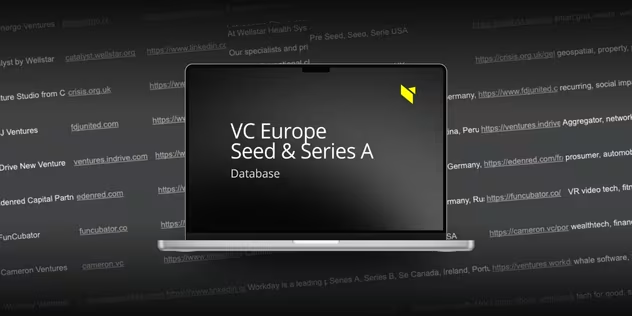
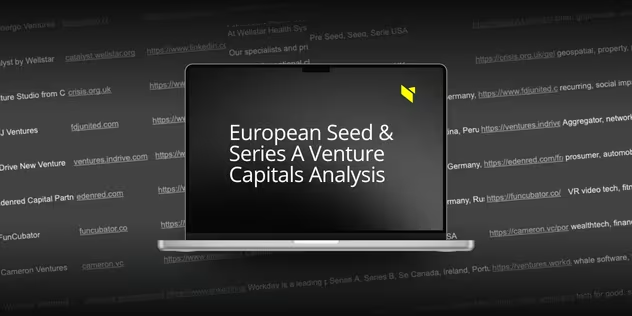
This is a free analysis of 2,560 European seed and Series A venture capital funds across more than 25 countries, covering what they invest in, where they sit, how much they write per check, and how they differ from each other. The underlying database comes with it. No form, no email, no gate.
Below are the findings that change how you build a target list.
What you will find in this article
- What a European seed and Series A check actually looks like, in euros
- How ticket sizes shift by up to five times depending on the country
- The ten sectors European VCs fund most, and the ones almost nobody funds
- Five fund archetypes, and how to tell which one you are pitching
- The structural facts about European funds that founders consistently miss
- How to turn 2,560 funds into a target list of 40
A note on the numbers first
Roughly half of the funds in this dataset disclose their investment sizes, and average data completeness across all fields sits around 75%. Country shares and fund-type breakdowns are estimates derived from the sample rather than audited figures.
Treat everything below as directional. Directional beats the alternative, which for most founders is a Twitter thread and a guess.
What European VCs actually write per check
This is the section people search for, so it goes first.
Series A checks run three to five times larger than seed checks. The most common single seed check is somewhere between €250k and €500k, which surprises founders who have internalized American numbers.
Real examples from the database show how wide the spread is. Seedcamp writes $350k to $1M. Black Seed VC writes £100k to £400k. Haatch does £300k to £800k. At the other end, Seed Capital in Denmark writes €2M to €4M at seed, which overlaps entirely with what many funds call Series A.
At Series A, Karma Ventures sits at €1M to €5M, ALSTIN Capital at €2M to €8M, Criteria Venture Tech at €5M to €15M, and Alven goes up to €30M across seed to Series C.
The overlap between late seed and small Series A is not a labeling error. Both cluster in the €1M to €3M band, and plenty of funds invest across both with flexible tickets. If your round is €2M, you are pitching two different stage labels for the same money.
Geography moves the check by five times
Where a fund sits changes what it writes more than almost any other variable.
UK funds run highest, at roughly £500k to £2M for seed and £2M to £10M for Series A. Germany and France sit close behind at €500k to €1.5M seed and €3M to €8M Series A. The Nordics come in lower at €300k to €1M and €2M to €5M. Eastern European funds write €100k to €500k at seed and €1M to €3M at Series A.
A Warsaw fund and a London fund can both call it a seed round while the checks differ by a factor of five.
Sector shifts it too. Deep tech and biotech command higher tickets, around €1M to €3M at seed and €5M to €15M at Series A, because the capital requirement before revenue is simply larger. SaaS sits in the middle. Consumer and e-commerce run lowest, at €250k to €1M seed.
Where the money is concentrated
The UK holds an estimated 30 to 35% of the funds in this dataset. Germany follows at 15 to 18%, France at 12 to 15%, and Spain at 8 to 10%. The Netherlands, Switzerland, and Italy each hold single digits. Belgium, Austria, Ireland, and Poland sit at 2 to 4% apiece.
The Nordics deserve separate mention. Sweden, Finland, Norway, and Denmark together account for 10 to 12%, which is more than France on a combined basis and considerably more than their population would predict. They also skew specialized rather than generalist.
London dominates as the single hub, with Berlin, Paris, and Amsterdam forming the secondary tier. Eastern Europe remains underrepresented, though Poland and the Czech Republic are visibly emerging.
One detail worth planning around: many European funds operate across two to four countries. A fund headquartered in Amsterdam may actively invest in Belgium and Germany. Filtering purely by headquarters city will make you miss funds that would happily take your call.
Fintech leads by a clear margin, appearing in roughly 950 to 1,100 fund profiles. That is a European peculiarity worth understanding: the continent's fragmented banking and payments infrastructure created a generation of fintech winners, and the funds followed.
Note the shares add well past 100%, because the average fund lists five to seven sectors. Most European VCs are not specialists. They are hedging.
The tail is where things get interesting. GovTech appears in only five to seven fund profiles. LegalTech in six to eight. EdTech and AgriTech in eight to ten each. Quantum computing shows up three or four times, space tech three to five, and nuclear three to four across a sample of 2,560 funds.
Then there is the genuinely rare end. Autonomous kitchens, heritage protection, land management, aerial robotics, and fleet management each appear exactly once.
If you are building in one of those categories, the practical consequence is severe. There are not ten funds for you to pitch. There are one or two, and your list has to be built by hand from portfolio pages rather than from sector filters.
Five fund archetypes
Knowing which type you are pitching changes the pitch.
The Generalist makes up roughly 40% of the market. Six to ten sectors, seed through Series B, tickets of €1M to €5M. They will take a meeting on almost anything, which means the bar is comparative rather than absolute. You are competing against every other deal that week, not against other companies in your category.
The B2B Specialist is about 25%. Enterprise SaaS, B2B software, developer tools, seed to Series A, €500k to €3M. They know your metrics benchmarks better than you do. Come with net revenue retention and payback period, not vision.
The Deep Tech Investor, around 15%, covers hardware, robotics, quantum, and advanced materials from pre-seed to Series A at €500k to €5M. Frequently government-backed or corporate. Timelines are longer and technical diligence is real.
The Vertical Specialist, roughly 10%, invests in one sector across all stages with tickets from €1M to €10M. Deep domain expertise means they will spot weak market assumptions immediately, and also that they can open doors nobody else can.
The Impact Investor, another 10%, runs a dual mandate of returns plus measurable impact, €500k to €5M, seed to Series B. Your impact framing has to be structural rather than decorative.
Four structural facts founders miss
Only about 40% of these funds prefer to lead. The other 60% are comfortable following. If your list is 40 funds and you have not identified which ones can actually price and lead a round, you may collect enthusiasm without ever getting a term sheet.
More than 80% co-invest. Syndication is standard practice in Europe. One committed lead moves conversations that were going nowhere on their own, which is an argument for sequencing your process rather than running all 40 conversations in parallel.
Thirty percent of these funds are micro funds under €50 million. Another 35% sit between €50M and €150M. Only about 10% manage over €500M. Fund size caps check size and dictates ownership targets, so a €40M fund cannot write you €3M no matter how much they like the company.
Sixty to seventy percent reserve capital for follow-ons. The fund that writes you €800k at seed may have €2M earmarked for your Series A. That makes the first check a relationship decision more than a transaction, and it is a fair question to ask in the first meeting.
On what they screen for: team quality ranks first for nearly every fund in the dataset. Market size needs to support a €1B or larger TAM for most. Product-market fit is treated as a hard requirement at Series A rather than a nice signal. And the majority require European headquarters or substantial European operations.
Turning 2,560 funds into a list of 40
Nobody pitches 2,560 funds. Here is how to cut it down.
Filter on stage first, and be honest. Pitching Series A funds at pre-seed is the single most common waste of a founder's time. Roughly 70% of the funds here are early stage, so the pool is large enough to be strict.
Filter on sector second. If a fund does not list your sector, it will not invest in your sector. That sounds obvious and gets ignored constantly.
Filter on geography third, including the multi-country funds mentioned earlier, not just the ones headquartered near you.
Then split the remaining list into leads and followers. Approach the potential leads first, in a tight window, so that competitive tension is real rather than manufactured.
Warm intros through portfolio companies outperform everything else. Every fund's portfolio page is public. Find the company closest to your space, talk to that founder, and ask for the introduction. It is slower than a cold email and converts at a completely different rate.
If you sell to VCs or their portfolios
Founders are the obvious audience for a database like this, but it works as a target list too.
Funds themselves buy software, from CRM and deal-flow tooling to research and portfolio-reporting products. More usefully, each of these funds sits on 20 to 50 active portfolio companies. One relationship with a fund's platform or talent team can put you in front of dozens of startups at once, with the fund's implicit endorsement attached.
That motion needs the same enrichment work as any other list: resolve funds to domains, find the partner and platform contacts, verify emails, and write to a real reason rather than a generic pitch. The database gives you the account universe. The rest is execution.
What founders get wrong
Expecting US valuations. European rounds typically price 20 to 40% below comparable American ones. Anchoring to TechCrunch headlines makes you look uninformed in the first meeting.
Pitching consumer to B2B funds. Around 70% of the capital here is B2B focused. If you are building consumer, your realistic pool is smaller than the headline number of 2,560 suggests.
Ignoring the path to profitability. European investors are structurally more conservative than their American counterparts on burn. A credible route to breakeven is an asset here in a way it often is not in the US.
Treating ESG as decoration. Between 8 and 12% of these funds run an explicit impact mandate, and the theme increasingly shows up in diligence even at funds that do not.
FAQ
Is the analysis free? Yes. Both the written analysis and the underlying database are open, with no form or email required.
How many VCs does it cover? 2,560 European seed and Series A funds across more than 25 countries.
What is the average seed round ticket in Europe? Individual seed checks average €500k to €2M, with the typical check landing between €750k and €1.5M. The most common first seed check is €250k to €500k.
What is a typical European Series A? Individual Series A checks average €2M to €10M, with most between €3M and €7M. Larger rounds reach €15M to €30M in competitive deals.
Which European country has the most VC funds? The United Kingdom, at an estimated 30 to 35% of the funds in this dataset, ahead of Germany and France.
What sector do European VCs fund most? Fintech, appearing in roughly 40% of fund profiles, followed by SaaS and AI.
How complete is the data? Around 75% on average across fields, with roughly half of the funds disclosing investment sizes. Verify anything you plan to act on directly with the fund.
Can I use this list for outreach rather than fundraising? Yes. Funds buy software themselves and each one connects to 20 to 50 portfolio companies. Enrich it first, as with any raw account list.
What to take away
The typical European seed check is €750k to €1.5M and the typical Series A is €3M to €7M. Anything you read that quotes American figures is describing a different market.
Geography swings the check by up to five times, and sector swings it again. A number that is normal in London is an outlier in Warsaw.
Fintech, SaaS, and AI dominate the funded sectors, and the average fund lists five to seven of them. Outside the top ten, the number of relevant funds collapses fast.
Sixty percent of these funds will not lead your round. Identify the ones that will before you spend three months on meetings.
We help companies research, segment, and reach the right accounts at scale, whether those accounts are VCs, their portfolios, or your actual customers. If that is the problem, book a free consultation.

.avif)