Most VC lists give you a fund name and a website. Then you sit there, because a fund does not read email. A partner does.
This database carries up to three named partner LinkedIn profiles per fund.
That single column changes fundraising from a submission process into an outreach process, and it is the reason this file is more useful than the directory you bookmarked and never opened.
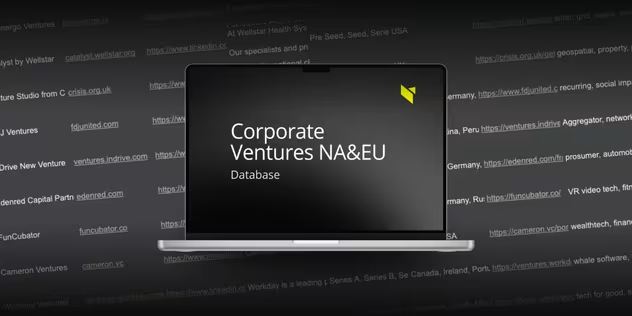
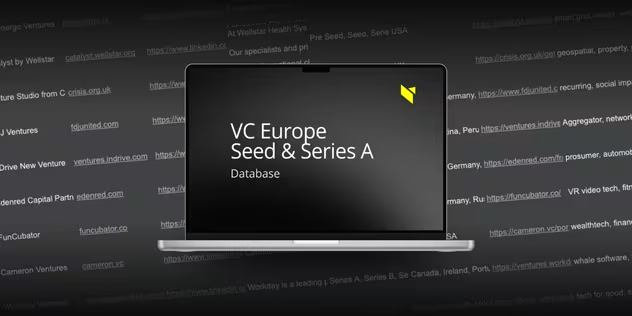
EU VC Seed + Series A is a free, ungated database of 2,555 European venture funds across 35 countries, with 13 fields per row: fund name, website, countries, investment size, sectors, general email, rounds covered, portfolio link, and up to three partner LinkedIn profiles.
Below: what the real country distribution looks like, why the partner layer matters more than the ticket data, and how to get from 2,555 funds to 40 conversations.
What you will find in this article
- The real geographic distribution, including one figure that contradicts common assumptions
- Why named partners beat general inboxes by a wide margin
- How to cut 2,555 funds down to a working shortlist
- A sequence for reaching a partner who does not know you
- Which fields to trust and which to verify
What is actually in the file
Thirteen columns per fund. Four of them do work no other free VC list does.
Partner LinkedIn profiles, up to three per fund. Named people, not a contact form.
General email. Present for a large share of funds, useful as a fallback and for firms that route through an investment team inbox.
Portfolio link. Where you check whether they already back a competitor, and where you find the founder who can make your introduction.
Investment size. Written as the fund states it, which means the formats vary wildly. You will see clean ranges like €250k to €4M, single figures like £1M, fund-level numbers like €150 million, and occasional prose. Parse before you filter.
The remaining fields cover website, countries, sectors, and rounds. Average data completeness across the file runs around 75%, so treat empty cells as unknown rather than as absent.
The real map of European venture
Counting funds by primary country produces a distribution that differs from the one most people carry in their heads.
Two things stand out.
Spain has more funds than France. By a margin of 25. The standard mental ranking of European venture puts France comfortably third behind the UK and Germany, and the count does not support it. If you are raising in Southern Europe, Spain deserves far more of your attention than its reputation suggests.
Germany is closer to the UK than expected. At 447 against 567, Germany holds roughly four fifths of the UK's fund count. The gap in headlines is much wider than the gap in the data.
The long tail runs deep. Czechia has 32 funds, Estonia 25, Latvia 17, Bulgaria 15, Greece 13, Romania 12, Lithuania 11. Even Iceland, Ukraine, Slovenia, Serbia, Malta, and Kosovo appear. Central and Eastern Europe holds well over 200 funds in this file, and almost none of them show up in the lists founders normally work from.
Why the partner layer is the point
Fundraising outreach fails in a predictable way. The founder finds the fund, opens the website, sees a contact form or an info@ address, sends the deck, and hears nothing.
That path fails because a general inbox is a queue with no owner. Nobody is measured on clearing it.
A named partner is different. They have a thesis, a sector they cover, a LinkedIn feed they read, and a professional interest in seeing deals before their competitors do. Reaching the right partner is not a favor you are asking. It is the job they are paid to do.
Three partners per fund also gives you a choice, and the choice matters. Partners specialize. At a generalist fund, one covers fintech, another covers health, another covers infrastructure. Sending your health company to the fintech partner produces a polite forward at best and silence at worst.
Check what each partner posts about and which board seats they hold before you pick. That research takes four minutes per fund and changes your reply rate more than any other variable.
Cutting 2,555 down to 40
Nobody contacts 2,555 funds. Here is the filter that produces a working list.
Stage first. The rounds column tells you what each fund covers. Roughly 70% of the European market is early stage from pre-seed to Series A, so the pool is large enough to be strict. Pitching a Series B fund at seed wastes the introduction you spent a month earning.
Sector second. Funds list five to seven sectors on average. If yours is absent, the answer is no before you write. Fintech is the most common sector across the European market by a wide margin, followed by SaaS and AI.
Geography third. Use the country columns, not just the headquarters city. Many of these funds operate across two to four countries, so filtering only on where they are registered will cut funds that would happily take your call.
Ticket size fourth, and treat this one as a soft filter because the field is inconsistently formatted and often reflects fund size rather than a per-deal check. Verify on the fund site before you disqualify anyone.
Then split leads from followers. Roughly 40% of European funds prefer to lead a round. Identify which of your 40 can actually price and lead, and approach those first, in a tight window, so competitive tension is real rather than manufactured.
Forty funds you understand beats 400 you filtered on one column.
Reaching a partner who does not know you
The database gives you the person. The rest is outreach, and the same rules apply here as in any cold outbound.
Warm introductions first. Every fund has a portfolio link in this file. Find the company closest to your space, talk to that founder, and ask for the introduction. Slower than email, and it converts at a completely different rate.
When you go direct, lead with the reason it is them. Not "I saw you invest in SaaS." Something closer to "you led the Series A in a company solving the adjacent half of this problem." Specificity proves you did the work, and partners can tell instantly.
Say the number early. How much you are raising, at what stage, and what the round is for. Partners screen on fit before they screen on quality, and hiding the ask wastes both sides' time.
One crisp proof point. A metric with a timeframe. Growth rate, revenue, retention, pilot conversion. One number that is real beats three that are rounded.
Keep the first ask small. A deck request or a short call, not a full pitch meeting. Lower friction converts better here for the same reason it does in sales outreach.
LinkedIn and email together. Partners live on LinkedIn. A connection request with context, followed by an email a few days later, outperforms either channel alone.
If you want the full mechanics of writing this kind of message, our cold email playbook covers the frameworks and the quality checks in detail.
What the money looks like
This database is the contact layer. For the benchmarks that tell you whether your ask is realistic, we published a separate analysis of the same 2,560-fund market covering ticket sizes by stage, by country, and by sector.
The short version: individual seed checks average €500k to €2M with a typical check of €750k to €1.5M, and Series A checks average €2M to €10M with most between €3M and €7M. Geography swings those numbers by up to five times, with UK funds writing the largest checks and Central and Eastern European funds the smallest.
Read the full European seed and Series A analysis before you set your target number.
If you sell to funds rather than raise from them
The same file works as a sales target list, and the partner column is again the reason.
Funds buy deal-flow tooling, research subscriptions, portfolio reporting, and back-office services. More usefully, each fund connects to a portfolio of companies at exactly the stage where they are building a go-to-market motion for the first time.
The route in is the same as it is for founders: a named partner, a specific reason for contact, and something useful attached. Platform and talent partners at these funds are often the most receptive contacts, because their job is to bring resources to the portfolio.
Five ways to waste this file
Emailing the general inbox when a partner is listed. The partner column exists precisely so you do not have to.
Contacting all three partners at once. It looks automated, because it is. Pick the right one.
Filtering on the investment size column without cleaning it. The formats are inconsistent enough that a naive filter will drop funds that fit and keep funds that do not.
Ignoring the portfolio link. It tells you about conflicts and gives you the warm path. Skipping it is the most common unforced error in fundraising outreach.
Treating it as a mailing list. Two thousand five hundred funds is a universe, not a segment. Sending the same message to all of them produces nothing except a reputation that travels fast in a small industry.
FAQ
Is the database free? Yes. No form, no email required, no gate. Open the sheet and make a copy.
How many funds does it include? 2,555 rows across 35 European countries, covering seed and Series A investors alongside funds that also do later stages.
Does it include contact details? Yes. Up to three partner LinkedIn profiles per fund, plus a general email for a large share of them and a portfolio link for most.
Which European country has the most VC funds? The United Kingdom with 567, then Germany with 447. Spain is third at 195, ahead of France at 170.
How complete is the data? Around 75% on average across fields. Investment size is the least consistent column, both in coverage and in format.
Should I email the fund or message a partner? Message a partner, and pick the one whose sector coverage matches you. General inboxes are queues nobody owns.
What check size should I expect? Typical European seed checks run €750k to €1.5M and Series A checks €3M to €7M, with wide variation by country and sector.
Can I use this for sales instead of fundraising? Yes. Funds buy software themselves and each one connects to a portfolio of early-stage companies.
What to take away
The partner column is what makes this file different. A fund does not answer email. A named partner with a matching sector thesis does.
Spain has more funds than France, and Germany is closer to the UK than the headlines suggest. Check the count before you accept the received ranking.
Central and Eastern Europe holds more than 200 funds that rarely appear on any list founders work from.
Cut to 40 funds on stage, sector, and geography before you write anything, then find the warm path through the portfolio link.
Verify the investment size column. It is the least reliable field in the file and the one most likely to make you disqualify a fund that fits.
We build and run outreach at this scale for clients, whether the target is investors, their portfolios, or your actual customers. If that is the work, book a free consultation.

.avif)