A Series A announcement is a buying signal with a 90-day shelf life. Most sales teams find out six months late, from a newsletter, after the budget is already spent.
So we built the list instead of waiting for one.
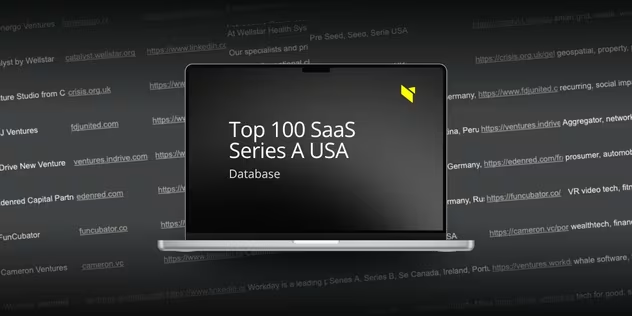
This is a free, no-gate database of 100 US SaaS companies that closed a Series A round between January 2025 and January 2026. Every row carries 14 fields: company, website, LinkedIn, industry, HQ, state, funding date, round size, lead VC, full investor list, ARR band, total funding raised, and a plain-English description of what the company actually sells.
Below the link, we did something most resource pages skip. We analyzed the 100 rows and pulled out what the data says about where US SaaS money went, who is buying right now, and how to turn this file into pipeline instead of another tab you never open.
What you will find in this article
- What is inside the Top 100 SaaS Series A database, field by field
- Six findings from the data: geography, round size, ARR bands, and investor concentration
- Why Series A is the shortest buying window in B2B SaaS
- A five-step process for turning a static list into a live outbound campaign
- The four mistakes that kill campaigns built on funding lists
- FAQ: sourcing, refresh cadence, compliance, and usage rights
What is a Series A SaaS company, and why should you care?
Series A is the first institutional round after a startup proves that people will pay for the product. Seed money buys the experiment. Series A buys the machine.
That distinction matters for anyone selling B2B. A seed-stage company has a founder doing everything and no budget line for you. A Series B company already signed contracts with your competitors. Series A sits in the middle, and it is the narrowest window in the funnel.
Here is what happens inside a SaaS company in the 6 months after the round closes:
- Headcount plans get approved, usually starting with sales and engineering
- The first RevOps or growth hire arrives and audits the stack
- Tooling budget appears where there was none
- The board asks for a repeatable go-to-market motion, not founder-led sales
- Vendor decisions get made fast, because the pressure is on burn and speed
Every one of those five is a purchase trigger. That is why funding data beats firmographic data. Company size tells you who they are. A funding round tells you what they are about to do.
Six things the data says about US SaaS Series A rounds
We analyzed all 100 companies in the database. The picture is sharper than the headline numbers suggest.
1. Two states hold two-thirds of the market
At city level it gets tighter. San Francisco accounts for 24 companies and New York City for 20. Boston, San Jose, Palo Alto, and Austin bring 4 each.
If your territory plan spreads evenly across the US, you are spreading thin. Two metros cover 44 of the 100 accounts, with the timezone, event calendar, and referral network that come with them.
2. The median Series A is $15M, and the distribution is boring
Ninety-one of the 100 companies disclosed a round size. The median is $15M. The mean is $20M.
Sixty-eight of 91 disclosed rounds land between $10M and $30M. That concentration is useful. It means you can price and scope one offer for the vast majority of this list instead of building three tiers.
A $15M round funds roughly 18 to 24 months of runway for a 25 to 50 person company. Your deal has to pay back inside that window or it will not survive the next board meeting.
3. Most of these companies are earlier than their round size suggests
Ninety-one companies reported an ARR band. The distribution is the single most actionable.
Almost half the list sits between $1M and $5M ARR while holding a $15M round. Read that again. These companies just raised 3 to 10 times their annual revenue, which means the board is expecting a step change in growth, and the current team cannot deliver it alone.
That gap is your offer. Not efficiency. Not cost savings. Speed to revenue.
4. Eighty-six out of 100 sell AI
We checked the description field of every company. Eighty-six mention AI, machine learning, or LLMs as core to the product. Twenty-one specifically position around agents or agentic workflows.
This changes how you write. "We use AI" is worthless as a differentiator when you are writing to a company whose entire pitch deck is AI. Your message has to survive a reader who builds this stuff.
Sell the outcome, name the mechanism, and skip the adjectives.
5. Y Combinator is the most common name on the cap table
Looking across all investors, not just lead investors:
Lead investors are far more fragmented. Ninety-eight rounds had a named lead, and no single firm led more than three.
The practical read: warm paths run through portfolios, not through firms. If you land one YC-backed account on this list, you have a reference that carries weight with 11 others. Portfolio-level referrals are the cheapest pipeline on this page.
6. Funding announcements cluster in autumn
November alone carried 16 of the 100 announcements. If your outbound calendar goes quiet in Q4 because "nobody buys in December," you are skipping the month with the most fresh capital in the market.
Across the full list, these 100 companies have raised roughly $3.7B in total funding. That is the size of the addressable budget sitting in one spreadsheet.
Why funding lists beat firmographic lists
Most outbound targeting works on static attributes. Industry, headcount, tech stack, location. Those attributes tell you whether a company could buy. They say nothing about whether it will buy this quarter.
Funding data is different because it is time-stamped. It tells you that a specific company got a specific amount of money on a specific date, with a specific investor now asking for results.
How to turn this database into a live outbound campaign
Downloading a list is not a campaign. Here is the process we run at Vanderbuild across 258 sales campaigns in 2025.
Step 1: Cut the list before you enrich it
Do not work all 100. Filter down to the accounts where your offer is a fit, then defend the cut. Useful filters from the file:
- ARR band - if you sell to companies with an existing sales team, drop everything under $1M ARR
- Funding date - rounds closed in the last 90 days behave differently from rounds closed 10 months ago
- Industry and description - the description column tells you what they actually sell, which the industry column often does not
- State - if you need timezone overlap or an in-person motion, cut to CA and NY first
A tight list of 30 accounts you understand beats 100 accounts you guessed at.
Step 2: Enrich from company to person
The database gives you the account. It does not give you the buyer. Push the LinkedIn company URLs into Clay, then run a waterfall through Prospeo, Findymail, and Apollo to build the contact layer.
For a Series A SaaS company, your entry points are usually:
- Head of Growth or VP Sales - owns the number the board is watching
- Founder or CEO - still involved in every vendor decision at this stage
- RevOps or first Sales Ops hire - often hired within 90 days of the round and looking for quick wins
- Head of Marketing - owns pipeline targets that just doubled
Verify every email before it enters a sequence. A list this small does not survive a bounce rate above 2%.
Step 3: Write to the trigger, not to the persona
The funding round is the reason you are writing. Say so in the first line, then move to the problem the round creates.
Step 4: Run multichannel, not email-only
Series A founders and growth leads live on LinkedIn. Run cold email through Smartlead or Instantly, and mirror the same accounts on LinkedIn with HeyReach. The touch that gets the reply is rarely the touch that creates recognition.
Keep the sequence short. Four to five touches over three weeks, then stop and move the account to a nurture list with a calendar reminder for the next quarter.
Step 5: Log everything and re-run in 90 days
Companies on this list will still be in market next quarter. The ones who ignored you in month two often reply in month six, once the first growth hire has failed to hit the number alone.
Push the whole list into your CRM with the funding date as a custom field. Set a task at 90 days. That single field turns a one-off campaign into a repeatable motion.
Four mistakes that kill campaigns built on funding lists
Mistake 1: Leading with congratulations. Every vendor in the market sends that email the same week. Congratulations is not a value proposition, and by week two it reads as noise.
Mistake 2: Treating the list as an ICP. The database is a starting universe, not a target profile. If you cannot explain in one sentence why a specific company needs your product, take it off the list.
Mistake 3: Sending before you enrich. The company row gives you an account. Without verified contacts and a real reason to write to that person, you are blasting a nice spreadsheet at a spam filter.
Mistake 4: Scaling before the message works. Test the offer on 30 accounts. If nobody replies, the problem is the offer, not the volume. Sending it to 3,000 more people will only prove you were wrong faster and more expensively.
FAQ: Top 100 SaaS Series A USA database
Is the database really free? Yes. No email gate, no form, no trial. Open the Google Sheet, make a copy, use it.
What time period does it cover? Rounds announced between January 2025 and January 2026, with 99 of the 100 closing during calendar 2025.
Where does the data come from? Public funding announcements, company websites, and LinkedIn, compiled and enriched by the Vanderbuild team. ARR bands are estimates, so treat them as directional signals for segmentation rather than audited financials.
Can I use this list for cold outreach in the US? US B2B cold email is legal under CAN-SPAM as long as you identify yourself, include a physical address, and honor opt-outs. If you are emailing from the EU or contacting EU-based staff at these companies, GDPR legitimate interest rules apply on top. Get your own legal read before you send at volume.
How often is it updated? We refresh periodically. If you want a version filtered to your ICP, or a live feed of new Series A rounds in your segment, we build those for clients.
Can I use it for investor research instead of sales? Yes. The lead VC and investor columns map who is actively writing Series A checks in US SaaS, which is useful whether you are raising or selling.
What to take away
- Two metros, San Francisco and New York, cover 44 of the 100 accounts. Concentrate there before you go national.
- The median round is $15M and 68 of 91 disclosed rounds sit between $10M and $30M. One offer covers most of this list.
- Half the companies are at $1M-$5M ARR with a $15M round in the bank. The gap between their revenue and their expectations is your entire pitch.
- Eighty-six of 100 sell AI. Drop the AI adjectives from your copy and sell the outcome.
- The funding date column is worth more than every other column combined. Use it, then use it again in 90 days.
The list is free. Turning it into booked meetings is the part most teams get wrong.
If you want the campaign built instead of the spreadsheet downloaded, book a free consultation. We will show you the segmentation, the sequence, and the numbers from campaigns we ran into this exact market.

.avif)