Before a first call with a GTM agency, most founders and heads of growth want the same answers. What do you actually build? How much of my team's time will it take? How does your lead generation pricing work, and why won't you charge per lead? Will my LinkedIn account get banned?
Here they are, written down, so the call can go to your market and your offer instead. Where the honest answer is "it depends," we say what it depends on.
What does a GTM engineering agency actually do?
What services does Vanderbuild offer?
We organize our work by area. In plain terms, we do GTM engineering (go-to-market engineering) and RevOps (revenue operations).
The value you see is leads. On the way there, we build repeatable systems that let AI work on your company's own data and turn it into revenue. An outbound project moves through four stages of maturity:
- Product-market fit validation: test sales theses on live campaigns.
- TAM and ecosystem mapping: count and segment your total addressable market.
- Recurring signal-based campaigns: reach accounts when something changes for them.
- CRM data activation: turn the data you already hold into pipeline.
What we build with you, stage by stage
Most outbound projects move through these four stages. We build every stage on Clay for data and Claude for AI, so the systems keep working after launch.


By default we start at stage 1. A company whose offer already works can start at stage 2 or 3.
What does GTM engineering cover?
GTM engineering means building systems that put data to work through ads, cold email, LinkedIn outreach, LinkedIn publishing, and more. Our outbound campaigns can be:
- micro campaigns around an event
- micro campaigns that test one sales thesis
- signal-based campaigns
- TAM campaigns that cover your whole addressable market
- awareness campaigns that collect feedback from the market
What does a RevOps agency build?
We build our systems on two orchestrators: Clay for data and Claude for AI. We restructure the data in your CRM and build workflows around it that run on what your sales process already collects.
In practice, that means systems for:
- recycling data and reheating lost deals and warm leads whose timing wasn't right
- routing leads to the right account executive
- qualifying and segmenting leads inside the CRM
Our job is to make sure that data is looked after, so every lead has the best chance of turning into a sale.
How a lead generation project with us runs: time, handoff, and KPIs
How much of my team's time does it take?
For an outbound project, the biggest block is the workshop at the start: 1 to 3 hours, depending on the campaigns. In it we settle who we go to, what you sell, and how you talk about it. After that, a 30-minute status call every week or every two weeks.
Larger projects on your CRM and data orchestration run as a series of workshops, usually every two weeks. The first one sets the roadmap. Each one after it checks that the roadmap still points the right way.
Plan on 5 to 10 hours a month in total, including handling what we generate. Handling replies and meetings is part of your team's daily work anyway, since your salespeople close deals and we add opportunities to their pipeline.
Where does Vanderbuild hand off to my sales team?
You choose one of two points. We hand over the moment a reply comes in, or we handle the reply ourselves and put the meeting in your calendar.
Which KPI do we agree on?
One of three, agreed at the workshop:
- Positive reply: someone says "yes, that sounds interesting."
- Meeting booked.
- SQL (sales qualified lead): a specific, priced opportunity in your pipeline or CRM.
The right one depends on your business. With a low ticket, for example a SaaS product, a positive reply is the better metric, because you don't need to meet everyone to start building touchpoints and conversions. For consulting and other complex sales, a deal opportunity in the pipeline usually fits better. Most of our projects use positive replies.
Done for you or done with you: whose tools do we use?
That is entirely your choice. We work in two models.
In the done-with-you model we teach your team how to connect the systems, set up the sending infrastructure, link it to your CRM, and run it afterward. Done for you, we run everything on our tools and sending infrastructure. If you later want to bring the system in-house, that works too. Weighing an in-house hire against an agency? We compare the two in GTM engineer: in-house or agency.
Done for you or done with you
The choice is yours. Data, messages, and the way we write them are yours in both models. The difference is where the system runs.
Scroll the table sideways to see every column.
| Aspect | Done for you | Done with you |
|---|---|---|
| Where the system runs | On our tools and our sending infrastructure | In your accounts, built from scratch |
| What stays with you | Your data, messages, and the way we write them | All of that, plus the workflows and sequences |
| Start | Faster: setup takes us far less time | Slower: we teach your team as we build |
| Price | Lower, and we pay for the tools | Higher, and you pay for the tools you keep |
| Later | You can still bring it in-house | Your team runs it on its own |
Pick done for you to launch fast. Pick done with you when your team will own the system.
Will you tell us if our offer won't sell through outbound?
Yes. We have told clients many times that a specific offer won't work through outbound.
We work at two levels: strategy and execution. We translate your offer into an outbound approach. Before any campaign goes live, we tell you how we expect it to perform, based on what we have seen. Four questions decide most of it:
- Does your market already understand the kind of solution you sell?
- Is the market trending, or saturated with vendors?
- Is your offer simple or complex?
- Do buyers connect it with a simple keyword, or do you have to explain what you sell every time?
When the answers say the offer won't sell directly through outbound, outbound can still help you build connections, grow your network, and find sales opportunities. The full test is in how to know if outbound will work for your company.
Lead generation pricing: what working with Vanderbuild costs
How much does Vanderbuild cost?
Three price points cover most of what we do:
- Co-build: from $2,000. We work with you and teach you how to improve your own system, often starting with an audit.
- Outbound campaigns: $5,000 a month for 3 months ($15,000). Validating your sales theses on live campaigns, then scaling the winners to your total addressable market.
- RevOps and GTM engineering: from $5,000 a month. Systems on Clay, CRM workflows, data recycling, routing, and qualification.
Three price points cover most of what we do
Prices in USD, net. On our stack the tools are included; in your accounts you pay for the tools you keep.
A paid outbound workshop is credited toward your monthly retainer if you continue with us.
Do tools cost extra?
It depends on where the system runs. Done for you, on our stack, the service is cheaper and we pay for the tools. You don't buy anything to launch a campaign. Done with you, in your accounts, the service costs more because we hand over our know-how, and you also budget for the tools you keep.
Can we start smaller than a full engagement?
Yes. Not sure yet whether we are the right partner? Start with a paid workshop that sets up your outbound: who you go to, what you sell, and how you say it. If you then continue with us, the workshop fee is credited toward your monthly retainer.
Why don't you do pay per lead?
Because a lead is hard to define fairly, and easy to fake.
For pay per lead to work, the contract has to define a lead very strictly: a booked meeting or a specific deal. But depending on your business, getting to that deal takes two weeks, a month, three months, or a year. Charging per lead would mean we bet on whether your business succeeds. Whether something sells also depends on your market position, offer, and knowledge of the market.
Pay per lead is also easy to game. Any agency can call 10 people and ask them to book meetings with you. You would get 10 "qualified" meetings, each person saying your offer is exactly what they need, and then they would ghost you. Every vendor paid per lead has a reason to do that.
So we write our commitments into the contract. Your order spells out what we will deliver. If you feel we are not delivering, you flag it. You don't pay the invoice until the work is back on track and you can see what is happening.
As Mateusz Sekta, our founder, puts it: "It's a partnership. You won't renew with us if we don't generate leads for you."
Is the lead generation pricing worth it? What you get back from a go-to-market agency
It pays off most for companies with large data flows, because that is where we deliver the most value.
Who gets the most value from working with Vanderbuild?
Companies with large data flows. The clearest case is a seed or Series A SaaS company with early product-market fit that wants lead generation at scale, fast. There is a lot of data to work with, so the value we add can grow quickly.
The second group is consulting firms. We run a consulting business ourselves, and we know you rarely sell a consulting service with a cold message. For consulting firms we build outbound and internal workflows that get the market to notice them, and outreach that opens conversations without selling directly.
How fast will we see results?
For outbound campaigns, first replies usually come within 2 to 3 weeks of launch, qualified meetings typically in weeks 4 to 6, and we review the whole engagement at day 90.
From workshop to the day-90 review
What happens in a three-month outbound engagement, and when you can expect replies and meetings.
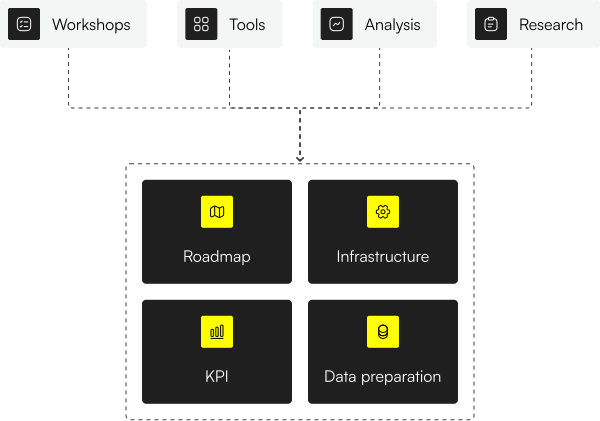 Weeks 1 to 2
Align and build
A 1- to 3-hour workshop on who we go to, what you sell, and how you say it. Then the roadmap, infrastructure, KPI, and data.
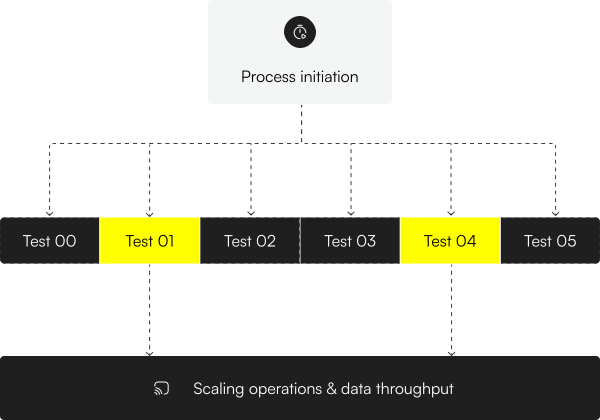 Weeks 3 to 10
Launch and scale
Campaigns go live, and we test, keep what works, and scale it. First replies usually come within 2 to 3 weeks of launch, and qualified meetings typically 4 to 6 weeks after launch.
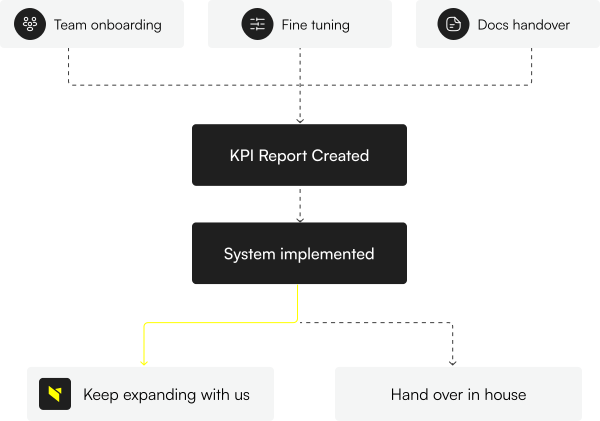 Weeks 11 to 12 and on
Stabilize and decide
We review the results together at day 90. You decide: take the system in-house, or keep expanding it with us.
Plan on 5 to 10 hours a month from your team, including handling the replies and meetings the campaigns bring in.
A few results from our published case studies:
- CX Labs: 4 SQLs and a 55% LinkedIn reply rate.
- Andritz: 162 Baltic companies, 31 responses, 7 qualified leads.
- A DACH healthcare company: a 38.5% response rate and 23 meetings in a month.
Our sales cycle is 12 months. Does a 3-month engagement make sense?
Yes, because a sales cycle and opportunity generation are two different things. If your cycle is 12 months, your team will spend 12 months selling to an account and coming back to it. But someone has to make the first contact, and that is what we generate.
"We're too small for you." Are you?
First, what does "too small" mean: that we are too expensive for you right now, or that you are earlier than the stage where we help most? There is a stage of company growth where we are most useful, and that is a fact. So the useful question is what you expect right now, and what made you book the call. We start from there.
What your buying committee will ask: references, GDPR, and LinkedIn safety
As the head of sales or growth who wants to work with us, you will probably have to convince a buying committee, usually legal and IT. These are the answers we give them. For the questions worth asking any agency, see 10 questions to ask an outbound agency before you sign.
Can we talk to your clients?
Yes. For every client on our website, we can give you a phone number, once that client agrees. Ideally, pick a company similar to yours, call them, and ask what working with us is like.
We also have case studies for almost every service we sell, showing how the same problem was solved at a company like yours. When something we propose is new for us, we say so from the start, so you know what is proven and what is R&D.
How do you handle GDPR?
The legal side of outbound is covered:
- We always sign a data processing agreement.
- Our GDPR overview is available to you.
- We have a set procedure for data requests and claims from the people we contact.
Will LinkedIn outreach get my account banned?
The risk always exists, and we won't tell you otherwise. What we do is keep it low:
- Limits. An account that isn't warmed up sends no more than 20 to 30 messages a day. We never push one account harder; to send more, we add accounts.
- Connection method. Outreach tools connect to LinkedIn through a pixel, a browser plugin, or proxy servers with a direct login. We use the last one.
- Track record. In three to four years of running outbound campaigns, we have never had an account banned.
What happens on the first call?
The first call is always a discovery session. We ask about the problem you want a GTM engineer or a RevOps team to solve and propose how to solve it. Sometimes that is a custom system built with us. Sometimes a tool already on the market solves it faster, and we tell you which one.
We won't push our solution. What counts for us is that you leave the call with good advice.
FAQ
What does a GTM agency do?
A GTM (go-to-market) agency builds the systems that turn data into pipeline: outbound campaigns on email and LinkedIn, signal-based outreach, and CRM workflows. Vanderbuild does GTM engineering and RevOps, built on Clay and Claude.
How much does lead generation cost with a GTM agency like Vanderbuild?
Co-build work starts at $2,000. Outbound campaigns cost $5,000 a month for 3 months ($15,000). RevOps and GTM engineering start at $5,000 a month. On our stack, tools are included.
What is pay per lead, and does Vanderbuild use it?
Pay per lead means paying for each lead an agency delivers instead of a monthly fee. We don't use it. We work on a retainer with a KPI agreed at the start: a positive reply, a booked meeting, or an SQL. If we don't deliver what your order says, you flag it and don't pay the invoice until the work is back on track.
Agency or in-house RevOps team?
Both work with us. Done for you, we run everything on our stack, which is faster and cheaper. Done with you, we build it in your accounts and teach your in-house team to run it; it costs more, and you pay for the tools.
How much time will our team spend on the project?
About 5 to 10 hours a month, including a 1- to 3-hour workshop at the start, a 30-minute call every one or two weeks, and handling the replies and meetings we generate.
How soon will we see replies?
For outbound campaigns, first replies usually come within 2 to 3 weeks of launch and qualified meetings in weeks 4 to 6. We review the engagement at day 90.
Who is Vanderbuild a good fit for?
Companies with large data flows, especially SaaS companies at seed or Series A with early product-market fit, and consulting firms that want the market to notice them.
Is LinkedIn automation safe?
The risk of a restriction always exists. We keep it low with 20 to 30 messages a day on accounts that aren't warmed up, proxy servers with a direct login, and more accounts instead of more volume per account. In three to four years of campaigns, we have never had an account banned.