.webp)
Most outbound engagements that disappoint were never mis-executed. They were mis-bought.
A company hires an agency that builds excellent technical systems, then waits for that agency to work out who to target and what to say. Nobody does. Three months later the campaign has perfect deliverability and no pipeline, and both sides are frustrated for reasons neither can name.
The problem was never quality. It was category, and underneath that, expectations.
There are roughly three types of outbound agency. Each one is a different contract about who owns which part of the work. Below is what each type owns, what stays with you, and what you should reasonably expect in return.
If you are already in buying conversations, our ten questions to ask an outbound agency covers what to ask once you know which type you want.
What Is an Outbound Agency?
An outbound agency runs proactive outreach to buyers who have not raised their hand: cold email, LinkedIn, cold calling, or some combination. That is the whole definition, and it is why the category is so confusing to buy from. Two firms can both describe themselves that way and sell almost nothing in common.
Outbound sales outsourcing covers everything from renting a technical setup to handing over the entire motion up to a booked meeting. The useful question is not whether a firm does outbound. It is which part of the work they take off your desk, and which part stays yours.
That is what the three types below describe.
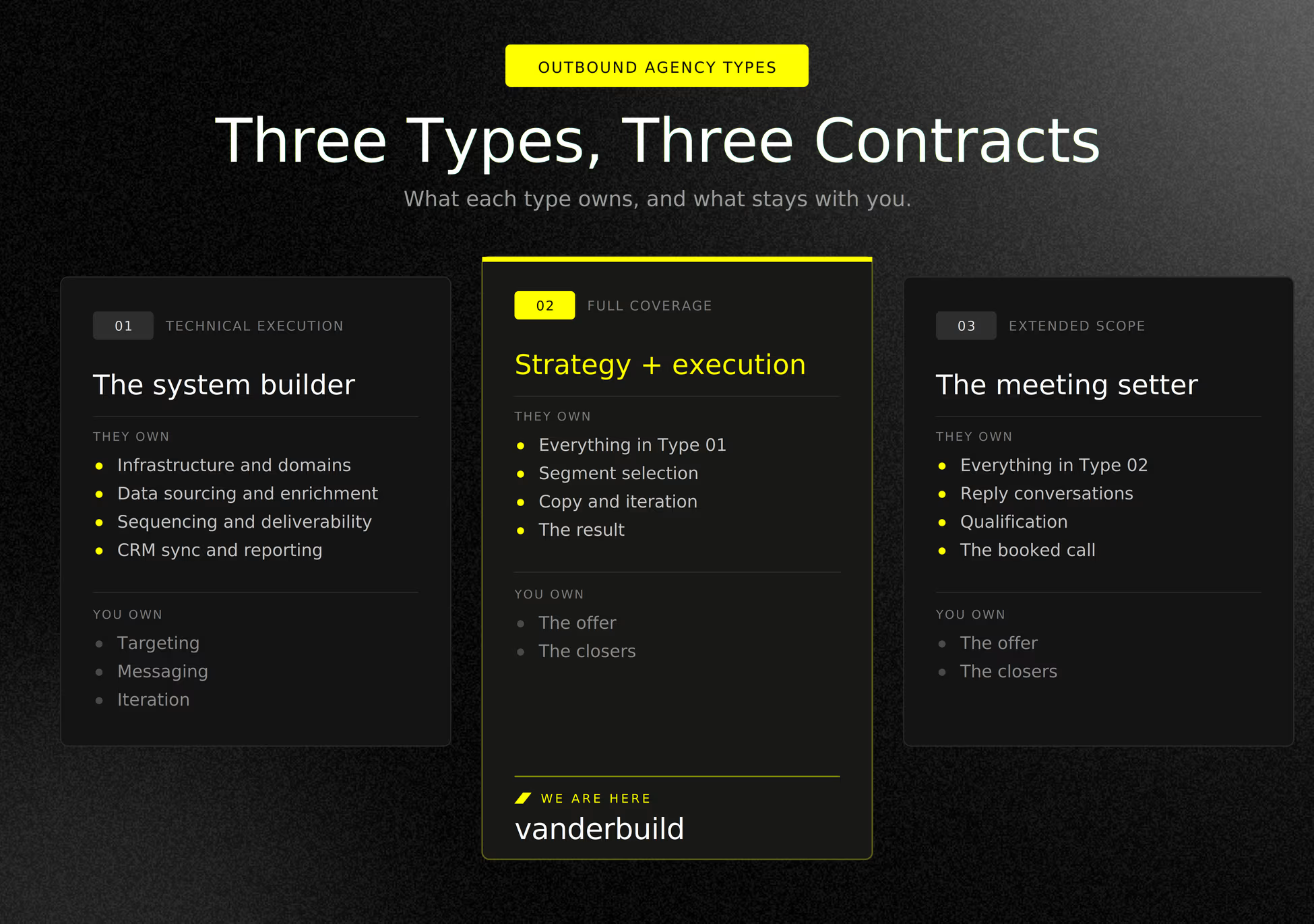
Type 01: The System Builder
They own the machine. You own the thinking.
These agencies are strong technically. They build sending infrastructure, source and enrich data, configure sequencing, keep deliverability healthy, and wire the whole thing into your CRM. Increasingly the category calls itself GTM engineering, and much of it has organised around Clay and adjacent tooling. We covered that discipline in depth separately, in what GTM engineering is and in our guide to Clay. The short version for this article: Type 01 sells that technical layer on its own, without the strategy attached.
What they will not do is decide who you should be selling to. They execute a strategy. They do not invent one.
What you should expect
Expect a working system inside four to six weeks. Domains warmed, inboxes configured, data flowing, sequences live, replies routed somewhere a human will see them. If you want to see what that build actually involves, our waterfall enrichment guide and the ten most common Clay setup mistakes cover the mechanics.
Expect them to ask what your ICP is, not how you know it. That question is out of scope, and a good Type 01 agency will say so rather than pretend otherwise.
Expect to write or approve the copy. They will implement it faithfully, including the parts that do not work.
Expect documentation and a handoff. The best in this category hand back something your team can operate, with named owners and a QA path. If the engagement ends and nobody internally can run what they built, you bought a dependency rather than a system.
Do not expect them to tell you the campaign is targeting the wrong market. They may notice. It is not what you hired them for.
Red flags
Vagueness about who owns the infrastructure at the end. Recommendations that only ever point to their own partners. Case studies that describe systems built rather than pipeline generated, with no mention of what happened next.
Type 02: Strategy and Execution
They own the machine and the thinking. You own the offer and the closing.
Type 02 is Type 01 with the strategy layer attached. The same technical work happens underneath, and someone sits on top of it deciding what all that machinery should be pointed at. Our go-to-market strategy guide for B2B startups covers how that thinking is built.
In practice it means one team doing both jobs: they decide the targeting, write the copy, build the campaigns, and own the result. You bring the product, the pricing, and the salespeople who take the calls. Everything between the market and the meeting is theirs.
The distinction matters commercially. A consultant hands you a strategy and leaves. A builder implements what you specify. This category does both, which is the only arrangement where one party can be held to the number.
The engagement usually opens with something closer to a research project than a setup task: a look at closed-won data, several sales hypotheses tested against the market in parallel, and a target list that survives contact with buyers rather than one assembled from a filter.
This is the category we sit in, doing the engineering and the strategy rather than one or the other, so read this section with that in mind.
What you should expect
Expect an argument about your ICP before you get a quote. If they accept your stated target market without asking how you know it, they are selling Type 01 at Type 02 pricing.
Expect multiple sequences per segment and a fixed iteration cadence, usually every two weeks, with per-variant reporting so that "it is not working" can become "variant three is not working."
Expect the first month to look like research. Hypotheses get tested and most get killed. A programme that books meetings in week two was either lucky or was never testing anything.
Expect them to handle negative replies and opt-outs. That is part of owning the result, not an add-on.
Expect a small time commitment from you, and be suspicious if it is large. An initial workshop, then time to handle positive replies. If the proposal implies weekly strategy meetings and constant approvals, you are buying a job rather than a service.
Do not expect them to fix a broken offer. They can find the market that responds best to what you have. They cannot make an offer compelling that is not.
Red flags
Willingness to run the messaging you supply without challenging it. No named iteration schedule. An unwillingness to tell you a segment is a bad idea, which usually means they have not looked closely enough to have an opinion.
Type 03: The Meeting Setter (B2B Appointment Setting)
They own everything up to the booked call.
B2B appointment setting extends Type 02 by taking the conversation from reply to confirmed calendar slot. Most run dedicated pods, typically an SDR, a researcher and a copywriter per account, and many add cold calling alongside email and LinkedIn.
The commercial model differs too, and that difference matters more than it first appears. Pricing is frequently tied to appointments, which attaches the vendor's incentive to the booking event rather than to what happens after it.
What you should expect
Expect meetings per month to be the headline number. That is the product. Ask immediately how they define a qualified meeting, and get the definition in writing before signature.
Expect a distinction between booked and held. These are different numbers and the gap between them is where most disappointment lives. A vendor who only reports booked meetings is reporting the metric they control rather than the one you care about.
Expect scripts and a playbook rather than bespoke messaging. The model runs on repeatability, which is a feature at volume and a limitation for complex offers.
Expect 30 to 60 days to a first meeting, compared with four to six months to ramp an in-house SDR.
Do not expect deep product knowledge. The pod is running several accounts at once. For offers that need real technical fluency in the first conversation, this model strains.
Red flags
A guarantee that counts booked rather than held meetings. Reluctance to define "qualified" precisely. Per-meeting pricing below roughly $100, which in practice tends to mean calendar filler.
What Each Type Costs: Outsourced SDR vs Agency Retainer
Ranges below come from published 2026 market data rather than from us, and vary widely by target seniority and market.
- Agency retainers commonly run $2,000 to $10,000 per month, with enterprise programmes above that.
- Per-appointment pricing runs $150 to $600 for mid-market B2B, and $600 to $1,500+ for C-suite targets at enterprise companies.
- Hybrid models are gaining ground: roughly $2,500 to $5,000 monthly retainer plus $150 to $400 per qualified meeting, which aligns incentives better than either extreme.
- An in-house SDR is commonly cited at $75,000 to $150,000 per year fully loaded, which is the number an outsourced SDR arrangement is usually compared against.
One cost that rarely appears on a quote: custom sending infrastructure. Building it properly is expensive, and any agency implying otherwise is either inexperienced or selling you something.
Which Type of Outbound Agency You Actually Need
Work backwards from what you already have, not from what you want the outcome to be.
If you have a proven ICP, a message that closes, and an in-house owner for both, buy Type 01. You are paying for engineering, and paying for strategy on top would be waste.
If your outbound has never worked, or you are moving from founder-led sales to something repeatable, you need Type 02. Previous attempts almost always failed upstream of execution, and buying more execution will reproduce the failure faster.
If you have closers sitting idle and a market you already understand, Type 03 solves a real bottleneck.
The expensive mistake is buying the cheapest type and expecting the most expensive one's output. That is a scope decision that shows up as a pricing decision three months later.
Ten questions that will tell you
The scorer below asks about your situation rather than about any agency. Answer all ten and it will point you at the type that fits, with the reasoning.
If the result is close between two types, read both sections above. The overlap is real, and the difference will usually come down to how much of the thinking you want to keep.
Before You Shortlist
One thing sits above all of this, and no agency type solves it: whether outbound can work for your business at all. If your offer requires a market education programme before it makes sense, every category above will underperform. We wrote the criteria up in how to know if an outbound sales strategy will work for your company.
If you are taking an established motion upmarket rather than starting from zero, our enterprise GTM strategy framework covers what changes at that stage.
Once you know outbound fits and which type you need, the ten questions will tell you whether the specific agency in front of you is any good at being that type.
Frequently Asked Questions
What is appointment setting?
Appointment setting is outreach whose deliverable is a booked meeting rather than a reply or a lead record. The vendor contacts prospects, handles the back-and-forth, qualifies against agreed criteria, and puts a confirmed slot in your calendar. In B2B it usually combines email, LinkedIn and phone, and it is the defining service of the Type 03 agencies above.
What is the difference between an SDR and a BDR?
The labels vary by company, but the common split is that SDRs work inbound leads and BDRs prospect outbound into cold accounts. When you outsource, the distinction usually collapses: an outsourced SDR team is almost always doing BDR work regardless of the title on the contract.
Is outsourcing outbound cheaper than hiring in-house?
Cheaper to start, and faster. An in-house rep is commonly cited at $75,000 to $150,000 per year fully loaded and takes four to six months to ramp, against 30 to 60 days for most agencies to book a first meeting. The trade is knowledge: an in-house rep accumulates product depth that a shared pod does not.
What is GTM engineering?
The technical layer of go-to-market sold as its own service: data sourcing and enrichment, sending infrastructure, routing, scoring, and the automation that connects them. It is what Type 01 agencies do. We wrote a full explainer separately: what is GTM engineering.
Do I need strategy and execution from the same vendor?
Not always, but they have to be joined somewhere. Bought separately you get a strategy nobody implements, or an implementation nobody aimed. If you split them, someone on your side has to own the seam, and that person needs the authority to overrule both. Type 02 exists because most companies would rather buy the seam than staff it.
How do I know which type of outbound agency I need?
Work backwards from what you already own. If your ICP and message are proven and someone internally owns them, you need engineering. If outbound has never worked, the gap is upstream of execution and you need strategy. If you have closers with idle capacity and a market you understand, you need meetings. The scorer above walks through it in ten questions.
Not Sure Which Type You Need?
Book a 30-minute call. We will tell you which of the three fits your situation, including when it is not us.